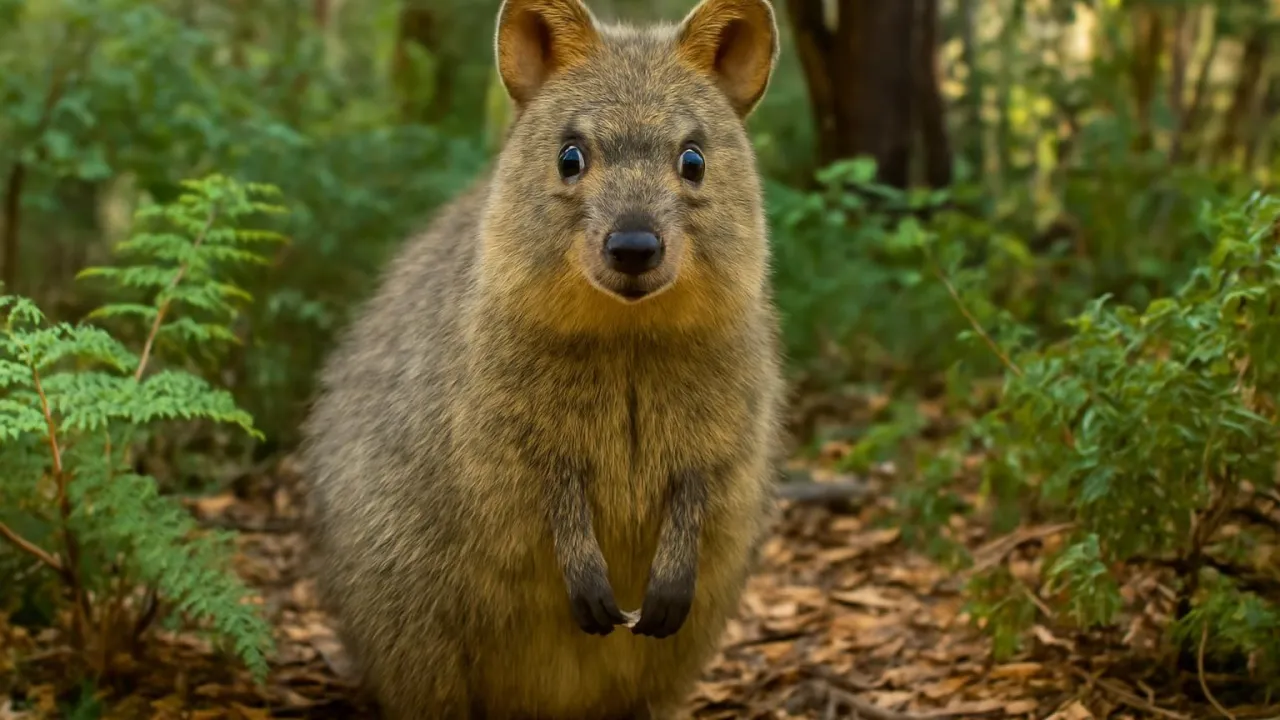
Quokkas have a special way of moving by hopping on their strong back legs.
✨ Word Sparks (Grade 2 Glossary)
Tap 🔊 to hear
marsupial
An animal with a pouch for its babies
herbivore
An animal that eats plants only
shrubland
A place with many small bushes and plants
🪝
Have you ever seen an animal that looks like it is always smiling?
1
Quokkas Are Small and Cute
Quokkas are small that live in Australia’s forests and . They have round faces and short tails. Their fur is brown and soft, and they hop to move around.
2
Where Quokkas Live
These animals live mainly on islands near Australia and some parts of the mainland. They like places with lots of bushes and trees. They hide in the shade during hot days.
3
What Quokkas Eat and Do
Quokkas eat leaves, grasses, and bark from plants. They are and need water to stay healthy. They mostly move around at night to stay cool.
Quokkas use camouflage and nocturnal habits to avoid predators and stay safe.
✨ Word Sparks (Grade 3 Glossary)
Tap 🔊 to hear
camouflage
Colors that help animals hide from others
marsupial
An animal with a pouch for its babies
nocturnal
Active at night, asleep during the day
🪝
Why do quokkas always look like they are smiling at you?
1
Quokka Appearance and Movement
Quokkas are small with soft brown fur and round faces. Their short tails help them balance while hopping. They use their strong back legs to move quickly through shrublands. Their friendly smile is caused by the shape of their mouth and eyes.
2
Habitat and Survival
These animals live mostly in southwestern Australia, especially on small islands. Their habitat includes forests and dense shrublands that provide food and shelter. Quokkas use to blend with the brown plants and avoid predators. They hide during the hot daytime to stay cool and safe.
3
Diet and Adaptations
Quokkas are herbivores that eat leaves, grasses, and bark to get nutrients. They have special teeth that help them chew tough plants. At night, they search for food when it is cooler and safer. Their ability to survive with little water is an important adaptation.
4
Reproduction and Life Cycle
Quokkas are , so females carry babies in pouches after birth. The babies stay in the pouch for several months to grow strong. After leaving the pouch, young quokkas learn to hop and find food. This life cycle helps them survive in the wild.
Quokkas play an important role in their ecosystem by helping plants grow through seed spreading.
✨ Word Sparks (Grade 4 Glossary)
Tap 🔊 to hear
ecotourism
Travel to see and protect wild animals
invasive species
Animals or plants that harm native wildlife
physiological
How an animal’s body works to survive
🪝
How does the quokka’s smile help it survive in Australia’s wild forests?
1
Quokka’s Unique Appearance and Movement
The quokka’s friendly smile is caused by the shape of its mouth and eyes, which makes it look happy to humans. This appearance helps it attract attention but does not scare predators. Quokkas move by hopping with strong back legs, which allows quick escapes from threats. Their short tails help them balance while moving through dense shrublands.
2
Habitat and Ecological Role
Quokkas live mainly in southwestern Australia, including small islands and mainland forests. Their habitat consists of dense shrublands and eucalyptus forests that provide food and shelter. As herbivores, they help spread seeds by eating plants and moving around. This role supports plant growth and the health of their ecosystem.
3
Adaptations for Survival
Quokkas use camouflage to blend with brown leaves and bushes, helping them avoid predators like foxes and snakes. They are mostly nocturnal, which means they are active at night when predators are less active. Their ability to survive on little water and tough plants shows important adaptations to dry environments.
4
Human Impact and Conservation
Human activities like land clearing and introduced predators have reduced quokka populations. Conservation efforts protect their habitats and control . Quokkas have become popular in , raising awareness about their survival needs. Protecting quokkas helps preserve Australia’s unique wildlife and ecosystems.
1. Why do quokkas blend in with their environment?
2. How do humans help quokkas survive?
🤯 Mind-Blowing Fact • Grade 5
Quokkas can hop up to 25 feet in one jump and survive days without drinking water.
✨ Word Sparks (Grade 5 Glossary)
Tap 🔊 to hear
macropodidae
Family of animals like kangaroos and wallabies
vulnerable
At risk of becoming endangered or extinct
mutualistic
A helpful relationship between animals and plants
🪝
What makes the quokka’s biology and behavior uniquely suited to southwestern Australia’s environment?
1
Taxonomy and Scientific Classification
The quokka, scientifically named Setonix brachyurus, belongs to the marsupial family , which includes kangaroos and wallabies. It is the only species in the genus Setonix and is closely related to other small macropods. This classification highlights its unique evolutionary path among Australian marsupials.
2
Physiological Adaptations and Mechanics
Quokkas have powerful hind legs that enable them to hop distances up to 25 feet in a single bound, helping them escape predators efficiently. Their digestive system is specialized to extract nutrients from tough, fibrous plants, allowing survival in nutrient-poor environments. Additionally, their thick fur provides insulation against temperature fluctuations common in southwestern Australia.
3
Ecological Role and Conservation Status
As herbivores, quokkas contribute to seed dispersal, which supports plant diversity and ecosystem health in their habitats. They are currently listed as due to habitat loss and predation by introduced species like foxes and cats. Conservation programs focus on habitat protection, predator control, and public education to ensure their survival.
4
Historical and Botanical Interactions
Quokkas have long been part of Indigenous Australian culture and folklore, symbolizing resilience and friendliness. Botanically, their diet includes eucalyptus leaves and native shrubs, which influences local plant community dynamics. Their interactions with native flora demonstrate important relationships within their ecosystem.
5
Quantitative Comparisons and Behavior
Quokkas typically weigh between 4.5 and 5.5 pounds (2 to 2.5 kilograms) and measure 16 to 21 inches (40 to 54 centimeters) in length. They can hop at speeds up to 12 miles per hour (19 kilometers per hour) when threatened. Their nocturnal activity patterns help them avoid daytime heat, and they can survive several days without water by extracting moisture from plants.