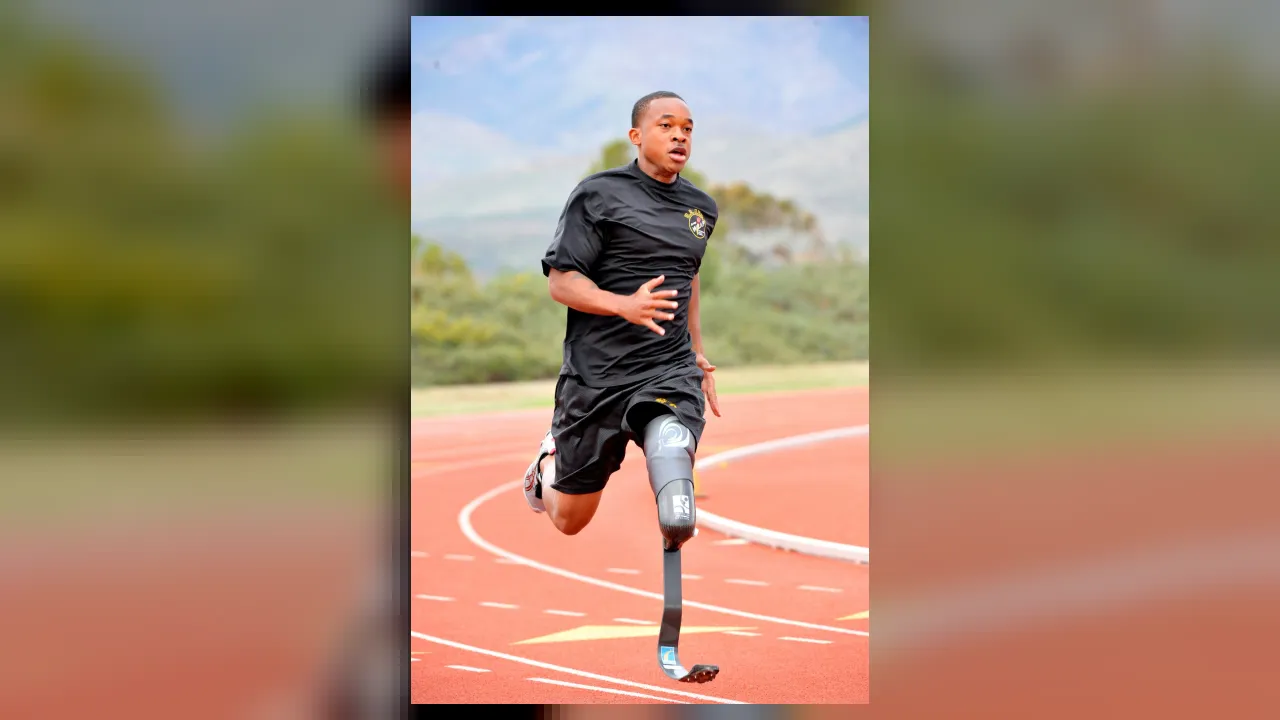
⚡ Everyday Impact SparkDesigns custom arms, hands, legs, and springy running blades that fit like a glove and respond to muscle signals
🤯 Mind-Blowing Fact • Grade 1
Curved carbon-fiber running blades were inspired by the springy back legs of sprinting cheetahs!
✨ Word Sparks (Grade 1 Glossary)
Tap 🔊 to hear
Prosthesis
Custom-made replacement for a missing body part
Socket
Smooth custom cup connecting limb to body
Bionic
Using smart electronics to copy body moves
🪝
How can a custom robotic hand pick up an egg without cracking it?
1
Building Custom Limbs
Whir, click, high-five! Some kids and grown-ups are born missing an arm or leg, or lose one in an accident. A prosthetist builds custom artificial limbs that help people walk, run, and hold things.
2
A Cozy Custom Fit
Every body is one of a kind! The prosthetist scans or molds a smooth cup called a so the new limb fits comfortably without rubbing.
3
Springy Blades and Superhero Colors
Kids often pick bright patterns, dinosaur prints, or curved springy blades made to sprint across the playground!
1. Why must a prosthetist make a custom socket for every single person?
2. Which fast animal inspired the curved running blades fitted by prosthetists?
🤯 Mind-Blowing Fact • Grade 2
Archaeologists in Egypt discovered a three-thousand-year-old wooden big toe carved with a leather hinge—the world's oldest known working prosthesis!
✨ Word Sparks (Grade 2 Glossary)
Tap 🔊 to hear
Carbon fiber
Super strong, feather-light woven black material
Sensor
Tiny detector reading muscle sparks or touch
Pediatric
Medical care specially focused on growing kids
🪝
How can thinking about squeezing your fist make a bionic hand close its fingers?
1
Part Artist, Part Engineer
Scan with a gentle light beam, sculpt a plaster model, and tighten tiny hex bolts! A prosthetist blends healthcare kindness with workshop engineering. Half the day is spent talking with patients and watching them move; the other half happens in a workshop filled with 3D printers and .
2
Listening to Muscle Sparks
When you flex a muscle in your arm, your body makes a tiny electrical spark! Bionic hands hold inside the socket that read those muscle sparks and tell tiny motors to open or pinch fingers.
3
Growing Right Along With Kids
Because kids grow taller every year, prosthetists adjust lengths and build special attachments for riding bikes, swimming, or playing violin!
1. How does a bionic arm know when the wearer wants to open or close its fingers?
2. Why is carbon fiber such a popular material in a prosthetist's workshop?
🤯 Mind-Blowing Fact • Grade 3
Microprocessor prosthetic knees contain motion sensors similar to smartphone gyroscopes, adjusting hydraulic resistance up to one hundred times during a single step!
✨ Word Sparks (Grade 3 Glossary)
Tap 🔊 to hear
Myoelectric
Controlled by natural electrical signals from muscles
Alignment
Lining up joints for smooth, balanced walking
Gait
A person's pattern of stepping and walking
🪝
Why is crafting the soft inner socket even more important than building the high-tech robotic knee or hand?
1
The Secret of Socket Comfort
Even the fanciest computerized knee cannot help if it hurts to wear! Prosthetists spend hours perfecting the socket—the custom interface connecting a patient's residual limb to the prosthesis. Using 3D optical scanners or plaster wraps, they cushion sensitive bone tips while placing gentle support over strong muscle areas.
2
Myoelectric Hands and Microprocessor Knees
Modern bionic arms use technology—'myo' means muscle and 'electric' means tiny nerve-muscle signals. Below-waist prostheses can feature microprocessor knees that check walking speed fifty times per second, stiffening automatically if the wearer stumbles on stairs!
3
Dynamic Alignment on the Walkway
In the room, a patient walks between parallel bars while the prosthetist watches hip, knee, and foot angles. Turning tiny titanium pyramid screws by just two degrees smooths out a limp into an effortless stride.
4
Special Gear for Every Passion
From waterproof swim legs and rock-climbing feet to custom guitar-pick attachments, prosthetists tailor designs around each person's dreams.
1. What does the word 'myoelectric' mean in a bionic arm?
2. Why do prosthetists carefully adjust the angle of a prosthetic foot and knee while watching someone walk?
🤯 Mind-Blowing Fact • Grade 4
Walking on a poorly aligned rigid prosthesis can demand up to forty percent more oxygen and heart effort than typical walking—showing why a prosthetist's biomechanics skill is crucial!
✨ Word Sparks (Grade 4 Glossary)
Tap 🔊 to hear
Recoil
Springing back into shape to release energy
Vacuum suspension
Airless suction holding a socket securely on
Orthotics
Designing supportive braces for existing limbs
🪝
How does a springy carbon-fiber foot give back energy on every step when it has no muscles or batteries inside?
1
Energy Storage and Return Physics
Watch your ankle when you walk barefoot: your Achilles tendon stretches like a thick rubber band as your foot lands, then snaps back to push you forward. Early wooden prostheses could not flex, forcing wearers to burn extra energy on every step. Modern prosthetists fit 'energy-storage-and-return' carbon-fiber feet and J-shaped Paralympic running blades that flex under bodyweight at heel strike and at toe-off—no batteries required!
2
Vacuum Suspension and Silicone Liners
Keeping a prosthetic leg securely attached during a hike or basketball game requires clever air physics. Patients roll a soft, medical-grade silicone liner over their skin before stepping into the rigid carbon socket; a one-way valve expels trapped air, creating gentle vacuum suction that locks the limb snugly in place.
3
Teamwork in Rehabilitation
Certified Prosthetists—who often hold dual credentials in (custom braces)—collaborate closely with orthopedic surgeons, physical therapists, and occupational therapists. At military medical centers in the Washington, D.C. and Virginia region, as well as Shriners and university children's hospitals, these teams pioneer next-generation mobility for wounded veterans and active kids.
4
3D Printing Accessibility
Additive 3D printing now lets prosthetists prototype lightweight, breathable sockets and colorful pediatric hand designs rapidly as young patients grow.
1. How does a carbon-fiber prosthetic foot help push a walker forward without using motors or batteries?
2. How does a one-way air valve help hold a modern lower-limb prosthesis securely in place?
🤯 Mind-Blowing Fact • Grade 5
With Targeted Muscle Reinnervation and machine-learning EMG sensors, wearers of advanced bionic arms can control individual finger grips instinctively just by imagining moving their missing hand!
✨ Word Sparks (Grade 5 Glossary)
Tap 🔊 to hear
Electromyography
Recording tiny electrical signals produced by muscles
Hydrostatic
Distributing pressure evenly through soft tissue
Ground Reaction Force
Upward push from floor during each step
🪝
How are prosthetists and neurosurgeons teaming up so bionic fingertips can actually send a sense of touch back to the human brain?
1
Biomechanics of Ground Reaction Forces
Every human stride launches a vector shooting upward from the floor through the ankle, knee, and hip. Certified Prosthetists (CPOs)—trained through master's-level biomechanics, materials science, and clinical residencies—align modular titanium pylons so that force vector passes just behind or ahead of prosthetic joints at exact millisecond phases of the gait cycle, ensuring stance stability followed by effortless swing.
2
Hydrostatic Socket Design and Laminations
Soft tissue behaves like an incompressible fluid under load, whereas superficial bone prominences like the tibial crest bruise easily under pressure. Prosthetists digitally sculpt CAD models from sub-millimeter laser scans to relieve pressure peaks while distributing weight hydrostatically, then vacuum-infuse epoxy resin through braided carbon-fiber and Kevlar weaves to create featherweight, high-tensile sockets.
3
Targeted Muscle Reinnervation and Pattern Recognition
For high-level upper-limb amputations, reconstructive surgeons can redirect severed arm nerves into remaining chest or shoulder muscle segments in a procedure called Targeted Muscle Reinnervation (TMR). When the wearer simply imagines closing a thumb or rotating a wrist, that reinnervated muscle patch contracts with clear millivolt signals! Prosthetists position multi-channel surface (EMG) electrodes inside the socket and calibrate machine-learning pattern-recognition algorithms to translate subtle muscle symphonies into fluid, multi-articulating finger grips.
4
Magnetorheological Knees and Bidirectional Touch
Cutting-edge microprocessor knees adjust internal magnetorheological fluid viscosity via electromagnetic fields up to one thousand times per second, preventing stumbles on uneven gravel or steep stairs. Meanwhile, pioneering osseointegrated implants and bidirectional neural interfaces route fingertip pressure and torque sensors back to peripheral sensory nerves, restoring intuitive touch feedback so wearers feel fragile objects without looking.
5
Human-Centered Engineering Across a Lifetime
Above every microchip, titanium adapter, and carbon-fiber weave, prosthetists remain lifelong clinical partners—blending orthopedic empathy, quantitative gait analysis, and sculptural artistry so advanced technology disappears into natural, confident motion.