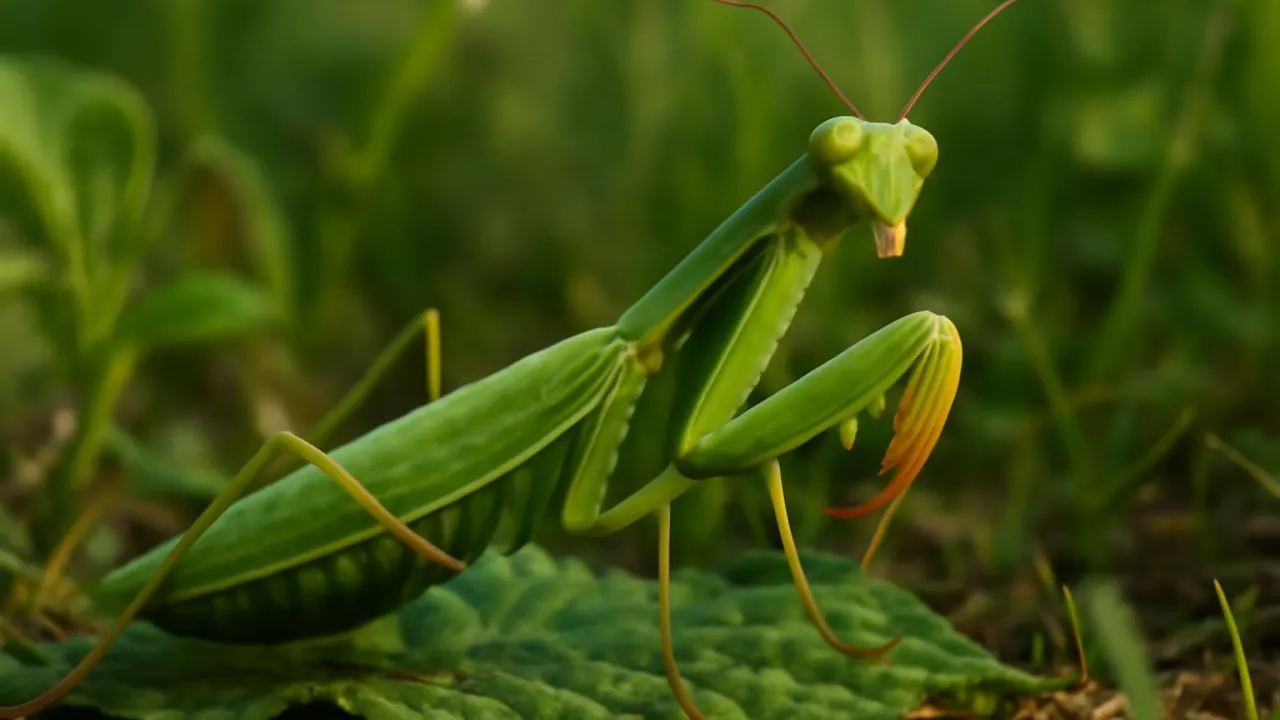
A praying mantis can turn its head nearly 180 degrees to spot prey.
✨ Word Sparks (Grade 2 Glossary)
Tap 🔊 to hear
prey
Animals that are hunted and eaten
nymph
A baby mantis that looks like a small adult
habitat
The place where an animal lives
🪝
Have you seen a bug that can turn its head to watch you?
1
Amazing Front Legs
The praying mantis holds its front legs like it is praying. These legs are sharp and strong to catch . It uses them to grab insects quickly and tightly.
2
Where It Lives
Praying mantises live in gardens, forests, and fields. They like warm places with many plants. They hide well among leaves and flowers.
3
How It Grows
The mantis starts as a tiny egg in a foam case. It hatches into a small mantis called a . The nymph sheds its skin many times as it grows.
Praying mantises have triangular heads with large eyes that provide 3D vision.
✨ Word Sparks (Grade 3 Glossary)
Tap 🔊 to hear
camouflage
Colors or shapes that help hide an animal
predator
An animal that hunts other animals
metamorphosis
A big change in an animal’s body as it grows
🪝
Did you know the praying mantis uses camouflage to hide from predators?
1
Camouflage and Hunting
The praying mantis blends into leaves and flowers to avoid . This helps it stay hidden while waiting for prey. It uses its sharp forelegs to snatch insects quickly. Its hunting method is a perfect example of adaptation.
2
Body and Movement
The mantis can rotate its head nearly 180 degrees to scan surroundings. Its large compound eyes give it excellent vision to spot prey. It moves slowly and carefully to avoid being seen. These body features help it survive in the wild.
3
Life Cycle and Growth
Praying mantises begin life as eggs inside a foam case called an ootheca. The young nymphs hatch looking like tiny adults but without wings. They molt several times, shedding their exoskeleton to grow larger. This growth process is called .
4
Role in Nature
Mantises help control insect populations by eating pests like flies and aphids. They are both and prey in their ecosystems. Their presence supports balanced food webs and healthy gardens. Humans appreciate mantises for natural pest control.
Some praying mantis species can mimic leaves or flowers to fool both prey and predators.
✨ Word Sparks (Grade 4 Glossary)
Tap 🔊 to hear
compound eyes
Eyes with many tiny lenses to see well
ecosystem
A community of plants and animals living together
predator
An animal that hunts other animals for food
🪝
How does the praying mantis’s body design help it survive in many places?
1
Adaptations for Survival
The praying mantis’s triangular head and large allow it to spot prey from many angles. Its forelegs have spines that help grasp slippery insects tightly. This design causes a fast and deadly strike that rarely misses. These adaptations increase its chances of survival in diverse habitats.
2
Ecological Role
Mantises play a vital role in by controlling insect populations, including pests harmful to crops. They serve as both and prey, maintaining balance in food webs. Their presence benefits farmers who rely on natural pest control methods. Human activities sometimes threaten mantis habitats, affecting this balance.
3
Geographic Distribution
Praying mantises live worldwide in temperate and tropical regions, from gardens to forests. They thrive in environments with abundant vegetation that offers camouflage and hunting grounds. Their ability to adapt to various climates allows them to colonize many continents. However, some species are more common in specific regions.
4
Cause and Effect in Behavior
Because mantises rely on stealth, they move slowly to avoid detection by and prey. Their ability to turn their heads causes effective scanning for threats and food. When prey approaches, their sudden strike causes quick capture and minimal escape chances. This behavior ensures successful feeding and survival.
A praying mantis’s strike is one of the fastest movements in the insect world, under 50 milliseconds!
✨ Word Sparks (Grade 5 Glossary)
Tap 🔊 to hear
raptorial
Special front legs used to catch prey quickly
stereoscopic vision
Seeing with both eyes to judge distance
mimicry
Looking like something else to hide better
🪝
What makes the praying mantis a unique insect in the order Mantodea?
1
Scientific Classification and Anatomy
The praying mantis belongs to the order Mantodea, which includes over 2,400 species worldwide. Its distinctive triangular head with flexible neck allows nearly 180-degree rotation for enhanced vision. The compound eyes provide , enabling depth perception critical for hunting. Its forelegs are equipped with spines to firmly grasp prey during rapid strikes.
2
Physiological Mechanics of Hunting
Mantises use a combination of stealth, camouflage, and lightning-fast reflexes to capture prey. Their forelegs snap shut in less than 50 milliseconds, one of the fastest predatory strikes in the insect world. Muscle contractions power this rapid movement, while sensory input from their eyes triggers the attack. This precise coordination allows mantises to catch insects much larger than themselves.
3
Conservation and Ecological Importance
Although mantises are widespread, habitat loss and pesticide use threaten some species. They play an important role in natural pest control by preying on agricultural pests. Conservation efforts focus on preserving habitats and promoting organic farming to reduce chemical impacts. Educating the public about mantises helps foster appreciation for their ecological benefits.
4
Botanical History and Mimicry
Some mantis species have evolved to mimic leaves, flowers, or sticks, enhancing camouflage and hunting success. This is a remarkable example of evolutionary adaptation to environmental pressures. These species can remain motionless for hours, blending perfectly with plant parts. Such adaptations improve survival rates by deceiving both predators and prey.
5
Quantitative Comparisons and Abilities
Praying mantises range from 1 to 6 inches (2.5 to 15 centimeters) in length, with some tropical species larger. Their strike speed can reach up to 50 milliseconds, faster than a human blink. They can rotate their heads almost 180 degrees, an ability rare among insects. Their weight varies from a few grams to over 10 grams, depending on species and age.