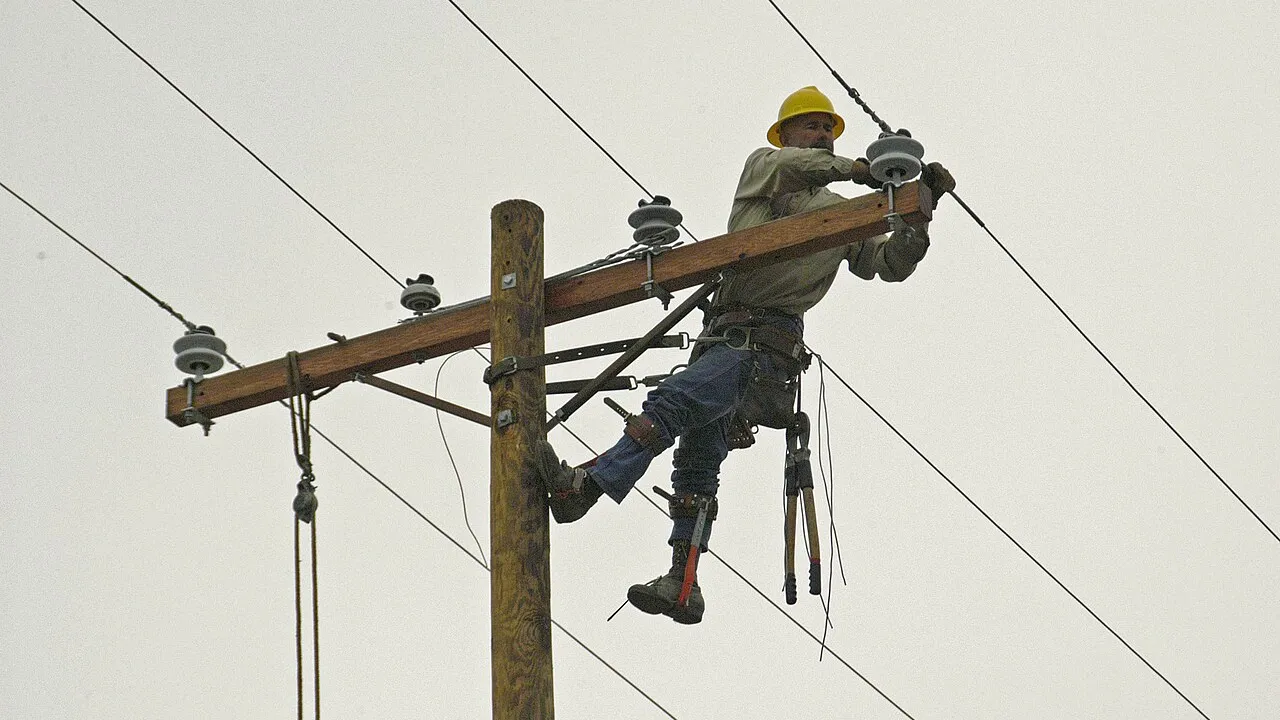
⚡ Everyday Impact SparkBraves icy winds and summer storms high above the ground to keep electricity flowing to homes, schools, and hospitals
🤯 Mind-Blowing Fact • Grade 1
Lineworkers test their thick rubber safety gloves with air before every shift to make sure there is not even one tiny pinhole!
✨ Word Sparks (Grade 1 Glossary)
Tap 🔊 to hear
power grid
connected wires carrying electricity to homes and towns
insulator
material like rubber that blocks electricity safely
bucket truck
a utility truck with a lifting work basket
🪝
Who fixes the tall power wires when a big storm knocks the lights out?
1
Up in the Bucket Truck!
hum-m-m! A white crane arm lifts a sturdy bucket high beside a tall pole. Inside wears a hard hat and thick rubber gloves! A lineworker keeps electricity flowing to your town.
2
Storm Heroes
Heavy snow or wind can snap tree branches across wires. Lineworkers rush out to fix broken lines safely.
3
Click—Lights Back On!
Soon, hospital machines hum, streetlamps glow, and your fridge stays cold again!
1. Why do power grid lineworkers wear special thick rubber gloves?
2. What important rule should kids ALWAYS follow if they see a fallen power wire on the ground?
🤯 Mind-Blowing Fact • Grade 2
When utility poles sit deep in forests where trucks cannot drive, lineworkers strap curved steel gaffs onto their boots and climb straight up wooden poles!
✨ Word Sparks (Grade 2 Glossary)
Tap 🔊 to hear
fiberglass
strong, lightweight material that blocks electric current
hot stick
a long insulated pole for working on live wires
restore
to fix something so it works smoothly again
🪝
How can a squirrel sit on one wire safely, yet lineworkers wear head-to-toe safety gear?
1
High-Wire Teamwork
Look up at the wooden poles along your road—metal cables carry electricity from distant power plants straight to your light switches! Building and repairing that giant web is the daily job of a power grid lineworker.
2
Rubber Sleeves and Hot Sticks
Electricity always looks for a path to the ground. Lineworkers ride inside buckets that block electric flow, drape orange rubber blankets over nearby wires, and reach switches using long fiberglass poles called "."
3
Neighbors Helping Neighbors
When hurricanes or ice storms hit another state, convoys of lineworkers drive hundreds of miles to help power fast!
1. Why is the lifting boom of a lineworker's bucket truck made of fiberglass instead of solid steel?
2. What do lineworkers do when a major storm knocks out power in a neighboring state?
🤯 Mind-Blowing Fact • Grade 3
For ultra-high-voltage towers in remote mountains, specially trained lineworkers actually step out of hovering helicopters right onto energized cables wearing conductive metal-mesh suits!
✨ Word Sparks (Grade 3 Glossary)
Tap 🔊 to hear
transformer
equipment that lowers high voltage for safe home use
voltage
the electrical pressure pushing current along wires
apprenticeship
paid multi-year training combining classes and fieldwork
🪝
What are those gray metal cylinders hanging near the top of neighborhood utility poles?
1
Stepping Down Giant Voltage
Cross-country steel towers carry electricity at super-high electrical push—hundreds of thousands of volts—far too strong for your kitchen toaster or desk lamp! Near the top of neighborhood utility poles, gray drum-shaped step that powerful current down to safe household levels, installed and maintained by a skilled power grid lineworker.
2
Overhead and Underground
Not all power lines hang high in the open sky! In many busy towns and cities, lineworkers also climb down into clean concrete underground vaults to splice thick insulated copper and aluminum cables where they stay shielded from howling wind, falling branches, and winter ice.
3
Four Years of Apprenticeship
Becoming a certified journey-level lineworker takes about four years of paid hands-on —mastering electrical circuit math, heavy rope rigging, pole-top safety rescue drills, and flame-resistant protective clothing.
4
Connecting Clean Energy
Today, lineworkers also wire brand-new community solar farms, wind turbines, battery stations, and electric school-bus chargers smoothly into the town grid!
1. What is the job of the gray cylinder-shaped transformer on a neighborhood utility pole?
2. Why do cities bury many electrical cables inside underground vaults?
🤯 Mind-Blowing Fact • Grade 4
If you laid all the power lines in the United States end to end, they would wrap around Earth's equator more than 200 times!
✨ Word Sparks (Grade 4 Glossary)
Tap 🔊 to hear
substation
a fenced yard switching and stepping grid voltages
grounding
connecting wires safely to Earth to prevent shocks
transmission
moving high-voltage power long distances across towers
🪝
Why is the North American electrical grid often called the single largest machine ever built by humans?
1
One Continent-Sized Machine
Flip on a classroom light switch and electrons surge at nearly the speed of light through a vast network of more than five million miles of and distribution lines stretching from the Atlantic coast to the Rockies! Because grid electricity must be generated at the exact instant it is used, keeping this continent-sized machine intact relies on the skill of the power grid lineworker.
2
Substations, Breakers, and Grounding
Electricity journeys in stages: power plants generate current, step-up boost voltage up to 500,000 volts so energy travels hundreds of miles with minimal heat loss, and neighborhood substations step it down again. Before touching de-energized storm-damaged lines, crews follow an unbreakable rule: "If it isn't grounded, it isn't dead"—clamping heavy copper cables onto lines so stray current cannot surprise anyone.
3
Drones and Smart-Grid Sensors
Modern lineworkers pair rugged grit with smart technology. Thermal-imaging drones inspect hilltop steel towers for overheating connectors before failures happen, while automated grid switches reroute electricity around fallen trees in seconds—shrinking outages from thousands of homes down to a single block.
4
First Responders of Infrastructure
During blizzards and hurricanes, lineworkers coordinate directly with 911 dispatchers—clearing live hazards for firefighters and restoring hospital circuits first.
1. Why do power companies boost electricity to very high voltage for long-distance transmission?
2. Which community buildings do lineworkers restore first after a severe storm?
🤯 Mind-Blowing Fact • Grade 5
Every October at the International Lineman's Rodeo, top utility crews from around the world compete in timed events—including climbing a 40-foot wooden pole while holding a raw chicken egg in their mouth without cracking it!
✨ Word Sparks (Grade 5 Glossary)
Tap 🔊 to hear
Faraday cage
a conductive metal shield routing electricity safely outside
three-phase AC
three synchronized alternating electric waves powering the grid
backfeed
dangerous electricity flowing backward into turned-off grid wires
🪝
How can a helicopter lineworker clamp directly onto a live 500,000-volt cable without feeling a shock?
1
Faraday Suits and Barehand Physics
Two hundred feet above an Appalachian gorge, a helicopter hovers inches beside a buzzing 500,000-volt transmission conductor. Reaching out with a wand, a specialist draws a crackling purple electrical arc, clips a bonding clamp onto the live cable, and steps onto the wire completely unharmed! How is that possible? Wearing a suit woven from 75 percent fire-retardant Nomex and 25 percent stainless-steel thread—a wearable —this elite power grid lineworker stays at the exact same electrical potential as the wire, with zero ground path for current to cross the body.
2
Three-Phase Alternating Current
Since Nikola Tesla and George Westinghouse championed alternating current (AC) in the 1890s, modern grids transmit power in three synchronized waves—three-phase 60-hertz AC—which is why transmission towers and crossarms carry conductors in sets of three. Lineworkers tension aluminum-conductor steel-reinforced (ACSR) cables using dynamometers, calculating sag so summer heat expansion never drops lines too low.
3
Arc-Flash Protection and Rigorous Standards
Everyday distribution work at 7,200 to 34,500 volts demands unwavering precision under OSHA high-voltage rules. Crews wear arc-rated clothing engineered to withstand intense thermal flashes, test lines with voltage detectors, and install protective grounds on both sides of a work zone to guard against accidental from improperly wired home generators.
4
Modernizing a Two-Way Clean Grid
For a century, electricity flowed strictly one way—from central power stations outward to homes. Today, rooftop solar arrays, utility battery banks, and electric vehicles send power flowing in multiple directions, requiring lineworkers to install smart reclosers, fiber-optic communications cables, and high-capacity transformers.
5
Backbone of Modern Life
Combining tradesperson craftsmanship, applied electromagnetism, and calm courage in nature's fiercest weather, power grid lineworkers keep every hospital monitor, water pump, and classroom computer alive.