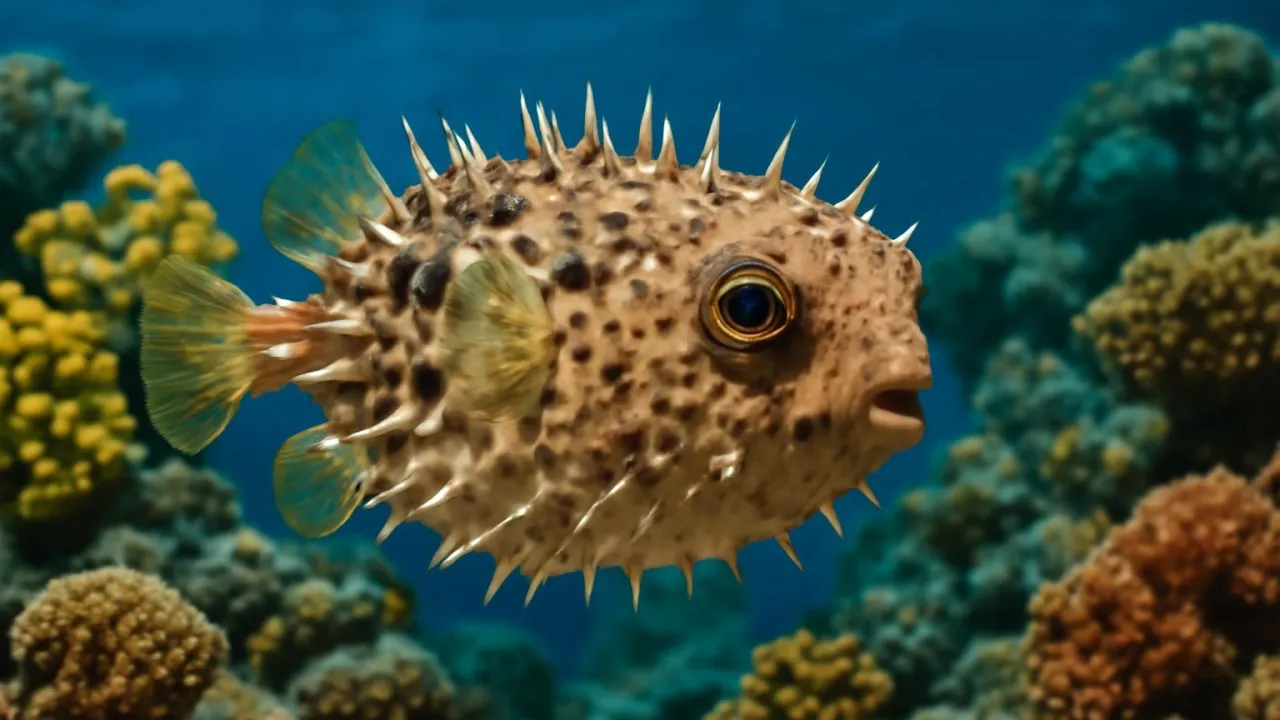
1. What does the porcupine pufferfish do to protect itself?
2. Where does the porcupine pufferfish live?
🤯 Mind-Blowing Fact • Grade 2
Porcupine pufferfish can inflate by swallowing water or air to triple their size!
✨ Word Sparks (Grade 2 Glossary)
Tap 🔊 to hear
predator
An animal that hunts other animals
coral reef
A colorful underwater home for many fish
inflate
To fill with air or water and get bigger
🪝
Have you ever seen a fish that looks like a spiky balloon?
1
Spikes and Puffing Up
The porcupine pufferfish has sharp spikes all over its body. When it feels scared, it puffs up like a balloon. This makes it look bigger to scare away .
2
Where It Lives
This fish lives in warm tropical oceans near and rocky areas. It can hide well among the rocks to stay safe. It swims slowly but can puff up quickly.
3
What It Eats
The porcupine pufferfish eats shellfish, crabs, and small animals on the sea floor. It uses strong teeth to break shells and get food inside. It likes to eat near the bottom of the ocean.
2. What kind of food does the porcupine pufferfish eat?
🤯 Mind-Blowing Fact • Grade 3
Porcupine pufferfish spikes are actually modified skin that stand out when inflated.
✨ Word Sparks (Grade 3 Glossary)
Tap 🔊 to hear
camouflage
Colors that help hide from predators
predator
An animal that hunts other animals
adaptation
A body change that helps survival
🪝
How does a porcupine pufferfish use its spikes to survive in the ocean?
1
Spiky Defense
The porcupine pufferfish has sharp spikes that cover its body. When threatened, it inflates by swallowing water to appear larger. This helps protect it from . Its spikes become more visible and harder to bite.
2
Habitat and Camouflage
This fish lives in tropical coral reefs and rocky ocean areas. Its brown and white colors help it blend in with the surroundings. helps it avoid and sneak up on prey. It often hides among coral or rocks.
3
Diet and Feeding
The porcupine pufferfish feeds on hard-shelled animals like crabs and mollusks. It uses strong teeth to crush shells and get nutrients inside. This diet provides the energy it needs to survive. It plays a role in controlling shellfish populations.
4
Survival Adaptations
Besides puffing up, it can swim away slowly to escape danger. Its ability to inflate is a key survival . This fish also has good eyesight to spot threats early. These traits help it live safely in a busy reef ecosystem.
1. What happens to the porcupine pufferfish’s spikes when it inflates?
2. Why does camouflage help the porcupine pufferfish?
🤯 Mind-Blowing Fact • Grade 4
Porcupine pufferfish can inflate in less than a second to avoid being eaten.
✨ Word Sparks (Grade 4 Glossary)
Tap 🔊 to hear
symbiosis
Two animals helping each other live
ecosystem
All living things in one place
habitat
The natural home of an animal
🪝
What causes the porcupine pufferfish to puff up and how does it affect its ocean home?
1
Cause and Effect of Puffing Up
When the porcupine pufferfish senses danger, it quickly inflates by swallowing water or air. This makes its body expand and its sharp spikes stand out more. The sudden size increase scares away predators and reduces attacks. This defense mechanism is very effective in its natural .
2
Role in the Ecosystem
Porcupine pufferfish help control populations of shellfish and crustaceans by feeding on them. Their strong teeth allow them to crush hard shells that other fish cannot eat. They are also prey for larger predators like sharks, fitting into the ocean food web. Their puffing defense helps maintain balance in the reef .
3
Symbiosis and Human Impact
These fish sometimes live near cleaner fish that remove parasites from their skin. This symbiotic relationship benefits both species. However, loss and pollution threaten coral reefs where they live. Protecting reefs helps keep porcupine pufferfish populations healthy and supports ocean biodiversity.
4
Geographic Distribution
Porcupine pufferfish are found in warm tropical and subtropical oceans worldwide. They prefer coral reefs and rocky coastal areas between 3 and 90 feet deep. Their wide distribution shows how well they have adapted to different marine environments. Understanding their range helps scientists protect them better.
1. How does puffing up help the porcupine pufferfish?
2. What is one way humans can help porcupine pufferfish?
🤯 Mind-Blowing Fact • Grade 5
Porcupine pufferfish can triple their body size in under one second by inflating their elastic stomachs.
✨ Word Sparks (Grade 5 Glossary)
Tap 🔊 to hear
Tetraodontiformes
An order of fish including puffers and relatives
physiology
How an animal’s body works and functions
conservation
Efforts to protect animals and their habitats
🪝
How do the porcupine pufferfish’s unique features support its survival and what is its role in marine biodiversity?
1
Taxonomy and Scientific Classification
The porcupine pufferfish, scientifically named Diodon holocanthus, belongs to the family Diodontidae. This family is part of the order , which includes pufferfish and their relatives. Its classification highlights its evolutionary adaptations like spine-covered skin and inflation abilities. Scientists study this species to understand fish defense mechanisms better.
2
Physiological Mechanics of Inflation
Porcupine pufferfish inflate by rapidly swallowing water or air into their highly elastic stomachs. This process causes their bodies to expand up to three times their normal size. The sharp spines, which are modified scales, become erect during inflation to deter predators. This physiological adaptation is energy-intensive but crucial for survival.
3
Conservation and Botanical History
While not currently endangered, porcupine pufferfish face threats from coral reef degradation and pollution. efforts focus on protecting reef habitats and reducing ocean pollution. Historically, these fish have fascinated humans due to their unique defense strategies and appearance. They also contribute to reef health by controlling shellfish populations.
4
Quantitative Comparisons and Habitat Range
Porcupine pufferfish typically grow up to 20 inches (50 cm) in length and weigh about 4 pounds (1.8 kg). They inhabit coral reefs and rocky areas at depths ranging from 3 to 90 feet (1 to 27 meters). Their inflation can increase their body volume by up to 300 percent within seconds. These quantitative traits help them survive in diverse marine environments.
5
Ecological Role and Human Interaction
As both predator and prey, porcupine pufferfish play a vital role in coral reef food webs. They regulate populations of shellfish and crustaceans, maintaining ecosystem balance. Humans impact them through reef destruction and pollution, but also through ecotourism and marine protection programs. Understanding their biology helps promote and sustainable ocean use.