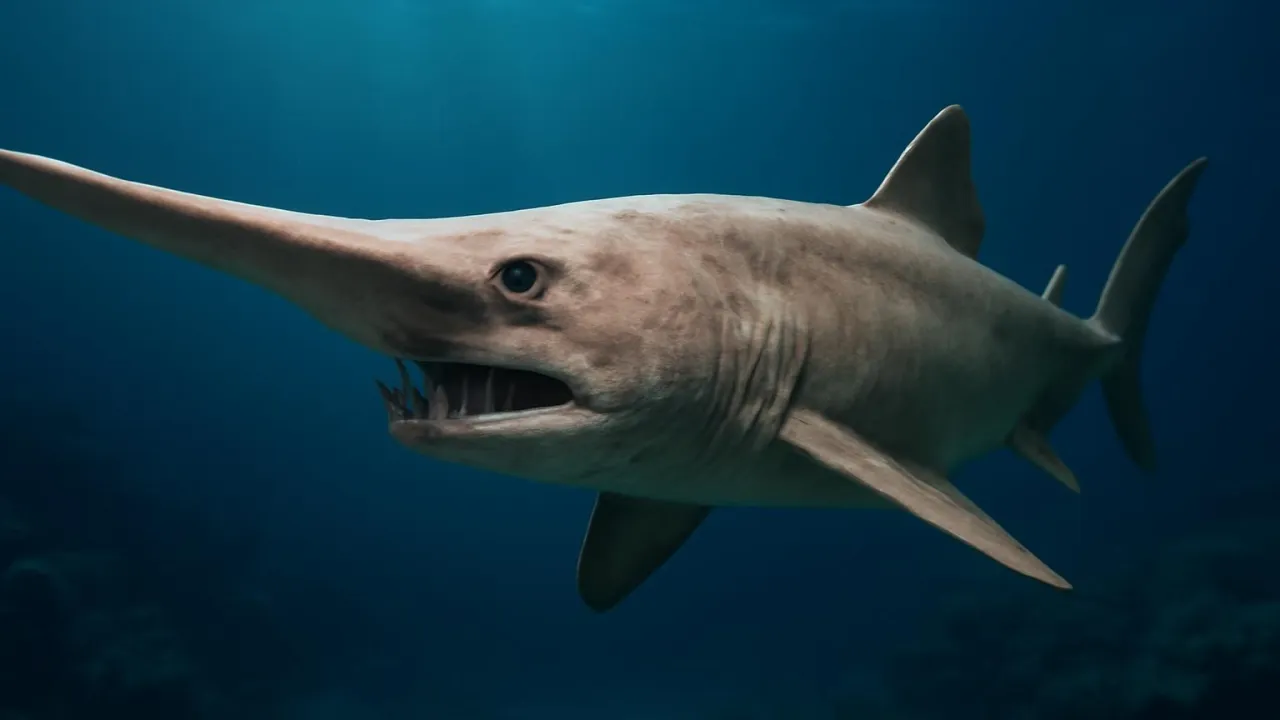
1. What part of the goblin shark looks like a sword?
2. How does the goblin shark catch its food?
🤯 Mind-Blowing Fact • Grade 3
The goblin shark’s jaw can extend forward up to 8 inches to catch prey quickly.
✨ Word Sparks (Grade 3 Glossary)
Tap 🔊 to hear
camouflage
Colors or shapes to hide from others
predator
An animal that hunts other animals
adaptation
A body change that helps survival
🪝
What if a shark could shoot its jaws out like a slingshot?
1
Deep Ocean Hunter
The goblin shark lives in deep ocean waters, often near the sea floor. It uses with its pale pink color to hide in dark water. This helps it avoid and sneak up on prey. Its slow swimming is an for conserving energy in cold, deep water.
2
Unique Nose and Senses
Its long, flat snout is covered with special sensors that detect electrical signals from prey. This helps the goblin shark find food in the dark ocean where light does not reach. The nose acts like a radar to sense tiny movements nearby.
3
Slingshot Jaw
The goblin shark has a jaw that can shoot forward quickly to catch prey. This jaw extension allows it to grab fast fish and squid before they escape. This unique feeding method is rare among sharks and helps it survive in the deep sea.
4
What It Eats
It mainly eats fish, squid, and crustaceans found near the ocean floor. Its sharp teeth help hold slippery prey tightly. The goblin shark is a that plays an important role in its ecosystem by controlling prey populations.
1. Why does the goblin shark have a pale pink color?
2. How does the goblin shark’s jaw help it catch prey?
🤯 Mind-Blowing Fact • Grade 4
Goblin sharks’ jaws can extend nearly one-third of their head length to capture prey swiftly.
✨ Word Sparks (Grade 4 Glossary)
Tap 🔊 to hear
protrusible
Can stick out forward to grab food
metabolism
How an animal uses energy to live
ecosystem
A community of living things and their home
🪝
How does a goblin shark’s strange jaw help it survive in the deep ocean?
1
Deep-Sea Habitat and Behavior
The goblin shark inhabits deep ocean regions worldwide, usually between 330 and 1,300 feet. Its pale pink skin provides camouflage in the dim light, allowing it to avoid predators and sneak up on prey. This shark moves slowly to conserve energy in the cold, high-pressure environment of the deep sea.
2
Jaw Mechanics and Feeding
Its highly jaws can shoot forward rapidly to snatch prey like fish and squid. This slingshot jaw mechanism is a rare adaptation that allows the goblin shark to catch fast-moving prey in an environment where food is scarce. The jaw’s extension can reach up to eight inches, increasing its hunting success.
3
Role in the Ecosystem
As a predator, the goblin shark helps maintain balance in deep-sea food webs by controlling populations of fish and crustaceans. Its slow and unique hunting strategy reduce competition with other deep-sea predators. This species also contributes to nutrient cycling when it consumes prey and is preyed upon by larger animals.
4
Geographic Distribution and Human Impact
Goblin sharks are found worldwide in deep waters but are rarely seen by humans due to their depth. Though not currently endangered, deep-sea fishing and habitat disturbance could affect their populations. Understanding their biology helps scientists protect these mysterious sharks and their fragile .
1. Why does the goblin shark move slowly in the deep sea?
2. What role does the goblin shark play in its ecosystem?
🤯 Mind-Blowing Fact • Grade 5
The goblin shark’s jaw can shoot forward in less than a tenth of a second to catch prey.
✨ Word Sparks (Grade 5 Glossary)
Tap 🔊 to hear
extant
Still alive today, not extinct
ligament
Tissue that connects bones and muscles
bycatch
Animals caught by mistake in fishing nets
🪝
How does the goblin shark’s jaw mechanism reveal evolutionary marvels of deep-sea life?
1
Taxonomy and Scientific Classification
The goblin shark, Mitsukurina owstoni, belongs to the family Mitsukurinidae and is the only species in its genus. It is a member of the order Lamniformes, which includes mackerel sharks. This species is considered a living fossil due to its ancient lineage dating back about 125 million years.
2
Physiological Adaptations and Jaw Mechanics
Its jaw is highly protrusible, capable of extending nearly one-third of the head length forward to capture prey. Specialized and muscles allow this rapid jaw projection, functioning like a slingshot. This adaptation is essential for feeding in the deep sea, where prey is scarce and often fast-moving. The jaw’s speed and reach are among the fastest and longest of any shark species.
3
Ecological Role and Conservation Status
Goblin sharks occupy deep-sea ecosystems worldwide, serving as mid-level predators controlling populations of fish, squid, and crustaceans. Although rarely encountered, they are vulnerable to in deep-sea fisheries. Currently, they are not listed as endangered, but habitat disruption poses potential risks to their populations. Conservation efforts focus on reducing deep-sea fishing impacts.
4
Botanical and Zoological Comparisons
Unlike many sharks, the goblin shark’s pink coloration results from visible blood vessels through translucent skin, an adaptation to deep-sea camouflage. This contrasts with surface sharks that rely on countershading. Its slow metabolism and unique jaw mechanics distinguish it from other cartilaginous fishes in similar habitats, highlighting evolutionary divergence.
5
Quantitative Comparisons and Research Insights
Goblin sharks can reach lengths up to 12 feet and weigh approximately 210 pounds. Their jaw can extend about 8 inches in under 0.1 seconds, one of the fastest jaw protrusions recorded. They inhabit depths ranging from 330 to 1,300 feet, where temperatures vary between 39 and 54 degrees Fahrenheit. These measurements help scientists understand their ecological niche and evolutionary adaptations.