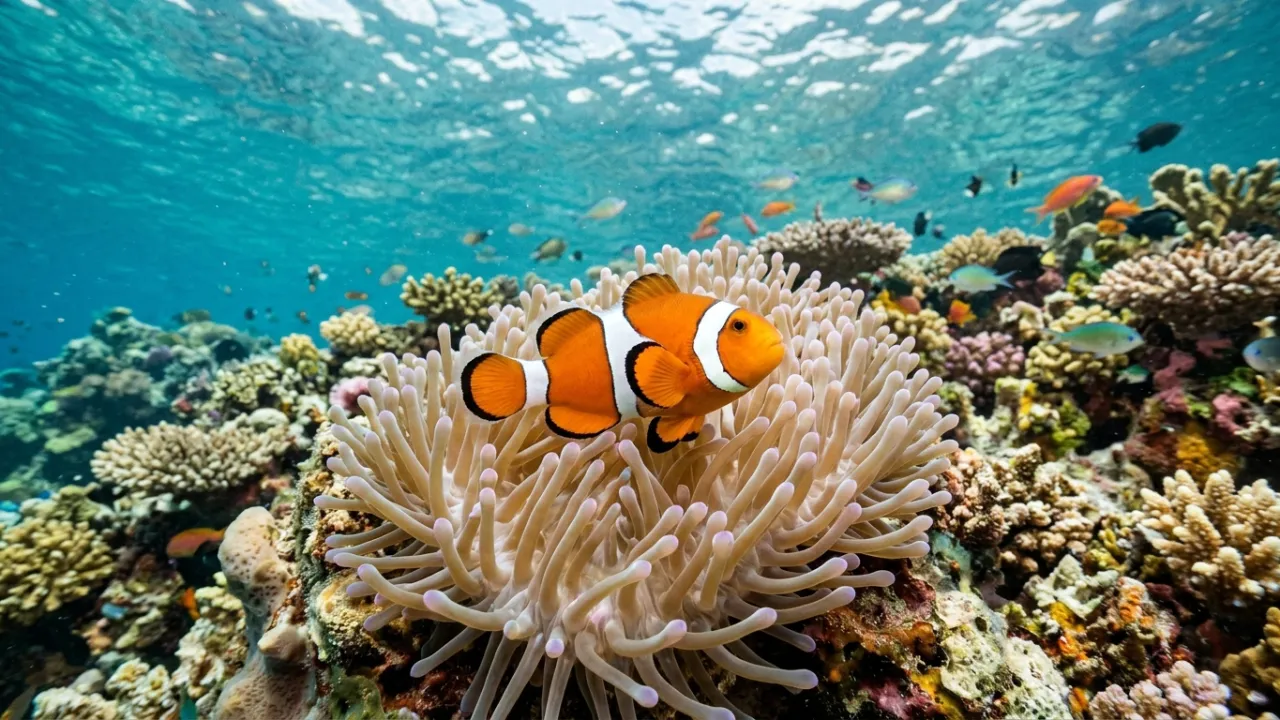
1. How many white stripes wrap around an Ocellaris Clownfish?
2. Where does the little clownfish hide from big hungry fish?
🤯 Mind-Blowing Fact • Grade 2
Unlike fast open-ocean swimmers, clownfish paddle with their side fins in a bouncy, rowing motion called 'waddling' through the water!
✨ Word Sparks (Grade 2 Glossary)
Tap 🔊 to hear
anemone
Ocean animal with waving stinging tentacles
mucus
Slippery protective slime on fish skin
lagoon
Calm shallow water sheltered by reef
🪝
Why can a tiny clownfish cuddle a stinging sea creature that scares away bigger fish?
1
Cozy Coral Reef Neighborhoods
Dive into a sunlit in the warm Pacific or Indian Ocean! Ocellaris Clownfish spend their whole lives near shallow coral reefs, rarely swimming more than a few inches from their favorite waving sea .
2
A Slippery Suit of Armor
Sea look like underwater flowers, yet they are actually animals armed with stinging tentacles! Fortunately, a clownfish wears a special coat of slippery over its scales so the anemone never stings its tiny roommate.
3
Guarding Tiny Coral Eggs
Parents lay hundreds of tiny orange eggs on a clean rock right beside their 's base. The careful father fans fresh water over the eggs with his fins until baby larvae hatch and swim into the sea.
1. What keeps an Ocellaris Clownfish from getting stung by its sea anemone home?
2. How does a father clownfish care for the eggs before they hatch?
🤯 Mind-Blowing Fact • Grade 3
A sea anemone hosting clownfish can grow up to three times faster than an anemone living all alone on the reef!
✨ Word Sparks (Grade 3 Glossary)
Tap 🔊 to hear
symbiosis
Close partnership between two different species
predator
Animal that hunts other animals
nutrients
Nourishing substances living things need
🪝
What happens when a colorful fish and a venomous sea creature team up as underwater best friends?
1
Two Partners, One Reef Fortress
Touch a sea anemone's waving tentacles, and microscopic harpoons fire venom in a blink—unless you are an Ocellaris Clownfish! Marine scientists call this win-win partnership mutualistic because two completely different ocean animals help each other survive on crowded, hungry coral reefs.
2
How the Slime Shield Works
Before moving into a new anemone, a clownfish gently brushes its rounded fins against the tentacles in a careful little dance. Coated in special sugar-free mucus, the fish's bright orange skin does not trigger the anemone's stingers, turning a dangerous trap into a cozy, -proof fortress.
3
Paying Rent With Reef Chores
In return, the feisty four-inch clownfish bravely chases away much larger butterflyfish that try nibbling its host's soft tentacles! Even better, the clownfish's natural waste provides rich that feed helpful microscopic algae living inside the anemone.
4
Nighttime Tentacle Blankets
Every night, when oxygen levels drop inside the folded tentacles, the sleeping clownfish wiggles gently back and forth, fanning fresh oxygen-rich seawater across its host like a living underwater pump until sunrise. Together, this tiny striped fish and its stinging home form one of nature's greatest ocean teams.
1. How does an Ocellaris Clownfish help its host sea anemone thrive?
2. Why does a clownfish perform a gentle brushing dance before moving into a new anemone?
🤯 Mind-Blowing Fact • Grade 4
Baby clownfish drifting in the open ocean actually follow the scent of rainforest leaves floating in coastal water to locate healthy coral reefs!
✨ Word Sparks (Grade 4 Glossary)
Tap 🔊 to hear
omnivore
Animal eating both plants and animals
zooplankton
Tiny drifting ocean animals near surface
larvae
Newly hatched young before adult form
🪝
How do tiny drifting baby clownfish smell their way home across miles of open ocean—and organize a strict royal court inside one anemone?
1
Life in the Indo-Pacific Coral Triangle
Across the warm, sunlit waters of Southeast Asia, the Philippines, and northern Australia—an underwater biodiversity hotspot called the Coral Triangle—Ocellaris Clownfish inhabit calm lagoons and outer reef slopes down to 50 feet (15 meters) deep. Because their rounded fins are built for quick turns rather than open-ocean speed, these dart out briefly to snap up drifting , tiny copepods, and benthic algae before retreating into magnificent sea anemones.
2
Smelling Rainforest Leaves Underwater!
Right after hatching on a moonlit night, transparent clownfish sweep out into the open sea for ten to twelve days on ocean currents. How do tiny half-inch fry ever find a coral reef again? Astonishingly, they sniff chemical scents washed into coastal lagoons from tropical island rainforest leaves and steer toward the underwater crackle of snapping shrimp and reef fish!
3
A Strict Size-Based Royal Court
Inside each host anemone lives a peaceful, size-ranked family group led by the largest fish—always the egg-laying female—followed by the second-largest breeding male and two to four smaller non-breeding helpers. Rapid jaw-popping clicks and gentle fin displays remind every roommate of its exact rank so nobody wastes energy fighting or gets chased out into open water.
4
Warming Seas and Responsible Reef Care
Because host sea anemones depend on internal photosynthetic algae just like reef-building corals, marine heatwaves can bleach anemones white and shrink clownfish shelter. Today, marine aquaculturists raise Ocellaris Clownfish in sustainable hatcheries so aquarium hobbyists can enjoy these colorful reef ambassadors without removing wild families from ocean reefs. Healthy coral reefs give thousands of marine species shelter, food, and crystal-clear places to grow.
1. What sensory clues guide drifting baby clownfish larvae back to a coral reef?
2. Why does breeding Ocellaris Clownfish in aquariums help wild Indo-Pacific coral reefs?
🤯 Mind-Blowing Fact • Grade 5
Scientists discovered that Ocellaris Clownfish slime lacks a single sugar molecule (sialic acid) found on most fish—preventing stinging harpoons from ever recognizing them as prey!
✨ Word Sparks (Grade 5 Glossary)
Tap 🔊 to hear
nematocyst
Microscopic stinging harpoon inside anemone cells
ichthyologist
Scientist who studies fishes and biology
protandrous
Starting life male before becoming female
🪝
What biochemical disguise prevents thousands of microscopic venomous harpoons from firing at Amphiprion ocellaris—and why is every clownfish born with the ability to switch roles?
1
Taxonomy and Diagnostic Fin Counts
Measuring just 3 to 4.3 inches (7.5 to 11 centimeters) long, Amphiprion ocellaris belongs to the damselfish family Pomacentridae across shallow reefs of the eastern Indian and western Pacific Oceans. Look closely beside its near-identical sister species, the Orange Clownfish (Amphiprion percula): marine distinguish A. ocellaris by its narrower black borders framing three white bars, a taller spinous dorsal fin (typically bearing 11 spines rather than 10), and a warm greyish-orange iris surrounding the pupil.
2
Biochemistry of Nematocyst Camouflage
Favored host anemones—specifically Heteractis magnifica, Stichodactyla gigantea, and Stichodactyla mertensii—arm their tentacles with millions of stinging capsules called cnidocytes. Each capsule houses a coiled, venom-tipped thread () that fires with bullet-like acceleration whenever sensory hairs detect sialic-acid sugars in a passing fish's slime. Remarkably, Amphiprion ocellaris secretes a specialized epidermal mucus stripped of N-acetylneuraminic acid; lacking that molecular trigger, the anemone perceives the clownfish as one of its own tentacles!
3
Tripartite Symbiosis With Zooxanthellae
This celebrated reef alliance operates as a three-way physiological engine inside tropical waters of 75 to 82 °F (24 to 28 °C) at depths of 3 to 50 feet (1 to 15 meters). While stinging tentacles shield the fish from moray eels and groupers, gill excretions from A. ocellaris deliver dissolved ammonium directly onto host tissues—fertilizer absorbed within minutes by symbiotic Symbiodinium dinoflagellate algae (zooxanthellae) to accelerate photosynthesis and tissue growth.
4
Protandrous Sequential Hermaphroditism
Equally extraordinary is the species' reproductive biology: all A. ocellaris juveniles mature into males first, an evolutionary strategy termed sequential hermaphroditism. Should a predator remove the dominant female atop the anemone's strict size queue, neural hormones trigger the breeding male to grow larger and irreversibly transform into the new egg-laying female within weeks while the largest subordinate matures into the new breeding male.
5
Ocean Chemistry and Reef Sensory Ecology
Controlled laboratory studies demonstrate that elevated dissolved carbon dioxide—ocean acidification—can disrupt neurotransmitter signaling inside larval clownfish olfactory bulbs while thermal stress above 86 °F (30 °C) bleaches host anemones white. Protecting clean reef water chemistry and marine sanctuaries across the Indo-Pacific ensures these remarkable fish-and-anemone partnerships continue thriving. Safeguarding tropical coral ecosystems ensures that future generations can marvel at this extraordinary underwater alliance.