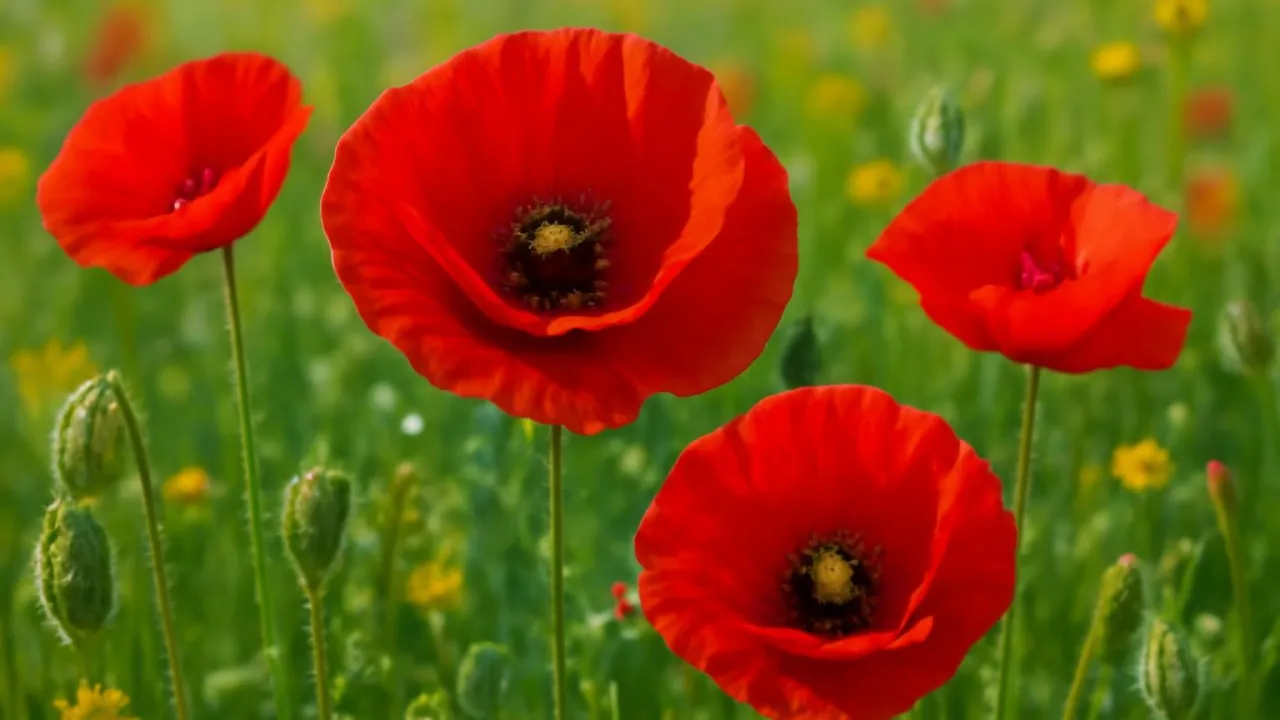
Some poppy seeds can stay alive for many years before they grow!
✨ Word Sparks (Grade 2 Glossary)
Tap 🔊 to hear
petals
The colorful parts of a flower that attract animals
pollinate
When bees help flowers make seeds by moving pollen
nectar
Sweet juice inside flowers that bees like to drink
🪝
Have you ever seen a flower that looks like a tiny red cup?
1
Bright Colors and Shapes
Poppies have bright red that look like soft cups. They also come in orange and pink colors. Their petals are thin and smooth, shining in sunlight.
2
Where Poppies Live
Poppies grow in sunny fields and gardens around the world. They like warm places and need water to grow tall. Farmers sometimes plant poppies for their pretty flowers.
3
A Special Flower Feature
Poppies open their in the morning and close them at night. This helps protect their pollen from rain and wind. Bees and butterflies visit poppies to collect and help them.
Poppy seeds can remain viable in soil for over 80 years before sprouting.
✨ Word Sparks (Grade 3 Glossary)
Tap 🔊 to hear
adaptation
A special trait that helps a plant survive better
pollination
When pollen moves from one flower to another to make seeds
dormant
A resting seed that waits for the right time to grow
🪝
Did you know poppies have a clever way to protect their pollen?
1
Colorful Petals and Camouflage
Poppies have bright red petals that attract pollinators like bees and butterflies. Their petals are thin and delicate but help the flower stand out in fields. The bright colors act like a signal to animals searching for nectar. This helps poppies survive and reproduce.
2
Life Cycle and Growth
Poppies start as tiny seeds that can stay in soil for years. When conditions are right, seeds sprout and grow into plants. The plants develop slender stems and open their petals in spring. This life cycle helps poppies thrive in different environments.
3
Pollination and Survival
Poppies rely on insects to pollinate their flowers by moving pollen from one bloom to another. This process helps create seeds for new plants. The petals close at night to protect pollen from rain and wind, increasing chances of success.
4
Poppy’s Role in Nature
Poppies provide nectar for many pollinators, supporting local ecosystems. Their seeds also feed some birds and small animals. By growing in fields and gardens, poppies add beauty and help maintain healthy habitats.
Poppies’ seeds feed many birds, helping wildlife survive harsh winters.
✨ Word Sparks (Grade 4 Glossary)
Tap 🔊 to hear
ecosystem
A community of living things and their environment
pollinator
An animal that helps flowers make seeds
adaptation
A change that helps a plant or animal survive
🪝
How do poppies’ bright petals affect their place in nature’s web?
1
Bright Petals and Adaptations
Poppies have vibrant red petals that attract such as bees and butterflies, which are vital for their reproduction. Their petals close at night, protecting pollen from rain and wind damage, which increases the chance of successful pollination. This helps poppies survive in temperate regions with variable weather. Bright colors also help poppies stand out among other plants, ensuring they receive enough visits from pollinators.
2
Ecosystem Role and Food Webs
Poppies contribute to local food webs by providing nectar for and seeds for birds and small mammals. These animals, in turn, support larger predators, creating a balanced . Poppies also help maintain soil health by growing in disturbed areas and preventing erosion. Their presence supports biodiversity and helps other plants by attracting beneficial insects.
3
Geographic Distribution and Growth
Poppies naturally grow in temperate zones across Europe, Asia, and North America, thriving in sunny fields and gardens. They prefer well-drained soil and moderate water but can tolerate a range of conditions. Human cultivation has spread poppies worldwide, where they are grown for ornamental purposes and seed production. Their ability to grow in diverse environments shows their strong skills.
4
Human Impact and Uses
Humans have used poppies for thousands of years for their beauty and medicinal properties, including pain relief. However, some species produce opiates, which require careful management to prevent misuse. Cultivated poppies support agriculture and horticulture industries worldwide. Conservation efforts focus on protecting wild poppy habitats from urban development and pollution to maintain ecological balance.
1. How do poppies help other plants in their environment?
2. What is one way humans use poppies?
🤯 Mind-Blowing Fact • Grade 5
Poppy seeds can stay dormant in soil for over 80 years, waiting for perfect growth conditions.
✨ Word Sparks (Grade 5 Glossary)
Tap 🔊 to hear
dormancy
A resting state when seeds wait to grow
pollinator
An animal that helps flowers make seeds
taxonomy
How scientists group plants and animals
🪝
What makes the poppy’s bright petals and seed dormancy vital for its survival and human use?
1
Taxonomy and Scientific Classification
Poppies belong to the genus Papaver within the family Papaveraceae, comprising over 70 species worldwide. The common poppy, Papaver rhoeas, is well-known for its vibrant red petals and cultural symbolism. These flowering plants are classified as annual or perennial herbs, depending on species, and are native primarily to temperate regions across Europe, Asia, and North America. Their classification helps scientists study their evolutionary relationships and ecological roles.
2
Physiological Mechanics and Adaptations
Poppies produce thin, delicate petals that reflect ultraviolet light, attracting like bees and butterflies efficiently. Their petals open during the day to expose reproductive organs and close at night to protect pollen from moisture and predators. The seeds possess a hard coat allowing them to remain dormant in soil for decades, ensuring germination occurs under favorable conditions. This mechanism maximizes survival chances in fluctuating environments.
3
Conservation and Botanical History
Historically, poppies have been cultivated for ornamental, culinary, and medicinal purposes, including opiate production from species like Papaver somniferum. Conservation efforts focus on protecting wild poppy habitats from urbanization and agricultural expansion, which threaten biodiversity. Botanical studies reveal poppies’ resilience and adaptability, making them valuable for ecological restoration projects. Their cultural significance, especially as symbols of remembrance, highlights their importance beyond ecology.
4
Quantitative Comparisons and Growth Conditions
Poppies typically grow between 1 and 3 feet (30 to 90 centimeters) tall, thriving in full sun with moderate water requirements. Their seeds can remain viable in soil for over 80 years, a remarkable adaptation compared to many other flowering plants. Flowering occurs mainly in spring and early summer when temperatures range from 55 to 75 degrees Fahrenheit (13 to 24 degrees Celsius). These precise growth conditions enable poppies to flourish in diverse temperate climates worldwide.
5
Ecological and Human Impact
Poppies play a critical role in ecosystems by supporting , which in turn sustain agricultural crops and wild plants. Their nectar provides essential nutrients to bees, butterflies, and other insects, promoting biodiversity. Human cultivation has expanded their range globally, but habitat loss and climate change pose threats to wild populations. Sustainable management and conservation are necessary to preserve poppies’ ecological functions and cultural heritage for future generations.