Piping Plover
Tiny Beach Bird with Mighty Survival Tricks
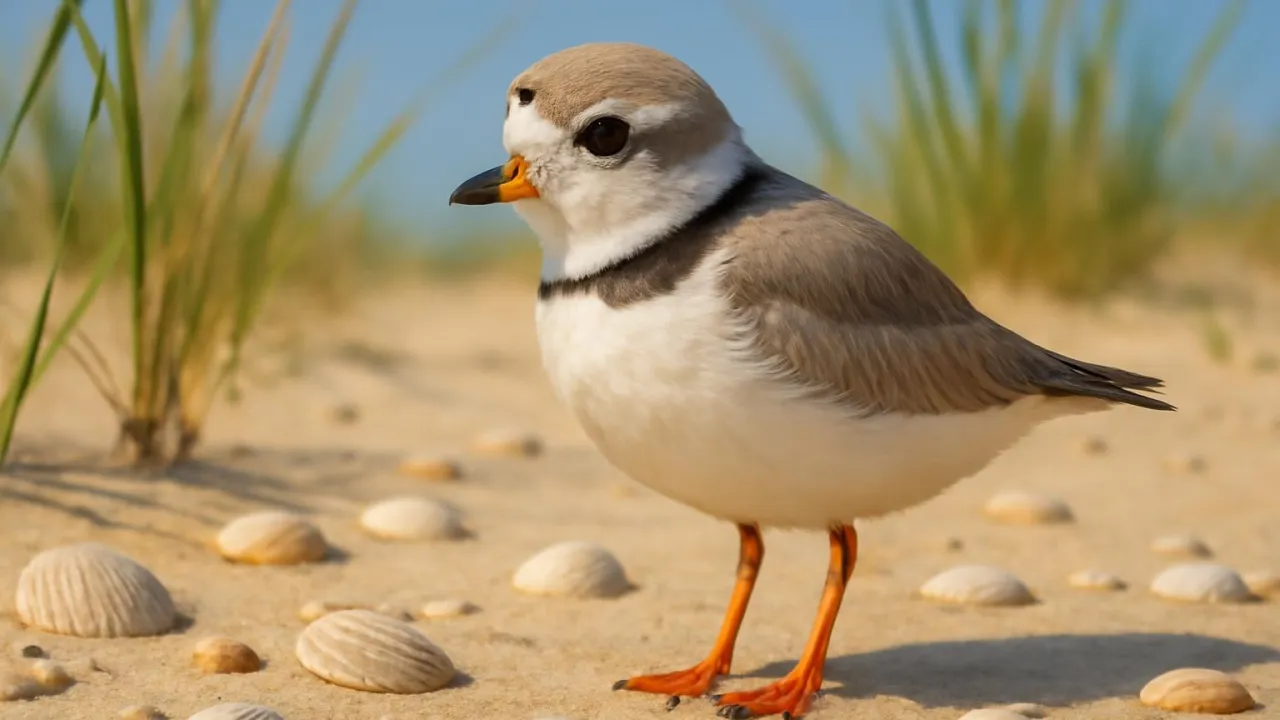
Piping plovers can sprint up to 10 miles per hour (16 kilometers per hour) to escape danger or chase prey!
1 Taxonomy and Physical Features
The piping plover, Charadrius melodus, belongs to the family Charadriidae, which includes other small shorebirds known as plovers. Adult piping plovers measure about 6.5 to 7 inches (17–18 centimeters) in length and weigh around 1.5 to 2 ounces (43–57 grams), making them lighter than a tennis ball. Their pale grayish-tan upperparts, white underparts, and distinctive black neck band provide both camouflage and species identification. During the breeding season, adults develop a bright orange bill tipped with black and orange legs, which help them blend into sunlit sand and scattered shells.
2 Survival Strategies and Adaptations
Piping plovers have evolved remarkable behavioral and physical adaptations for survival in open beach habitats. Their cryptic coloration and tendency to crouch motionless help them evade predators such as foxes, raccoons, and gulls, as well as avoid detection by humans. When a predator approaches, adults may perform a 'broken-wing display,' feigning injury to lure threats away from vulnerable nests or chicks. Their short, strong bills allow them to probe sand efficiently for invertebrates, while their long legs enable quick sprints along the shoreline.
3 Life Cycle and Reproduction
These birds breed from late April through August, laying three to four eggs in shallow scrapes above the high tide line. The eggs, measuring about 1.2 inches (3 centimeters) long, are speckled to resemble pebbles and sand grains, minimizing predation risk. Incubation lasts 25 to 28 days, with both parents sharing the duty. Chicks are , meaning they can walk and feed themselves within hours of hatching, but remain dependent on parents for protection. Fledging occurs after about 25 days, when young birds can fly and escape most threats.
4 Ecosystem Importance and Human Impact
Piping plovers are considered an for healthy coastal ecosystems because their presence reflects undisturbed, high-quality beaches. They help control populations of insects and small crustaceans, contributing to the balance of shoreline food webs. Human activities such as beachfront development, off-road vehicles, unleashed pets, and pollution have dramatically reduced their nesting habitat, leading to population declines. Conservation efforts—including posting signs, erecting protective fencing, and restricting beach access during breeding season—have helped some populations recover, but the species remains federally threatened in the United States.
5 Conservation, Research, and Global Status
Today, fewer than 8,400 adult piping plovers remain worldwide, with the largest populations found along the Atlantic Coast, Great Lakes, and Northern Great Plains of North America. Conservationists monitor nests, band chicks, and track migrations using lightweight , revealing that some plovers travel over 1,500 miles (2,400 kilometers) between breeding and wintering grounds. Ongoing research focuses on understanding migration routes, genetic diversity, and the effects of climate change on nesting success. Protecting the piping plover not only preserves a unique species but also safeguards entire beach ecosystems for future generations.
1. What is one reason piping plover eggs are speckled?
2. How far can some piping plovers migrate between seasons?