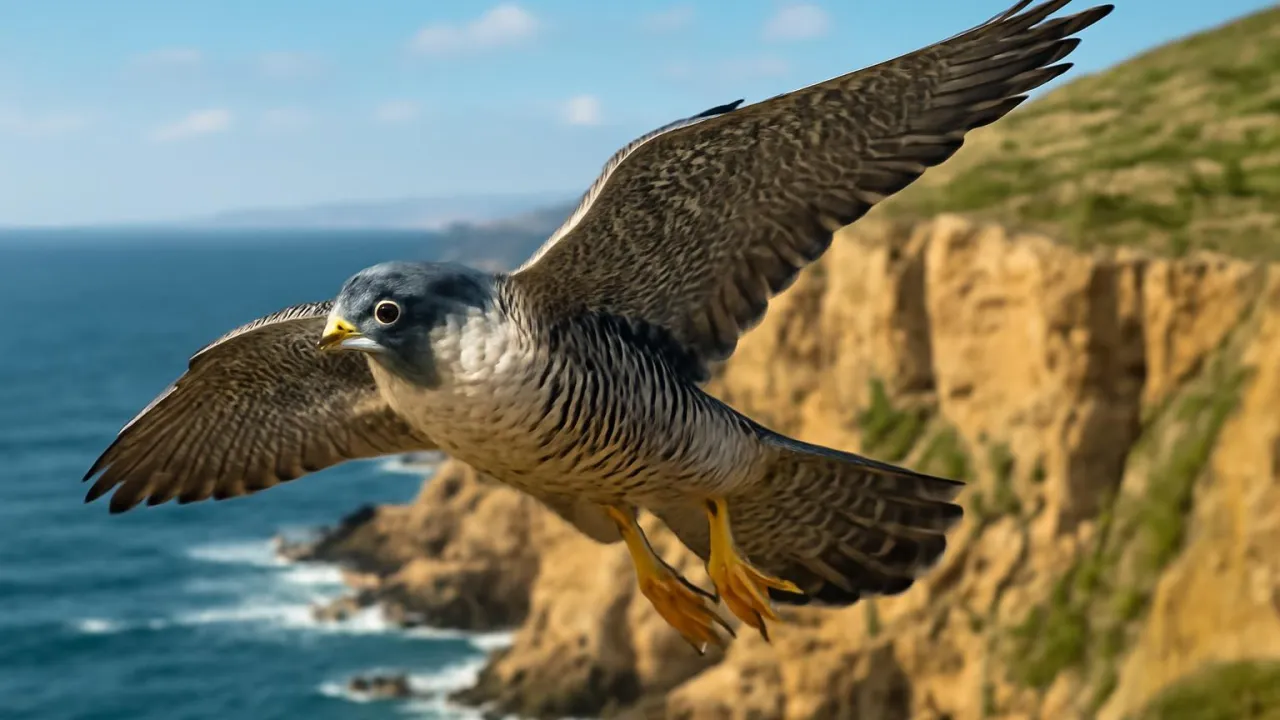
1. What does the peregrine falcon catch when it dives?
2. Where do peregrine falcons like to live?
🤯 Mind-Blowing Fact • Grade 2
Peregrine falcons can reach diving speeds over 200 miles per hour, faster than any other animal!
✨ Word Sparks (Grade 2 Glossary)
Tap 🔊 to hear
prey
Animals that are hunted and eaten
nest
A home birds build to lay eggs
streamlined
Shaped to move fast through air or water
🪝
Have you ever seen a bird that can dive faster than a race car?
1
Super Fast Flyer
The peregrine falcon is the fastest bird in the world, and it can dive at speeds over 200 miles per hour. It uses this speed to catch other birds while flying high in the sky. When it dives, it folds its wings back to become very .
2
What It Looks Like
This falcon has blue-gray feathers on its back and white feathers on its belly. It has a dark mask around its eyes and a sharp hooked beak. Its strong wings help it fly fast and catch .
3
Where It Lives
Peregrine falcons live all over the world, often near cliffs or tall buildings in cities. They like places where they can build high up and have open spaces to hunt flying birds.
4
Life Cycle and Growth
The female lays eggs on cliff ledges or building tops. Baby falcons hatch after about a month and grow strong wings. They learn to fly and hunt from their parents before leaving the .
Peregrine falcons can spot prey from over a mile away using their sharp eyesight!
✨ Word Sparks (Grade 3 Glossary)
Tap 🔊 to hear
adaptation
A body change that helps survival
camouflage
Colors that help hide from others
predator
An animal that hunts other animals
🪝
Did you know peregrine falcons are the fastest animals on Earth when they dive?
1
Incredible Speed and Hunting
Peregrine falcons can dive at speeds over 200 miles per hour, making them the fastest animals on the planet. This incredible speed helps them catch prey mid-air, mostly other birds. Their streamlined body shape and strong wings reduce air resistance during dives. This allows them to hunt efficiently and survive in many environments.
2
Physical Features and Adaptations
These falcons have sharp, hooked beaks used to tear meat from their prey. Their keen eyesight helps them spot prey from great distances. The dark mask around their eyes reduces glare from sunlight, improving vision. Their feathers are dense and smooth, which also helps with fast flight and .
3
Habitat and Distribution
Peregrine falcons live almost everywhere on Earth, except Antarctica. They prefer nesting on high cliffs or tall buildings in cities. This habitat choice protects their nests from and gives them a good view for hunting. They are highly adaptable and can thrive in many climates and regions.
4
Life Cycle and Growth
Females lay eggs on bare cliff ledges or building ledges without building nests. The eggs hatch after about 30 days, and chicks grow quickly. Young falcons learn to fly and hunt by practicing with their parents. This learning period is crucial for survival in the wild.
2. Why do peregrine falcons nest on cliffs or tall buildings?
🤯 Mind-Blowing Fact • Grade 4
Peregrine falcons helped scientists discover how pesticides affect wildlife and led to important conservation laws.
✨ Word Sparks (Grade 4 Glossary)
Tap 🔊 to hear
ecosystem
A community of living things and their home
symbiosis
When two species help each other live
pesticide
Chemicals that kill pests but can harm animals
🪝
How does the peregrine falcon’s incredible speed affect its role in ecosystems worldwide?
1
Speed and Hunting Success
The peregrine falcon’s ability to dive at over 200 miles per hour allows it to catch fast-flying birds, which are its main prey. This hunting skill helps control populations of pigeons and other birds, maintaining balance in . Its streamlined body and powerful muscles reduce air resistance and increase acceleration during dives. These adaptations make it one of the most efficient aerial predators on Earth.
2
Habitat and Geographic Range
Peregrine falcons have an extensive geographic range, living on every continent except Antarctica. They inhabit diverse environments, from coastal cliffs to urban skyscrapers, showing remarkable adaptability. Their choice of nesting sites on high ledges protects their young from many ground predators. Human-made structures have helped them expand into cities, where they find abundant prey and nesting spots.
3
Role in Food Webs and Symbiosis
As top predators, peregrine falcons play a crucial role in food webs by regulating prey bird populations. This control helps prevent overpopulation and supports healthy . They sometimes share nesting areas with other birds, creating a form of where both species benefit from protection. Their presence indicates a healthy environment with clean air and abundant prey.
4
Impact of Human Activity
In the mid-20th century, use caused peregrine falcon populations to decline sharply due to eggshell thinning. Conservation efforts, including banning harmful chemicals and captive breeding, have helped their numbers recover. Today, peregrine falcons thrive in many urban areas, showing resilience to human changes. Protecting their habitats remains important to ensure their continued survival.
5
Life Cycle and Reproduction
Peregrine falcons lay eggs on bare ledges, with no nest structure, relying on high locations for safety. Incubation lasts about 33 days, after which chicks hatch and grow rapidly. Young falcons develop strong flight muscles by practicing hunting flights with their parents. This learning phase is vital for their survival and eventual independence.
1. Why are peregrine falcons important in ecosystems?
2. How did humans help peregrine falcon populations recover?
🤯 Mind-Blowing Fact • Grade 5
Peregrine falcons can reach dive speeds over 200 miles per hour, making them the fastest animals on Earth.
✨ Word Sparks (Grade 5 Glossary)
Tap 🔊 to hear
raptor
A bird that hunts other animals for food
nictitating membrane
A clear eyelid that protects eyes in flight
phenotypic
Visible traits an animal shows outside
🪝
What physiological traits enable the peregrine falcon to achieve the highest recorded dive speeds among animals?
1
Taxonomy and Scientific Classification
The peregrine falcon, Falco peregrinus, belongs to the family Falconidae within the order Falconiformes. It is a widely distributed species known for its remarkable hunting adaptations. Its genus name, Falco, refers to its sickle-shaped wings used for rapid flight. This species exhibits significant variation across its global range, adapting to diverse habitats.
2
Physiological Mechanics of High-Speed Diving
Peregrine falcons achieve dive speeds exceeding 200 miles per hour through aerodynamic body shaping and powerful flight muscles. Their tapered wings reduce drag, while specialized respiratory systems prevent oxygen deprivation during rapid descents. The falcon's protects its eyes from debris at high velocity. Additionally, reinforced skeletal structures absorb impact forces upon prey capture.
3
Conservation History and Human Impact
Pesticide contamination, especially from DDT, caused catastrophic declines in peregrine falcon populations during the 20th century due to eggshell thinning. Intensive conservation programs, including captive breeding and reintroduction, have restored populations globally. Urban nesting on skyscrapers mimics natural cliff habitats, facilitating species recovery. Ongoing monitoring ensures population stability amid environmental changes.
4
Ecological Role and Quantitative Comparisons
As apex aerial predators, peregrine falcons regulate avian prey populations, influencing ecosystem dynamics across continents. Their dive speed, measured at over 200 mph (320 km/h), surpasses that of any other animal. Adult falcons typically weigh between 1.5 to 3.5 pounds (0.7 to 1.6 kg), with wingspans of 3.3 to 3.6 feet (1 to 1.1 meters). These metrics highlight their exceptional adaptations for hunting efficiency.
5
Reproductive Behavior and Development
Peregrine falcons exhibit monogamous pair bonds and site fidelity to traditional nesting locations on cliffs or urban structures. Females lay 3 to 4 eggs on bare ledges without constructing nests. Incubation lasts approximately 33 to 35 days, with both parents participating in feeding chicks. Juveniles fledge at around 42 days, gradually developing hunting skills essential for survival. Their ability to thrive in urban environments shows their remarkable adaptability.