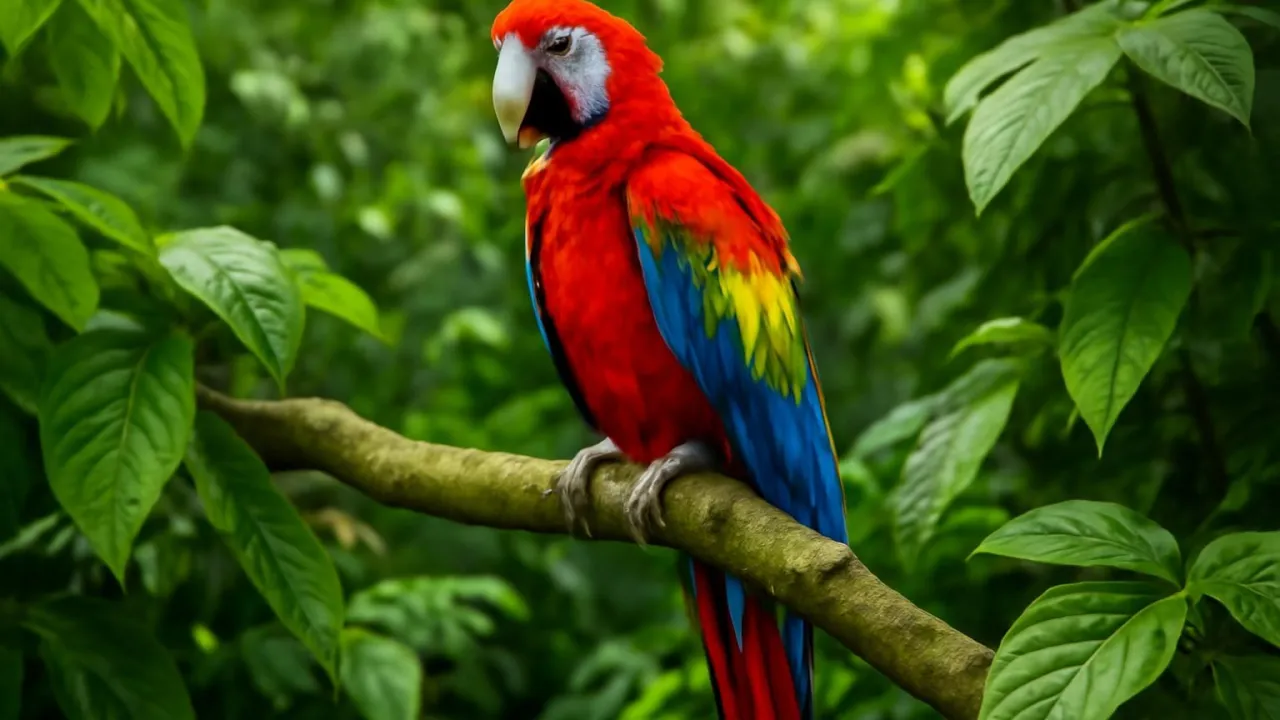
Scarlet macaws can fly up to 35 miles per hour through the forest!
✨ Word Sparks (Grade 2 Glossary)
Tap 🔊 to hear
rainforest
A warm forest with lots of rain
nest
A safe home birds build in trees
beak
A bird’s hard mouth used to eat food
🪝
Have you ever seen a bird with feathers as bright as a rainbow?
1
Colorful Feathers
The scarlet macaw has bright red feathers with blue and yellow wings. Its colors help it stand out in the . These feathers make it easy to spot flying in the sky.
2
Rainforest Home
Scarlet macaws live in tropical where it is warm and wet. They build in tall trees to stay safe. The forest gives them food and shelter every day.
3
Strong Beak
This bird uses its strong to crack open nuts and seeds. It also eats fruits and flowers for energy. The beak helps the macaw get food that other birds cannot.
Scarlet macaws can live over 40 years in the wild, showing strong survival skills!
✨ Word Sparks (Grade 3 Glossary)
Tap 🔊 to hear
camouflage
Colors that help animals hide
nutrients
Food parts that give energy
predator
An animal that hunts other animals
🪝
Did you know scarlet macaws use bright colors to hide in the rainforest?
1
Bright Colors and Camouflage
Scarlet macaws have bright red, blue, and yellow feathers that help them blend into colorful rainforest flowers. This protects them from . Their feathers also signal to other macaws during flight.
2
Habitat and Life Cycle
These birds live in tropical rainforests where they build nests in tall trees. They lay eggs that hatch after about a month. The chicks grow feathers and learn to fly before leaving the nest.
3
Strong Beak Adaptation
The macaw’s strong curved beak cracks hard nuts and seeds that other birds cannot open. This adaptation allows it to access important for energy. The beak also helps the bird climb branches.
4
Role in the Ecosystem
Scarlet macaws help spread seeds by eating fruits and dropping seeds far away. This pollination helps plants grow. They are part of a food web where they avoid like snakes and monkeys.
Scarlet macaws can fly up to 35 miles per hour and live over 40 years in the wild.
✨ Word Sparks (Grade 4 Glossary)
Tap 🔊 to hear
camouflage
Colors that help animals hide from danger
ecosystem
A community of plants and animals living together
conservation
Protecting nature and animals from harm
🪝
How do scarlet macaws use their bright feathers to survive in the rainforest?
1
Color and Survival
Scarlet macaws’ bright red, blue, and yellow feathers serve as among colorful rainforest flowers, helping them avoid predators. Their vivid colors also play a role in social signaling and mating displays to attract partners. This combination of camouflage and display is vital for their survival and reproduction.
2
Habitat and Geographic Range
These birds inhabit tropical rainforests from southern Mexico to Brazil, thriving in warm, humid climates. They prefer tall trees for nesting and roosting, which provide safety from ground predators and access to abundant food sources. The wide range allows them to adapt to various forest environments.
3
Ecosystem Role and Food Web
Scarlet macaws contribute to seed dispersal by eating fruits and dropping seeds far from parent plants, aiding forest regeneration. They also serve as prey for predators like large snakes and birds of prey, maintaining balance in the food web. Their presence supports many other rainforest species.
4
Human Impact and Conservation
Deforestation and illegal pet trade threaten scarlet macaw populations, reducing their natural habitats. efforts focus on protecting rainforests and enforcing laws to prevent trapping, helping these birds survive for future generations. Education programs also raise awareness about their importance.
Scarlet macaws live up to 50 years and can fly faster than most other rainforest birds.
✨ Word Sparks (Grade 5 Glossary)
Tap 🔊 to hear
plumage
The colorful feathers covering a bird’s body
zygodactyl
Feet with two toes forward and two toes backward
seed dispersal
Spreading seeds to grow new plants
🪝
What makes the scarlet macaw’s bright feathers and strong beak vital for survival in tropical rainforests?
1
Scientific Classification and Appearance
The scarlet macaw, scientifically named Ara macao, belongs to the Psittacidae family, known for strong curved beaks and vivid . It measures about 32 inches long, with bright red feathers covering most of its body, complemented by blue and yellow on its wings. This colorful plumage plays a critical role in communication and camouflage within the dense rainforest canopy.
2
Physiological Adaptations
Its powerful beak can exert significant force to crack open hard nuts and seeds, providing essential nutrients for energy and survival. The feet, with two toes pointing forward and two backward, allow it to grasp branches firmly and manipulate food skillfully. These adaptations enable the macaw to thrive in its complex environment.
3
Ecological Role and Behavior
Scarlet macaws play a crucial role in by consuming fruits and spreading seeds across the forest floor, promoting plant diversity and forest regeneration. Their loud, distinctive calls facilitate communication over long distances within dense rainforest canopies, helping maintain social bonds and territory.
4
Conservation Status and History
Although currently listed as Least Concern, scarlet macaw populations face threats from habitat loss and illegal pet trade, which have reduced numbers in some areas. Conservation programs emphasize habitat preservation, captive breeding, and legal protection to maintain genetic diversity and population stability. Public education raises awareness about their ecological importance.
5
Quantitative Comparisons and Facts
Scarlet macaws can fly at speeds up to 35 miles per hour and weigh between 2.5 to 3.5 pounds. They live up to 50 years in the wild, making them one of the longest-living parrots in tropical ecosystems. Their wingspan can reach up to 41 inches, allowing powerful and agile flight through dense forest.