1. Why do many neighborhood pastry bakers start work very early in the morning?
2. What makes bread dough puff up with soft, airy pockets?
🤯 Mind-Blowing Fact • Grade 2
A classic French croissant has up to fifty-five paper-thin layers of butter and dough folded back and forth like an accordion!
✨ Word Sparks (Grade 2 Glossary)
Tap 🔊 to hear
pastry
Baked treats made from rich flaky dough
piping bag
Cone-shaped bag squeezing frosting into shapes
flaky
Breaking into crisp, delicate thin layers
🪝
Why can a soup cook toss in an extra handful of carrots, while a pastry baker weighs every gram on a scale?
1
Exact Kitchen Chemistry
When making vegetable soup, adding an extra spoonful of peas is no big deal. In baking, however, leaving out half a spoon of baking powder can turn a fluffy birthday cake flat as a pancake! That is why a baker measures ingredients carefully.
2
Why Scales Beat Cups
Scoop flour with a measuring cup twice and one scoop might pack down heavier than the other. Professional bakers weigh flour, sugar, and butter in grams on digital scales so every batch comes out identical.
3
Cool Marble Benches
Bakers roll pie crusts and chocolate curls on cool stone tables so butter stays firm instead of melting onto their hands!
1. Why do professional pastry bakers weigh flour on a digital scale instead of scooping with cups?
2. Why do pastry kitchens often have cool marble tabletops?
🤯 Mind-Blowing Fact • Grade 3
Archaeologists found a 4,000-year-old wall painting inside an ancient Egyptian tomb showing royal bakers kneading dough, shaping spiral rolls, and tending dome ovens!
✨ Word Sparks (Grade 3 Glossary)
Tap 🔊 to hear
gluten
Stretchy wheat protein network trapping dough bubbles
leavening
Gas or steam lifting baked goods upward
tempering
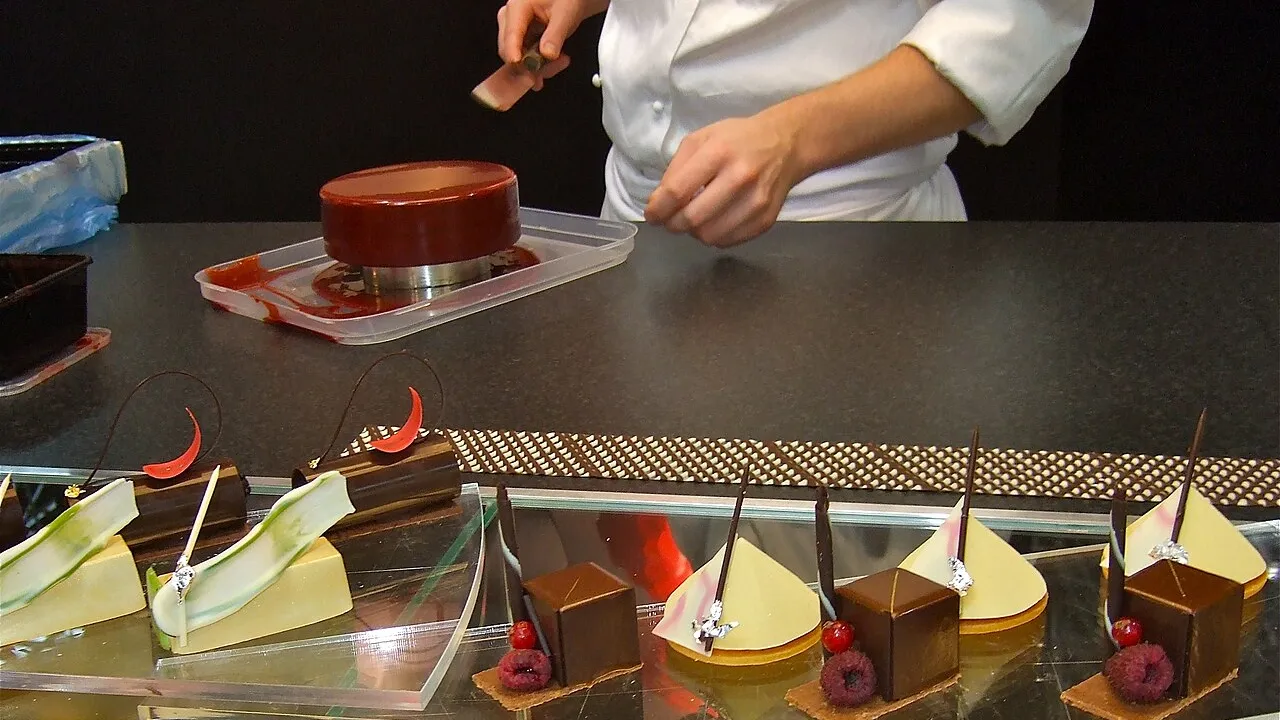
Heating and cooling chocolate for glossy snap
🪝
How do steam, stretchy flour webs, and shiny chocolate crystals work together in a bakehouse?
1
Stretchy Gluten Nets
Stretch a ball of bread dough between two floury hands and hold it toward the light—it forms a thin windowpane without tearing! Creating and controlling —stretchy protein webs formed when wheat flour meets water—is a key superpower of a pastry baker.
2
Chewy Bread vs. Tender Cake
Not every treat wants strong ! Chewy bagels need lots of kneading to build strong webs that trap gas bubbles. Delicate cupcakes and fruit tarts need gentle mixing and low-protein cake flour so every bite stays soft and crumbly.
3
Puffing Up with Steam
When cold butter folded inside puff pastry hits a 400-degree oven, the tiny water droplets inside the butter flash into steam—lifting dough layers sky-high without any yeast at all!
4
Snappy Shiny Chocolate
Pastry chefs also 'temper' melted chocolate—warming and cooling it to exact temperatures so cocoa crystals lock together with a glossy shine and crisp snap!
1. What lifts flaky puff pastry and pie crust layers up in a hot oven when there is no yeast inside?
2. Why does a pastry baker temper melted chocolate to exact temperatures?
🤯 Mind-Blowing Fact • Grade 4
Some artisan bakeries care for heirloom sourdough starters that have been fed continuously every single day for more than one hundred years!
✨ Word Sparks (Grade 4 Glossary)
Tap 🔊 to hear
fermentation
Microbes turning sugars into bubbles and flavor
proofing
Final warm rest letting shaped dough rise
hydration
Ratio of water weight to flour weight
🪝
How do 'baker's percentages,' wild sourdough microbes, and architecture help pastry bakers build showstopping desserts?
1
Living Starters and Proofing Rooms
Open a glass jar bubbling quietly on a bakery shelf and you'll meet a sourdough starter—a friendly ecosystem of wild yeasts and lactic-acid bacteria fed daily with flour and water! Tending that living culture inside temperature-controlled cabinets is part of the daily craft of an artisan baker and pastry baker.
2
The Universal Math of Baker's Percentages
Professional bakers around the world write formulas using baker's percentages, where total flour weight always equals 100 percent and every other ingredient is listed as a percentage of the flour! If a baguette formula calls for 70 percent , a baker using 10 kilograms of flour immediately knows to weigh 7 kilograms of water—making it effortless to scale from ten loaves to five hundred.
3
Inclusive Baking for Food Allergies
Modern pastry artists also apply food science to welcome guests with celiac disease or allergies—substituting almond, oat, or rice flours, aquafaba (whipped chickpea liquid that mimics egg whites!), and fruit pectins to craft delicious gluten-free and dairy-free treats.
4
Edible Architecture
For weddings and community celebrations, pastry chefs use wooden dowels, sugar-glass sculptures, and geometry so multi-tiered cakes stand tall and level!
1. In 'baker's percentages,' if a bread formula calls for 65% water and the baker uses 1,000 grams of flour, how much water is needed?
2. What surprising plant ingredient can pastry bakers whip into fluffy meringue peaks instead of egg whites?
🤯 Mind-Blowing Fact • Grade 5
Cocoa butter can crystallize into six different microscopic shapes, yet master chocolatiers and pastry bakers target exclusively 'Form V' crystals—the only form that snaps crisply in your hand and melts velvety-smooth at 93.8°F on your tongue!
✨ Word Sparks (Grade 5 Glossary)
Tap 🔊 to hear
lamination
Folding butter and dough into thin layers
gelatinization
Warm wet starch swelling to set crumb
oven spring
Rapid final dough rise inside hot ovens
🪝
Why is baking a three-stage chemical transformation where altitude, crystal polymorphism, and enzyme timing decide every crumb?
1
Inside the Deck Oven
Slide a scored boule of sourdough onto a 475-degree stone hearth and inject a burst of steam: in the first ten minutes, yeast activity surges () before halting around 140 degrees Fahrenheit, starch granules absorb water and gelatinize around 180 degrees, and surface sugars caramelize past 320 degrees into a crackling mahogany crust! Orchestrating all three thermal milestones at once defines the mastery of a pastry baker.
2
Pâtissier vs. Boulanger Traditions
In classical European guilds, baking branched into two twin disciplines that many modern artisans combine: the boulanger, specializing in fermented breads and laminated viennoiserie (croissants and brioche), and the pâtissier, crafting custards, pâte à choux éclairs, spun-sugar confections, and plated desserts.
3
Lamination and Crystal Polymorphism
Laminating croissant dough is pure materials engineering: folding a cold butter block into dough three successive times ($3^3 = 27$ butter layers!) creates alternating waterproof fat barriers and hydrated gluten sheets. Equally precise is chocolate tempering: cocoa butter can solidify into six different crystal shapes (Forms I through VI), yet only *Form V* melts smoothly at human body temperature (93 degrees Fahrenheit) while contracting cleanly from molds with a mirror gloss!
4
Adjusting for High Altitude and Humidity
Move a Virginia sea-level cake recipe to Denver, Colorado—one mile above sea level—and lower atmospheric pressure causes leavening gases to over-expand and collapse while water evaporates early! Skilled pastry chefs reduce baking powder, boost liquid slightly, and raise oven temperature so structure sets on time.
5
Craft, Heritage, and Joy
Blending grain-mill agronomy, organic chemistry, and sculptural design, pastry bakers turn humble harvests into centerpieces of human celebration.