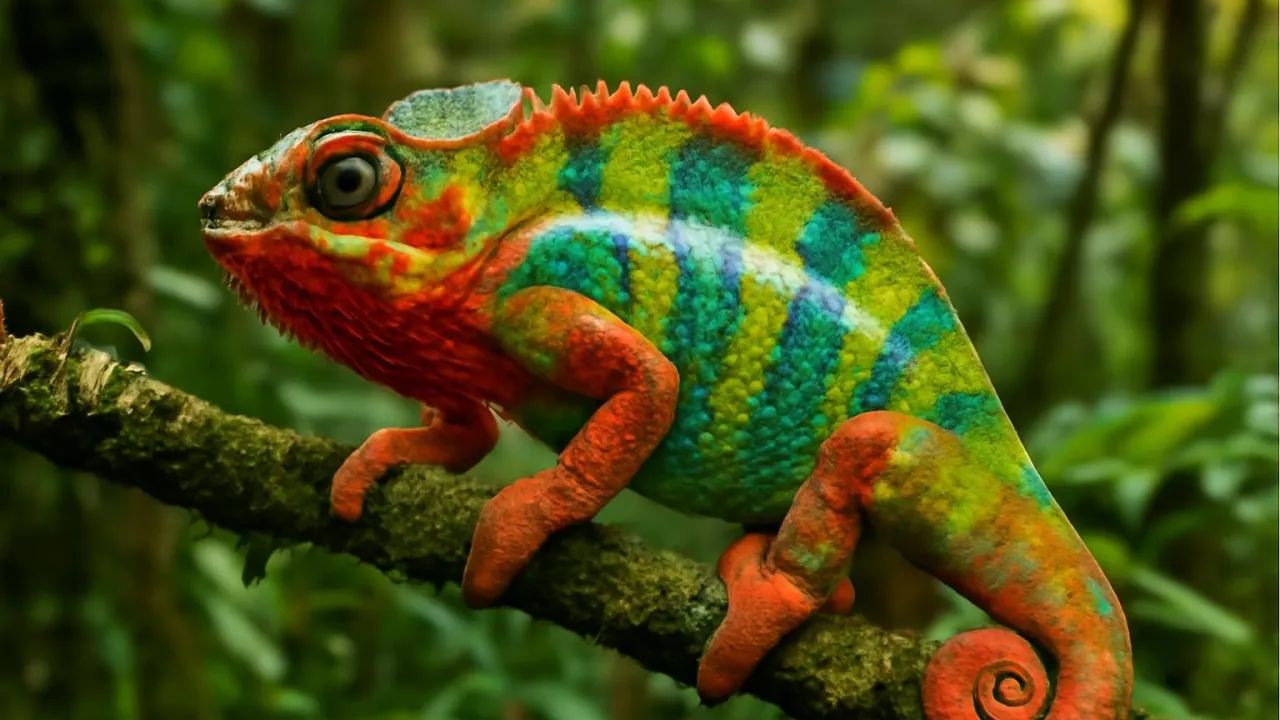
Panther chameleons can change their skin color to match their mood or surroundings!
✨ Word Sparks (Grade 2 Glossary)
Tap 🔊 to hear
predator
An animal that hunts other animals for food
insect
A small bug with six legs and wings
tongue
A long body part inside the mouth used to catch food
🪝
Have you ever seen a lizard change colors like a rainbow?
1
Colorful Skin
Panther chameleons live in Madagascar forests, where they show bright colors. They can be red, blue, or green, and their colors change to hide or talk to others.
2
Slow and Careful
These lizards move slowly on tree branches and use their curled tail to hold on tightly. They walk carefully to avoid and stay safe.
3
Bug Catchers
Panther chameleons eat like crickets and flies. They catch bugs with their long sticky that shoots out fast to grab food.
Panther chameleons can change colors using special skin cells called chromatophores!
✨ Word Sparks (Grade 3 Glossary)
Tap 🔊 to hear
camouflage
Colors that help animals hide in nature
prehensile
Able to grab or hold tightly, like a tail
nutrients
Food parts animals need to grow and be healthy
🪝
Did you know the panther chameleon can change colors to survive in the wild?
1
Amazing Color Changes
Panther chameleons can change their skin color to blend into their environment. This helps them hide from predators and sneak up on prey. Their skin contains special cells that reflect light to create different colors. Color changes also show their mood or help them communicate with other chameleons.
2
Slow and Careful Movement
These chameleons move slowly and carefully to avoid being seen by predators. They use their tail to grip branches tightly for balance. Their feet have two toes on each side to hold branches firmly. This adaptation helps them climb trees and stay safe in their forest habitat.
3
Catching Insects
Panther chameleons eat insects like crickets and flies to get . They use their long, sticky tongue to catch prey quickly from a distance. This fast tongue is an adaptation that helps them survive in the wild. Their sharp eyes can see insects clearly, even when hidden in leaves.
4
Life in Madagascar
Panther chameleons live only in Madagascar’s tropical forests, where it is warm and humid. This habitat provides plenty of insects and trees for climbing. The forest ecosystem supports many animals, including chameleons, birds, and frogs. Protecting this habitat is important for their survival.
1. What helps panther chameleons hide from predators?
2. How do panther chameleons catch insects?
🤯 Mind-Blowing Fact • Grade 4
Panther chameleons’ color changes can signal mood, temperature, or social status!
✨ Word Sparks (Grade 4 Glossary)
Tap 🔊 to hear
chromatophores
Skin cells that change color by reflecting light
arboreal
Living in trees or climbing on branches
deforestation
Cutting down forests that animals need to live
🪝
How does the panther chameleon’s color-changing ability help it survive in Madagascar’s forests?
1
Color Change and Communication
Panther chameleons change their skin color by expanding special cells called , which reflect light differently. This ability allows them to camouflage themselves from predators and prey, making it easier to survive. They also use color changes to communicate with other chameleons during mating or territorial disputes. Bright colors can signal aggression or readiness to mate, while dull colors show calmness.
2
Adaptations for Tree Life
Living in Madagascar’s tropical forests, panther chameleons have adapted to an lifestyle by developing strong, grasping feet with two toes on each side. Their prehensile tail acts like a fifth limb, helping them hold onto branches securely. These adaptations allow them to move slowly and carefully through the canopy to avoid predators and hunt insects. Their slow movements also prevent detection by both prey and enemies.
3
Role in the Ecosystem
Panther chameleons play an important role in controlling insect populations by feeding on crickets, flies, and other bugs. This helps maintain balance in the forest food web. In turn, they serve as prey for birds and snakes, contributing to the ecosystem’s health. Human activities like threaten their habitat, which can disrupt these natural relationships and endanger the species.
4
Geographic Distribution
Panther chameleons are native only to Madagascar, an island with unique biodiversity. They inhabit humid tropical forests mainly in the eastern and northern parts of the island. Their limited range makes them vulnerable to habitat loss and climate change. Conservation efforts focus on protecting these forests to ensure panther chameleons continue to thrive in the wild.
1. Why do panther chameleons change color besides hiding?
2. What threatens the panther chameleon’s habitat?
🤯 Mind-Blowing Fact • Grade 5
Panther chameleons use nanocrystals in their skin to change colors in less than a second!
✨ Word Sparks (Grade 5 Glossary)
Tap 🔊 to hear
iridophores
Skin cells with crystals that reflect light
endemic
Found only in one special place on Earth
insectivore
An animal that mainly eats insects
🪝
What scientific secrets allow the panther chameleon to change colors and thrive in Madagascar’s forests?
1
Scientific Classification and Habitat
The panther chameleon, scientifically named Furcifer pardalis, belongs to the Chamaeleonidae family and is to Madagascar’s tropical forests. This species inhabits humid, warm environments primarily in the island’s eastern and northern regions. Its restricted geographic range makes it particularly vulnerable to environmental changes and habitat destruction caused by human activities such as deforestation.
2
Physiological Mechanism of Color Change
Panther chameleons change color through the manipulation of nanocrystals within specialized skin cells called . By adjusting the spacing of these nanocrystals, the chameleon reflects different wavelengths of light, producing vivid colors ranging from blue to red. This physiological process allows rapid color shifts that serve multiple functions including camouflage, thermoregulation, and social signaling.
3
Conservation Challenges and Efforts
Despite their adaptability, panther chameleons face threats from habitat loss due to deforestation and illegal pet trade. Conservation programs in Madagascar aim to protect forest habitats and regulate trade to preserve wild populations. Public education and habitat restoration are critical to maintaining ecological balance and ensuring the species’ long-term survival in their native environment.
4
Ecological Role and Behavior
As , panther chameleons help control insect populations, impacting the forest food web significantly. Their slow, deliberate movements and prehensile tails aid in arboreal navigation and predator avoidance. Color changes also communicate mood, temperature regulation, and reproductive status, which are vital for social interactions and survival.
5
Quantitative Comparisons and Adaptations
Adult panther chameleons can reach lengths up to 20 inches (50 centimeters) and weigh around 3.5 ounces (100 grams). Their tongue can extend up to twice their body length in under 0.07 seconds to capture prey. They thrive in temperatures between 75 and 85 degrees Fahrenheit (24 to 29 degrees Celsius), showcasing remarkable physiological adaptations to their tropical environment.