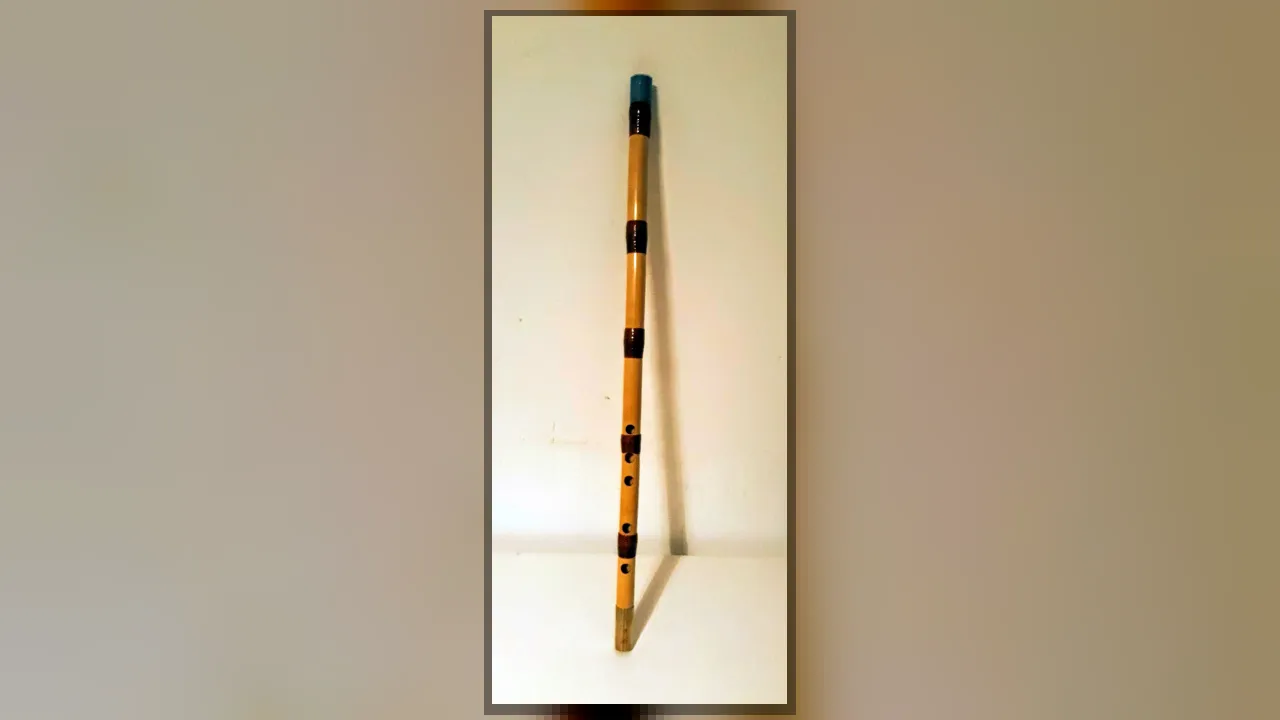
2. Where is the seventh finger hole hidden on a traditional ney?
🤯 Mind-Blowing Fact • Grade 2
The word ney comes from an ancient Persian word that simply means reed!
✨ Word Sparks (Grade 2 Glossary)
Tap 🔊 to hear
marsh
Wet muddy land where tall grasses grow
node
Natural ring joint on a plant stem
slant
A sloping angle that leans sideways
🪝
Why is a plain hollow reed one of the hardest flutes in the world to make a sound on at first?
1
Older Than the Pyramids
Long before pianos or guitars existed, shepherds along the Nile and Tigris rivers cut tall reeds to make music. Today, the ney is one of the oldest instruments still played around the world.
2
Nine Knots in One Cane
Makers harvest giant golden cane that grows with ring-shaped joints called . A classic Turkish or Arabic ney uses a stalk with exactly nine segments, hollowed cleanly from end to end.
3
Finding the Secret Angle
There is no whistle block inside to guide your breath. Musicians hold the tube at a and aim a thin stream of air across the top rim until a husky, glowing note blooms. Once found, that sweet sound feels peaceful and timeless.
1. How many natural cane segments are found in a classic traditional ney?
2. Why does making your first note on a ney take patient practice?
🤯 Mind-Blowing Fact • Grade 3
Thirteenth-century poet Rumi opened his famous masterpiece Masnavi with a poem praising the singing reed flute!
✨ Word Sparks (Grade 3 Glossary)
Tap 🔊 to hear
beveled
Cut with a smooth sloping edge
maqam
Traditional Middle Eastern system of musical scales
resonance
Rich echoing fullness of a musical sound
🪝
Why do Turkish, Arabic, and Persian masters play the same ancient cane flute with three different mouthpieces?
1
Breath and Wind Combined
Half airy whisper, half golden bell—that unmistakable sound greets listeners whenever a ney begins a solo. Because air splits directly across an open rim, gentle breath noise blends naturally with clear musical tones.
2
Three Regional Styles
Across the Middle East, neighbors adapted the cane rim in clever ways. Arabic players blow across bare reed, while Turkish masters add a flared rim cap called a baspare for rich . Even more amazingly, Persian players tuck a thin metal-sleeved rim right behind their upper front teeth!
3
Overblowing into Higher Registers
With only six front holes and one high thumb hole, fingerings alone cover just a few steps. By tightening the embouchure and increasing breath speed, musicians overblow into higher harmonics spanning nearly three octaves.
4
Poetic Soul of Maqam
Subtle tilts of the head raise or lower pitches by tiny fractions, bringing Middle Eastern melodic modes called to vivid life. Paired with plucked lutes like the oud and gentle frame drums, the ney weaves calm, meditative songs across centuries.
1. How is the Persian style of playing the ney unique among flutes?
2. How does a ney player adjust tiny pitch shades needed for a maqam?
🤯 Mind-Blowing Fact • Grade 4
Professional ney players often carry a quiver of seven to twelve flutes of different lengths so they can match any singer's vocal range!
✨ Word Sparks (Grade 4 Glossary)
Tap 🔊 to hear
oblique
Held at a slanted diagonal angle
taqsim
Expressive solo musical improvisation in Middle Eastern tradition
transpose
Shift a melody higher or lower in pitch
🪝
How did a humble marsh reed outlast empires to become the centerpiece of Middle Eastern classical acoustics?
1
Five Millennia of Continuity
Walk past museum reliefs carved in Old Kingdom Egypt around 3000 BCE and you will spot court musicians holding long flutes identical in principle to modern instruments. Few acoustic designs in human history have survived nearly five millennia across Egypt, Mesopotamia, Persia, and Anatolia without needing mechanical redesign.
2
Anatomy of Arundo Donax
Artisans harvest giant reed cane, Arundo donax, drying straight stalks in cool shade before piercing the internal diaphragms of nine natural internodes. Instead of uniform machine drilling, those slight organic variations inside each chamber scatter high frequencies just enough to wrap every pitch in a warm, smoky halo.
3
Rim-Blown Acoustics and Consort Sizes
Because a keyless cane cannot easily into distant keys without losing pure intonation, professional ensembles keep an entire family of neys of varying lengths. A long Turkish Mansur ney speaks in solemn baritone tones around A3, whereas a shorter Bolahenk or Shah ney sings higher with agile brilliance to match different vocalists.
4
Interdental vs. Bilabial Mastery
Whether cradling a polished horn baspare against pursed lips in Istanbul, blowing bare cane in Cairo, or guiding air between the upper incisors in Tehran, virtuosos exploit overblown second, third, and fourth harmonics to weave meditative solo improvisations called that explore every emotional corner of a scale.
1. Why do master ney musicians own many flutes of different lengths?
2. What gives the ney its signature smoky, breath-infused tone color?
🤯 Mind-Blowing Fact • Grade 5
New cane flutes soak up oils—makers regularly pour sweet almond or sesame oil through the bore to seal microscopic pores and sweeten the acoustic response!
✨ Word Sparks (Grade 5 Glossary)
Tap 🔊 to hear
internode
Smooth stem section between two plant knots
formants
Resonant frequency bands shaping an instrument's voice
equal temperament
Tuning system dividing octaves into twelve equal steps
🪝
How does an unadorned stalk of Arundo donax unlock microtonal intervals and harmonic registers without a single moving part?
1
Oblique Rim Aeroacoustics
From the opening breath of a solo improvisation, listeners hear both turbulent wind and crystalline pitch fused into one voice. Organologists classify the ney under Hornbostel-Sachs 421.111.12: an open, end-blown flute with finger holes. Tilting the axis roughly thirty to forty-five degrees lets the musician direct a narrow air jet obliquely across the beveled rim, exciting longitudinal waves inside an open-open tube.
2
Harmonic Series Overreliance
Unlike modern Boehm flutes whose wide tone holes emphasize the lowest fundamental register, much of the ney's expressive core lives in its overblown second, third, and fourth harmonics. Shifting breath pressure alters the harmonic mode effortlessly, spanning roughly two and a half to three octaves—from raspy, vocal fundamentals near 220 hertz on longer Mansur canes up past 1,500 hertz.
3
Internal Node Geometry
Selected stalks of Arundo donax must divide into nine proportional , with the rear thumb hole positioned symmetrically above six frontal apertures grouped in two triads. When makers sear open the internal nodal rings, subtle constrictions remain inside the bore; acousticians note that these micro-baffles stabilize overblown harmonics, temper bore impedance, and enrich high-frequency .
4
Divergent Embouchure Traditions
Regional organology branched into distinct acoustic solutions across West Asia and North Africa: Levantine and Egyptian Arabic nays preserve the raw beveled reed; Ottoman Turkish instruments crown the proximal end with a conical water-buffalo horn or delrin baspare that cushions the lips and amplifies mid-band warmth; Iranian neys armor the rim in thin brass so players can wedge the edge behind their upper incisors, steering the airstream with the tongue to jump seamlessly between gritty chest-like fundamentals and pure upper partials.
5
Microtonal Precision in Modal Music
Turkish makam, Arabic maqam, and Persian dastgah systems demand neutral thirds and subtle comma inflections—such as fifty-three-comma octave divisions—absent from twelve-tone . By combining precise axial head rotation with fractional hole shading, virtuosos navigate delicate intervals that have captivated listeners from ancient Memphis and Sufi Mevlevi sanctuaries to modern concert halls.