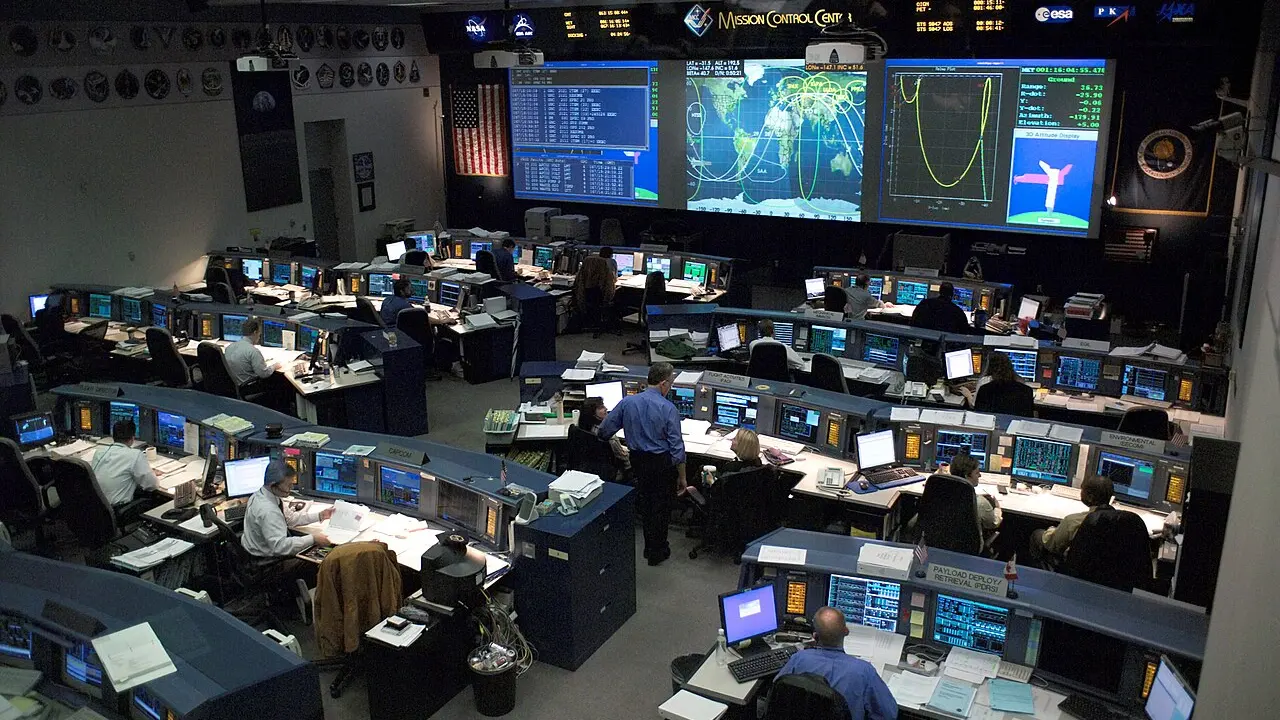
1. Why does the leader poll every desk to hear 'Go!' before rocket liftoff?
2. When do helpers inside Mission Control watch over astronauts in orbit?
🤯 Mind-Blowing Fact • Grade 2
During the 1969 Apollo 11 Moon landing, twenty-six-year-old specialist Steve Bales and Flight Director Gene Kranz had just seconds to recognize a computer overload alarm and make the safe call to land!
✨ Word Sparks (Grade 2 Glossary)
Tap 🔊 to hear
console
A multi-screen desk monitoring spacecraft systems
call sign
A short radio nickname for each control desk
checklist
Ordered steps checked off so nothing is missed
🪝
Imagine being the orchestra conductor for a rocket flying seventeen thousand miles per hour!
1
Like Conducting an Orchestra
Inside a quiet room glowing with giant curved screens, dozens of specialists watch streams of numbers from outer space. Leading that whole team with a calm voice over a headset is a mission control flight director.
2
Every Desk Watches One Job
No single person could track all thousands of spacecraft parts alone! One desk checks solar batteries, another tracks rocket steering, and another monitors clean cabin air. Each specialist reports right to the flight director.
3
Practicing Surprise Problems
Months before liftoff, trainers sneak pretend alarms into practice simulators. Practicing tough surprises teaches the whole team to stay cool, listen closely, and keep astronauts safe.
1. Why does Mission Control divide spacecraft monitoring across many specialized desks?
2. Why do trainers run pretend alarms during practice simulations before a real flight?
🤯 Mind-Blowing Fact • Grade 3
Virginia native Chris Kraft—born in Phoebus, Hampton—invented the entire concept of NASA Mission Control and served as America's very first Flight Director!
✨ Word Sparks (Grade 3 Glossary)
Tap 🔊 to hear
telemetry
Live spacecraft sensor readings beamed down by radio
CAPCOM
The controller who speaks directly to astronauts
splashdown
Parachute landing of a space capsule in ocean water
🪝
How did calm teamwork on Earth rescue three astronauts 200,000 miles away when an oxygen tank ruptured on Apollo 13?
1
The Calmest Voice in the Room
Look across NASA's Christopher C. Kraft Jr. Mission Control Center in Houston or Wallops Range Control in Virginia: lines of glowing orbital arcs sweep across a giant map of Earth. Sitting at the 'FLIGHT' console, a mission control flight director holds final responsibility for every decision affecting crew safety and mission success.
2
Decoding Radio Call Signs
Over crisp audio loops, controllers speak in short call signs to save precious seconds. FIDO calculates exact orbital paths, EECOM watches cabin air and cooling, EGIL tracks electrical power, and —often a fellow astronaut—talks directly with the crew in space.
3
Apollo 13's Finest Hour
When an oxygen tank ruptured aboard Apollo 13 halfway to the Moon in 1970, Flight Directors Gene Kranz, Glynn Lunney, Milt Windler, and Gerry Griffin led round-the-clock shifts. Engineers built an emergency air-scrubber adapter out of cardboard, tape, and a sock—and radioed instructions that brought all three astronauts safely home!
4
Foundations of Space Teamwork
Every flight director lives by famous core values: discipline, competence, confidence, toughness, and teamwork—listening to the quietest expert in the room whenever data speaks.
1. Which Mission Control specialist speaks directly on the radio with the astronauts in orbit?
2. How did Mission Control save the Apollo 13 crew after an oxygen tank failed in deep space?
🤯 Mind-Blowing Fact • Grade 4
Flight Directors write massive 'Flight Rules' books listing thousands of pre-planned 'If X happens, do Y' decisions so nobody has to argue from scratch during a three-second launch emergency!
✨ Word Sparks (Grade 4 Glossary)
Tap 🔊 to hear
flight rules
Pre-agreed emergency decisions written before launch day
orbital debris
Old satellite fragments circling fast around Earth
voice loop
A shared headset audio channel linking control desks
🪝
How do you steer a spacecraft safely around a tiny paint fleck hurtling toward it faster than a speeding bullet?
1
Virginia Roots of Mission Control
Before Houston ever echoed with 'Go for launch,' Virginia aerospace engineer Chris Kraft grew up beside Hampton Roads, graduated from Virginia Tech, and joined Langley Research Center. Realizing human spaceflight moved far too fast for slow committee meetings, Kraft invented real-time Mission Control—establishing the decisive role of the mission control flight director.
2
Listening to Twenty Conversations at Once
Step behind the FLIGHT console today, and you will see an astonishing feat of focus. Through a multi-channel headset matrix, the flight director monitors multiple simultaneously while watching live telemetry from the International Space Station, commercial crew capsules, or cargo rockets lifting off from Virginia's Wallops Island. Backroom engineering teams crunch deeper math behind every front-room desk.
3
Dodging Orbital Debris
Even a millimeter-sized fleck of old satellite paint orbiting at 17,500 miles per hour packs kinetic punch! Whenever space-tracking radar predicts debris passing too close to the station's safety box, the flight director coordinates trajectory specialists and international partner centers in Munich, Tsukuba, and Moscow to fire thrusters for a precise Debris Avoidance Maneuver.
4
Psychological Safety Saves Lives
Great flight directors never rule by fear. Instead, they foster a culture where the newest junior engineer feels empowered to speak up immediately if a single pressure graph looks off by half a percent.
1. Why did Virginia engineer Chris Kraft invent real-time Mission Control?
2. Why do flight directors write thick books of 'Flight Rules' months before a rocket ever launches?
🤯 Mind-Blowing Fact • Grade 5
On Apollo 12 in 1969, lightning struck the Saturn V rocket twice right after liftoff, scrambling every display—until flight controller John Aaron calmly told the Flight Director 'Try SCE to Aux,' saving the entire Moon mission in seconds!
✨ Word Sparks (Grade 5 Glossary)
Tap 🔊 to hear
fault tree
A logic chart mapping every cause of system failures
light-minute
Distance radio or light waves travel in sixty seconds
Go/No-Go
A strict readiness poll verifying safety before proceeding
🪝
How will Mission Control lead human explorers on Mars when a single radio message takes twenty-two minutes just to arrive?
1
Systems Integration in Real Time
During the final minutes of an orbital docking or lunar descent, tens of thousands of telemetry parameters—propellant pressures, star-tracker quaternions, thermal-loop flow rates, and cabin partial pressures—stream across fiber and Tracking and Data Relay Satellites every second. Synthesizing inputs from two dozen discipline consoles into crisp, irreversible calls is the responsibility of a mission control flight director.
2
Fault Trees and Pre-Planned Flight Rules
Human brains under sudden stress can suffer tunnel vision, so spaceflight operations rely on rigorous systems thinking. Before any vehicle clears the tower, flight directors and systems engineers construct exhaustive ''—tracing how a single shorted valve could cascade across electrical, thermal, and guidance buses—and codify thousands of binding Flight Rules.
3
SimSup Torture Tests
Flight directors earn certification only after hundreds of hours in 'integrated simulations' run by Simulation Supervisors (SimSups), who inject compound hardware failures, telemetry dropouts, and cabin leaks simultaneously. Controllers are graded not on never facing problems, but on cross-checking raw physics rather than trusting a single faulty sensor.
4
International Coordination Across Time Zones
Modern human spaceflight is global. Houston's Flight Control Room coordinates continuously with payload operations in Huntsville, space-launch ranges at Cape Canaveral and Virginia's Wallops Flight Facility, and partner control centers in Europe, Japan, and Canada—managing complex solar-power attitude constraints and robotic berthings.
5
Adapting for Deep-Space Light Delays
While radio signals reach Low Earth Orbit in milliseconds and the Moon in 1.3 seconds, Mars lies four to twenty-two away! Today's flight directors are pioneering asynchronous mission operations and onboard AI fault-isolation tools so future Martian crews and Earth teams collaborate seamlessly across interplanetary distances.