⚡ Everyday Impact SparkUncovers how ocean creatures—from glowing deep-sea jellies to giant blue whales—survive and keep seas healthy
🤯 Mind-Blowing Fact • Grade 1
Marine biologists write notes underwater using ordinary graphite pencils on white plastic slates because ink pens wash away!
✨ Word Sparks (Grade 1 Glossary)
Tap 🔊 to hear
coral reef
colorful underwater home built by tiny animals
scuba
breathing tank gear for swimming underwater
tide pool
rocky beach puddle holding sea stars
🪝
What is it like to put on flippers and write notes underwater beside sea turtles?
1
Bubbles Over the Coral Reef
Bloop, bloop! Silver air bubbles float up through clear blue water. Wearing fins, a mask, and an air tank, an ocean life scientist glides past rainbow fish!
2
Waterproof Pencils and Whale Songs
Special plastic slates let divers write notes right underwater! Up on the boat, underwater microphones listen to humpback whales sing.
3
Helping Ocean Homes Thrive
Studying crabs, dolphins, and colorful helps us keep their salty ocean homes clean and safe!
1. How do ocean life scientists take notes while diving underwater?
2. What tool lets scientists on a boat hear whales singing underwater?
🤯 Mind-Blowing Fact • Grade 2
Colorful corals look like bumpy rocks or flowers, yet every reef is actually built by millions of tiny cousin animals to jellyfish!
✨ Word Sparks (Grade 2 Glossary)
Tap 🔊 to hear
hydrophone
special microphone built to listen underwater
kelp
giant brown seaweed growing in underwater forests
nursery
safe place where young organisms grow strong
🪝
How can you track where a sea turtle or whale swims without ever hurting its skin?
1
From Tide Pools to Kelp Forests
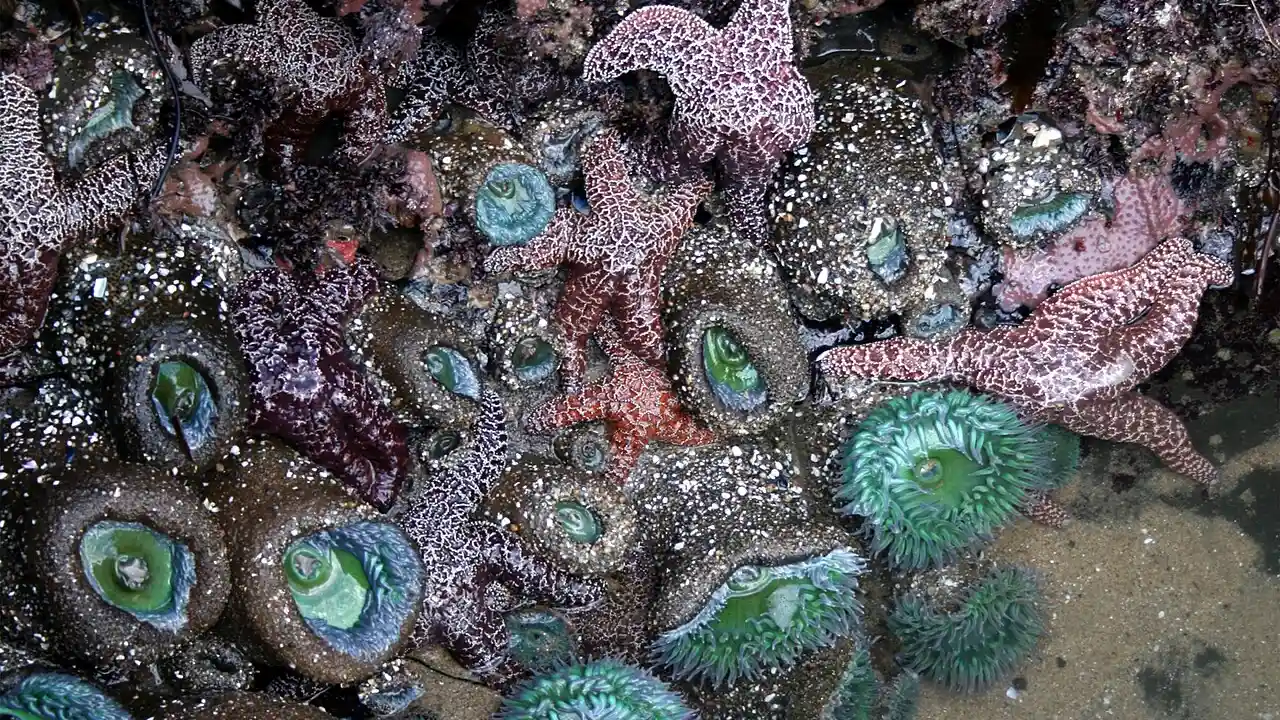
Low tide uncovers rocky tide pools packed with clinging sea stars, anemones, and scuttling hermit crabs. Whether kneeling on wet coastal rocks or diving beneath swaying forests, ocean life scientists study how saltwater plants and animals depend on one another.
2
Gentle Suction-Cup Tags
How deep does a humpback whale dive for lunch? Leaning carefully from an inflatable boat, researchers press soft rubber suction-cup tags onto a whale's back with a long pole! Hours later, the tag pops off harmlessly and floats up with video and dive logs.
3
Growing Baby Corals
Many specialists also tend underwater 'coral nurseries,' growing healthy reef branches and attaching them to damaged reefs so fish return!
1. How do soft suction-cup tags stay on a whale without hurting it?
2. What are colorful reef-building corals actually made of?
🤯 Mind-Blowing Fact • Grade 3
One single adult Eastern oyster in the Chesapeake Bay can filter and clean up to fifty gallons of cloudy bay water every single day!
✨ Word Sparks (Grade 3 Glossary)
Tap 🔊 to hear
bioluminescence
natural light made inside living creatures
phytoplankton
microscopic ocean drifters making food from sunlight
food web
connected network showing what eats what
🪝
How can a single cup of plain seawater tell a scientist every fish and shark that swam past an hour ago?
1
Tiny Plankton Anchor Giant Food Webs
Everyone loves charismatic dolphins, sea otters, and manta rays—yet a huge share of marine biology happens under microscopes! Sunlit surface waters teem with , microscopic plant-like drifters that use photosynthesis to feed krill, small fish, and even filter-feeding blue whales.
2
Finding Clues With Environmental DNA
What if a rare shark or shy octopus hides whenever divers swim nearby? Today's scientists scoop a bottle of seawater, pump it through a fine filter, and sequence 'environmental DNA'—tiny shed skin and mucus cells floating in the water—revealing every species that visited recently!
3
Glowing Creatures of the Midnight Zone
Below 650 feet, sunlight fades into the twilight and midnight zones. Using gentle deep-sea cameras, researchers discover Comb jellies, lanternfish, and vampire squid that flash their own chemical light—called —to communicate or confuse predators.
4
Restoring Oysters and Seagrass
Closer to home in bays like Virginia's Chesapeake, biologists restore seagrass meadows for blue crabs and build oyster reefs where a single adult oyster filters up to fifty gallons of water a day!
1. How does 'environmental DNA' (eDNA) let biologists spot shy sea creatures without catching them?
2. How do restored oyster reefs help clean coastal bays like Virginia's Chesapeake Bay?
🤯 Mind-Blowing Fact • Grade 4
Roughly eighty percent of all deep-sea organisms studied by marine biologists in the ocean's twilight and midnight zones can make their own glowing bioluminescent light!
✨ Word Sparks (Grade 4 Glossary)
Tap 🔊 to hear
symbiosis
close partnership helping two different species survive
aquanaut
scientist living and working in underwater habitats
pelagic
living out in open ocean waters
🪝
How did pioneers Rachel Carson and Sylvia Earle inspire the world to protect ocean food webs from surface tide pools to dark sea trenches?
1
Pioneers Who Opened Ocean Eyes
Before Rachel Carson became famous for environmental conservation, she began her career as an aquatic biologist editing marine publications and writing The Sea Around Us in 1951, awakening millions of readers to ocean wonder. Decades later, marine botanist and explorer Sylvia Earle—nicknamed 'Her Deepness'—led an all-female team of living underwater in the Tektite II habitat and walked untethered on the seafloor 1,250 feet down in an armored JIM suit!
2
Coral Symbiosis and Heat Stress
Modern marine biologists investigate delicate partnerships that hold whole ecosystems together. Reef-building corals house microscopic algae called zooxanthellae inside their tissues: the algae share sugars made from sunlight, giving corals vibrant colors and ninety percent of their energy! When marine heatwaves warm tropical seas too long, stressed corals expel their algae and turn ghostly white—a crisis called coral bleaching—prompting biologists to breed naturally heat-tolerant coral strains.
3
Satellite Bio-Logging Across Ocean Basins
Tracking migratory —like leatherback sea turtles, bluefin tuna, and North Atlantic right whales—takes satellite telemetry and photo-identification catalogs. Just as humans have unique fingerprints, humpback whales have one-of-a-kind fluke tail patterns and white sharks have distinct dorsal fin notches!
4
Sustainable Fisheries and Marine Protected Areas
Working with commercial watermen from New England to Virginia's Eastern Shore, fisheries biologists survey juvenile crab and striped bass populations to set science-based catch limits and turtle-excluder net designs so seafood harvests stay abundant for future generations.
1. Why does 'coral bleaching' happen when ocean water stays too warm for weeks?
2. How do researchers recognize individual humpback whales year after year without tagging every whale?
🤯 Mind-Blowing Fact • Grade 5
Green Fluorescent Protein (GFP), first discovered in glowing Pacific crystal jellyfish, won the 2008 Nobel Prize because doctors and geneticists now use it to light up living human cells under microscopes!
✨ Word Sparks (Grade 5 Glossary)
Tap 🔊 to hear
keystone species
organism holding an entire ecosystem in balance
rebreather
bubble-free diving gear recycling exhaled breathing gas
metagenomics
sequencing all DNA inside an environmental sample
🪝
Why did a glowing jellyfish tide-pool protein win a Nobel Prize—and what else are marine biologists discovering in Earth's largest biosphere?
1
Life Across Ninety-Nine Percent of Living Space
Measured by three-dimensional volume rather than flat map area, Earth's oceans—averaging 3,688 meters deep—represent more than ninety-five percent of all habitable living space on our planet! Yet scientists estimate hundreds of thousands of eukaryotic marine species and millions of marine microbes remain undescribed. Marine biologists integrate molecular genomics, comparative physiology, bioacoustics, and quantitative population modeling to understand how life adapts across extremes from freezing Antarctic brines to crushing hadal trenches.
2
Marine Biotechnology and the Nobel Jellyfish
Curiosity-driven marine biology repeatedly transforms human medicine. While collecting crystal jellyfish (Aequorea victoria) off Washington's Friday Harbor in the 1960s, researcher Osamu Shimomura isolated Green Fluorescent Protein (GFP)—a discovery that earned the 2008 Nobel Prize in Chemistry after geneticists learned to attach glowing GFP markers to watch human brain neurons, insulin cells, and viruses work in real time! Similarly, blue horseshoe crab hemolymph safeguards hospital vaccines against bacterial toxins, and cone-snail peptides inspire non-addictive pain medicines.
3
Trophic Cascades and Kelp Forest Ecology
Field ecologists using closed-circuit —which recycle exhaled breath silently without scaring fish with noisy bubbles—have revealed powerful trophic cascades. Along Pacific rocky coasts, sea otters act as a keystone predator by eating spiny sea urchins; when otters vanish, unchecked urchin 'barrens' devour giant Macrocystis kelp forests that otherwise sequester carbon and shelter hundreds of fish species.
4
Passive Acoustic Networks and Metagenomics
Modern marine censuses combine non-invasive tech: seafloor hydrophone arrays coupled with machine-learning algorithms track critically endangered North Atlantic right whales migrating past busy Mid-Atlantic shipping lanes so vessels automatically slow down, while shotgun eDNA metabarcoding profiles entire coral-reef microbiomes from two liters of filtered water.
5
Assisted Evolution and Blue Carbon Conservation
Confronting ocean warming, deoxygenation, and acidification, conservation marine biologists pioneer 'assisted evolution'—culturing heat-resilient Cladocopium algal symbionts for reef restoration—while mapping coastal seagrass, mangrove, and salt-marsh 'blue carbon' reserves that lock away carbon up to ten times faster per acre than terrestrial forests.