1. What wraps around marimba mallets to help make a soft, warm sound?
2. How many mallets do marimba players often hold at the same time to play chords?
🤯 Mind-Blowing Fact • Grade 2
In Guatemala, the marimba is so beloved as the national instrument that ensembles of three or four musicians often stand side by side playing one long marimba together!
✨ Word Sparks (Grade 2 Glossary)
Tap 🔊 to hear
mellow
Smooth, gentle, and warm to listen to
bass
The lowest, deepest notes in music
soloist
A musician performing a piece all alone
🪝
Why does a marimba sound warm and mellow like hot cocoa while a xylophone pops like bright fireworks?
1
A Gentle Giant Made of Wood
Booooom-hum! Step close to a concert marimba and you might feel its lowest notes tickle your ribs! Though it looks like a supersized xylophone, its voice is far deeper, smoother, and rounder.
2
Wide Thin Bars and Tall Tubes
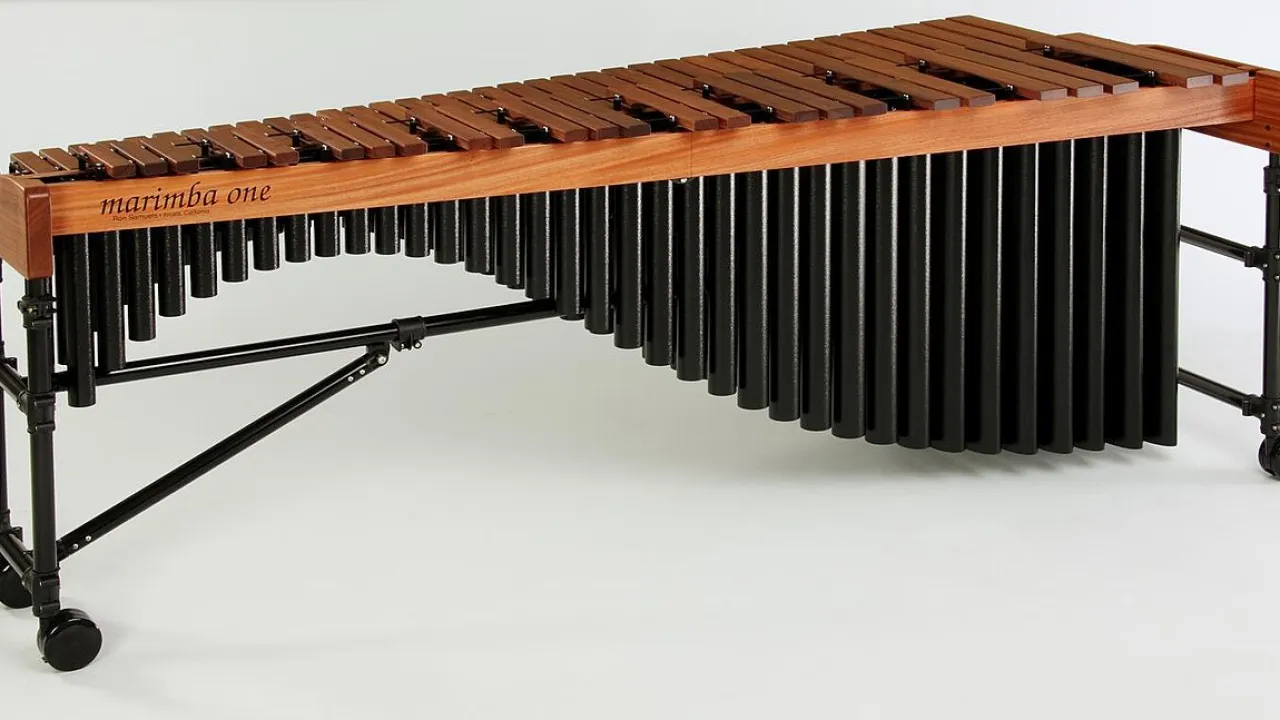
Marimba builders carve wider, thinner rosewood bars with a deep scoop underneath so the wood bends easily into low pitches. Beneath the end, golden metal tubes reach nearly to the stage floor, swelling every quiet vibration into a rich hum.
3
Dancing With Four Mallets
Instead of hard plastic sticks, players use mallets wrapped in soft yarn. By holding two mallets in each hand, one can play notes and singing melodies together!
1. How are marimba bars shaped differently from xylophone bars?
2. In which country is the marimba celebrated as the treasured national instrument?
🤯 Mind-Blowing Fact • Grade 3
In 1935, American inventor Clair Omar Musser assembled a one-hundred-piece International Marimba Symphony Orchestra that performed on stages from Chicago to Carnegie Hall!
✨ Word Sparks (Grade 3 Glossary)
Tap 🔊 to hear
resonance
Rich boosting of sound inside a hollow space
chromatic
Including all twelve sharp, flat, and natural notes
flexible
Able to bend slightly without snapping apart
🪝
How can a single percussionist weave bass lines, harmonies, and soaring melodies across eight feet of rosewood?
1
The Pipe Organ of the Forest
Close your eyes when four yarn mallets roll gently across a concert marimba, and you might swear a warm wooden cathedral organ is breathing onstage! No other mallet percussion instrument spans from rumbling cello-deep bass all the way up to sparkling birdlike highs.
2
Secret Scoops and Tuned Air Columns
Every rosewood or padauk bar is carefully carved with a deep arch underneath its center. Carving away wood makes the bar more , lowering its pitch without needing twelve-foot planks! Directly below each bar hangs a hollow aluminum or brass resonator tube sealed at the bottom, sized so the air inside vibrates in with the wood above.
3
Four-Mallet Grip Magic
Using clever finger techniques, marimbists hold two mallets in each hand and spread or narrow the distance between them in midair. Soft yarn or cord wrapped around rubber cores cushions each strike, smoothing away harsh clicks.
4
From West Africa to the Americas
Centuries ago, enslaved African artisans brought gourd-resonated xylophone traditions to Central America and southern Mexico. Indigenous Mayan and Mexican builders adapted local hormigo wood and carved cedar boxes, giving birth to the modern marimba!
1. Why do builders carve a deep arch underneath the middle of a marimba bar?
2. Which two regions' musical traditions blended in Central America to create the modern marimba?
🤯 Mind-Blowing Fact • Grade 4
Traditional Central American marimbas glue a tiny patch of delicate pig-intestine membrane called tela over a wax ring on each wooden resonator box to add a prized, festive buzz known as charleo!
✨ Word Sparks (Grade 4 Glossary)
Tap 🔊 to hear
parabolic
Shaped like a smooth, symmetrical U-like curve
wavelength
Distance one complete sound wave travels through air
octave
Span from one note to double its frequency
🪝
Why does hot concert-hall lighting change how a marimba's metal tubes match its wooden bars?
1
Five Octaves of Singing Hardwood
Step before a five- concert grand marimba and you face a sweeping sculpture more than two and a half meters wide! Starting down at C2—two octaves below middle C, matching the lowest string of a cello—sixty-one graduated rosewood bars climb smoothly to C7, letting soloists transcribe Bach lute suites and rich contemporary concertos.
2
Double-Octave Harmonic Carving
What gives the marimba its lush, velvety voice compared with the snappy xylophone? Builders mill a deep arch under each bar that tunes not only the fundamental pitch, but also the first prominent overtone precisely two higher—a four-to-one frequency ratio! Because two octaves blend seamlessly to the human ear, every struck note sounds pure, round, and resonant rather than edgy.
3
Temperature, Air Speed, and Adjustable Stops
Beneath the bars hang closed-bottom brass or aluminum resonators equal to one quarter of each note's sound . Curiously, room temperature affects wood and air in opposite ways: warm stage lights make air molecules move faster, raising the resonator tube's pitch slightly, while slight expansion softens the wood's pitch! High-end marimbas include movable rubber plugs inside the tubes so players can fine-tune resonance to any hall.
4
Chiapas, Guatemala, and the Chromatic Leap
Growing from West African balafon ancestors in seventeenth-century Chiapas and Guatemala, traditional marimbas originally used buzzing wax-and-membrane holes on wooden box resonators. In the 1890s, Guatemalan builder Sebastián Hurtado added a second row of sharp-and-flat bars, unlocking full chromatic repertoire.
1. How is a marimba bar's main overtone tuned to give it such a warm, pure sound?
2. Why do concert marimbas often have adjustable plugs at the bottoms of their resonator tubes?
🤯 Mind-Blowing Fact • Grade 5
On a concert marimba's lowest C2 bar, the sound wave in air is over five meters long—meaning its quarter-wavelength brass resonator tube must stretch more than four feet tall beneath the frame!
✨ Word Sparks (Grade 5 Glossary)
Tap 🔊 to hear
polyphonic
Weaving multiple independent musical lines at once
partials
Individual component frequencies inside a complex tone
contrapuntal
Combining distinct melodies that move independently together
🪝
How do parabolic bar carving, quarter-wavelength acoustics, and independent four-mallet mechanics turn planks of tropical timber into a polyphonic concert grand?
1
Polyphonic Architecture in Tropical Timber
Watch a virtuoso marimbist glide across a five-octave concert grand and four yarn-wrapped mallets seem to blur into eight! Spanning sixty-one bars from C2 (65.4 hertz) to C7 (2,093 hertz) across roughly 2.55 meters of width, the modern concert marimba commands the harmonic range of a string quartet within a single acoustic idiophone.
2
Triple-Harmonic Tuning and Flexural Physics
Left rectangular, a slab of Dalbergia stevensonii (Honduras rosewood) or African padauk vibrates with discordant transverse bending modes. Master tuners sculpt a deep, multi-contoured parabolic undercut beneath the center and shoulders of each bar, simultaneously reducing central stiffness to reach low bass frequencies and aligning the upper . On premier concert marimbas, builders achieve 'triple tuning': the fundamental (1f), the second partial at the double octave (4f), and even the third partial at three octaves plus a major third (10f) lock into consonant alignment, yielding velvety warmth.
3
Quarter-Wavelength Helmholtz & Pipe Coupling
Suspended along nodal lines 22.4 percent from each bar's ends, the keyboard floats above vertical aluminum or brass tubes sealed at their lower tips. Each cylinder acts as a stopped quarter-wavelength resonator; for low C2 (wavelength ~5.27 meters in 20°C air), a straight tube requires roughly 1.3 meters of vertical clearance, prompting builders to miter or curve bass tubes near the floor. Close coupling trades extended sustain for rich fundamental projection, and adjustable stoppers compensate when rising hall temperatures accelerate the speed of sound in air.
4
Stevens and Burton Four-Mallet Kinematics
Twentieth-century pioneers transformed mallet technique from two-stick melody playing into mastery. Cross-stick grips such as the Burton grip and independent grips such as Leigh Howard Stevens's method allow isolated finger rotation to fire inner and outer mallets across intervals exceeding an octave in one hand, while multi-tonal mallets—wound tightly over rubber cores—shift brightness dynamically from whisper-soft rolls to percussive accents.
5
Diasporic Synthesis Across Three Continents
Rooted in West African gourd-resonated xylophones carried across the Atlantic, the marimba took new shape in seventeenth-century Chiapas and Guatemala as African and Mayan craftspeople fashioned hormigo bars over cedar cajones with buzzing mirliton membranes. Sebastián Hurtado's 1894 chromatic marimba doble and early twentieth-century North American innovations by Deagan and Clair Omar Musser propelled the instrument onto international concerto stages through composers like Darius Milhaud, Keiko Abe, and Eric Ewazen.