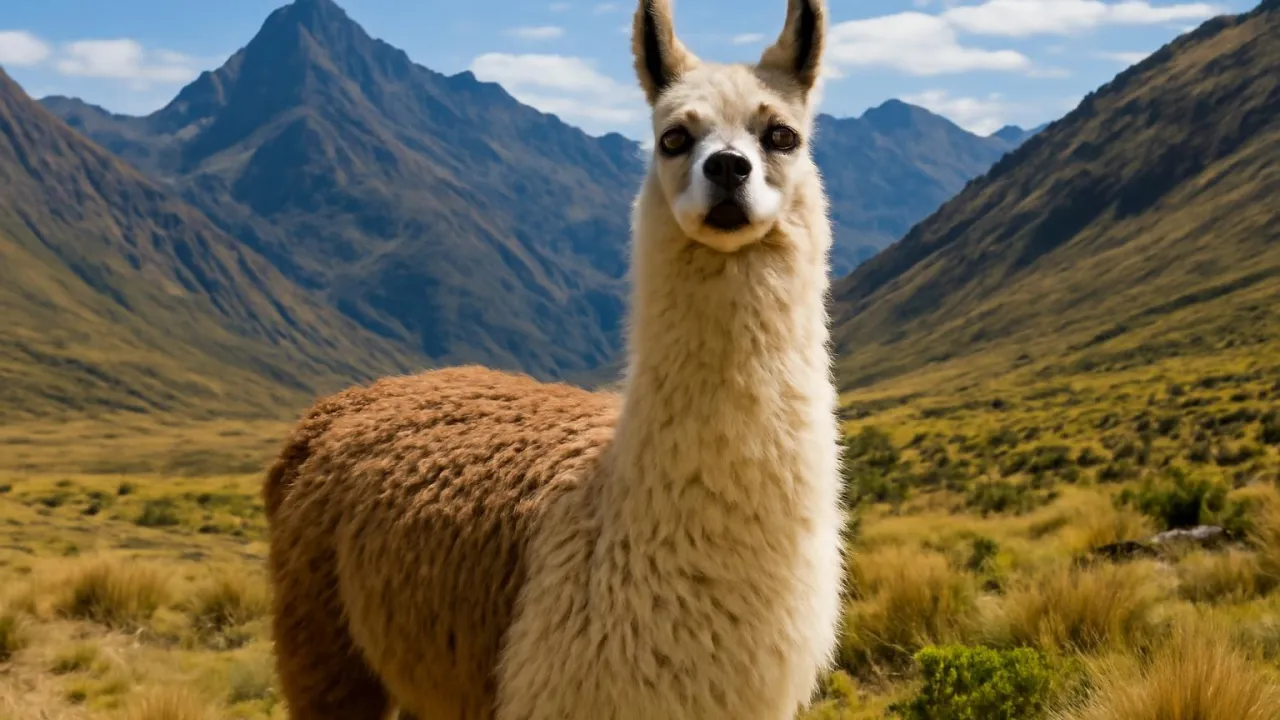
Llamas can carry about one-third of their body weight for long distances!
✨ Word Sparks (Grade 2 Glossary)
Tap 🔊 to hear
herbivore
An animal that eats only plants
Andes
A big mountain range in South America
fur
Soft hair that covers animals’ bodies
🪝
Have you ever wondered how llamas carry heavy loads in the mountains?
1
Warm Wool and Thick Fur
Llamas have thick wool that keeps them warm in cold mountain weather. Their soft protects them from wind and snow. People use llama wool to make warm clothes. This wool is very light and fluffy.
2
Mountain Homes and Food
Llamas live high in the Mountains where it is cold and rocky. They eat grass, leaves, and shrubs that grow in these areas. Llamas are , so they only eat plants. They can survive on little water.
3
Strong and Helpful Animals
Llamas can carry heavy loads up steep mountain paths for many miles. They walk carefully on rocks and do not slip. Llamas make soft humming sounds to talk to each other. They are friendly and smart animals.
Llamas’ wool is so warm and light that people use it to make soft sweaters and blankets.
✨ Word Sparks (Grade 3 Glossary)
Tap 🔊 to hear
insulation
Keeps heat from escaping or coming in
nutrients
Good things in food that help animals grow
adaptation
A body change that helps survival
🪝
Did you know llamas have special wool that helps them survive cold mountain climates?
1
Adapted Wool for Cold
Llamas have thick wool that acts as against cold mountain air. This wool traps warm air close to their skin, helping them stay warm. Their wool is also water-resistant, which protects them from rain and snow. This helps llamas survive in harsh climates.
2
Mountain Habitat and Diet
Llamas live in the Andes Mountains, where the air is thin and cold. They eat plants like grass and shrubs, which provide important . Being herbivores means llamas do not eat meat. Their diet helps them gain energy to carry heavy loads.
3
Strong Bodies and Movement
Llamas have strong legs and padded feet that help them walk on rocky mountain paths without slipping. Their body shape and balance allow them to climb steep slopes easily. This physical helps llamas avoid predators and find food.
4
Communication and Social Life
Llamas communicate by humming softly to each other, which helps keep their herd together. They also use body language like ear and tail movements to show feelings. This social behavior helps llamas protect each other from danger and find mates.
Llamas can carry loads up to 75 pounds while breathing easily at altitudes over 13,000 feet!
✨ Word Sparks (Grade 4 Glossary)
Tap 🔊 to hear
ecosystem
A community of plants and animals living together
symbiotic
A helpful relationship between living things
respiratory
Relating to breathing and air flow
🪝
How do llamas survive and thrive in the cold, rocky Andes Mountains?
1
Wool and Weather Protection
Llamas have thick, insulating wool that protects them from cold temperatures and strong mountain winds. This wool also repels water, which helps llamas stay dry during rain or snow. Because of this, llamas can live comfortably at high altitudes where few animals survive. Their wool is valuable to humans for making warm textiles.
2
Role in Mountain Ecosystems
Llamas play an important role in their by grazing on grasses and shrubs, which helps control plant growth. They also serve as prey for mountain predators like pumas, maintaining balance in the food web. Llamas’ manure enriches the soil with nutrients, supporting plant life. This relationship helps keep the Andes ecosystem healthy.
3
Adaptations for Mountain Life
Llamas have strong, padded feet that provide excellent grip on rocky and uneven terrain, preventing slips and falls. Their efficient system allows them to breathe well in thin mountain air, supplying enough oxygen to their muscles. These adaptations enable llamas to carry heavy loads over steep paths without tiring easily.
4
Geographic Distribution and Human Impact
Native to the Andes Mountains of South America, llamas have been domesticated for thousands of years. Humans use llamas as pack animals and for their wool. Farming llamas has helped local communities survive harsh mountain environments. However, habitat changes and overgrazing can affect wild llama populations.
1. Why is llama wool important in cold mountain areas?
2. How do llamas help their mountain ecosystem?
🤯 Mind-Blowing Fact • Grade 5
Llamas’ blood carries oxygen more efficiently than most mammals, helping them thrive at high altitudes.
✨ Word Sparks (Grade 5 Glossary)
Tap 🔊 to hear
hemoglobin
A protein in blood that carries oxygen
domestication
When humans train animals for help
ecological
Relating to how living things interact
🪝
What unique traits allow llamas to thrive as pack animals in the high Andes Mountains?
1
Taxonomy and Scientific Classification
Llamas belong to the family Camelidae and species Lama glama. They are closely related to alpacas, vicuñas, and guanacos, all native to South America. Unlike camels, llamas do not have humps but share many physiological traits. Their evolutionary adaptations allow them to survive in harsh mountainous environments.
2
Physiological Adaptations for High Altitudes
Llamas have large lung capacities and with high oxygen affinity, enabling efficient oxygen transport in thin mountain air. Their padded, two-toed feet provide excellent traction on rocky terrain, preventing injury. Additionally, their thick wool insulates against cold temperatures and repels moisture, critical for survival at elevations above 13,000 feet.
3
Domestication and Cultural Significance
Humans have domesticated llamas for over 4,000 years, primarily in the Andes region. They serve as pack animals capable of carrying loads up to 75 pounds for long distances. Llama wool is prized for its softness and warmth, used in traditional textiles. These animals hold cultural importance for indigenous Andean peoples and contribute to local economies.
4
Ecological Role and Conservation
In their native ecosystem, llamas influence plant community dynamics through selective grazing and seed dispersal. They also provide prey for native predators, maintaining balance. Although domesticated populations are widespread, wild relatives face habitat pressures from human activity. Conservation efforts focus on sustainable grazing and habitat protection.
5
Quantitative Comparisons and Performance
Adult llamas typically weigh between 250 and 450 pounds (113 to 204 kilograms) and stand about 5.5 to 6 feet (1.7 to 1.8 meters) tall. They can carry roughly 25 to 30 percent of their body weight, approximately 75 pounds (34 kilograms), over rough mountain terrain. Llamas can travel up to 8 miles (13 kilometers) per day at moderate speeds of about 3 miles per hour (5 km/h).