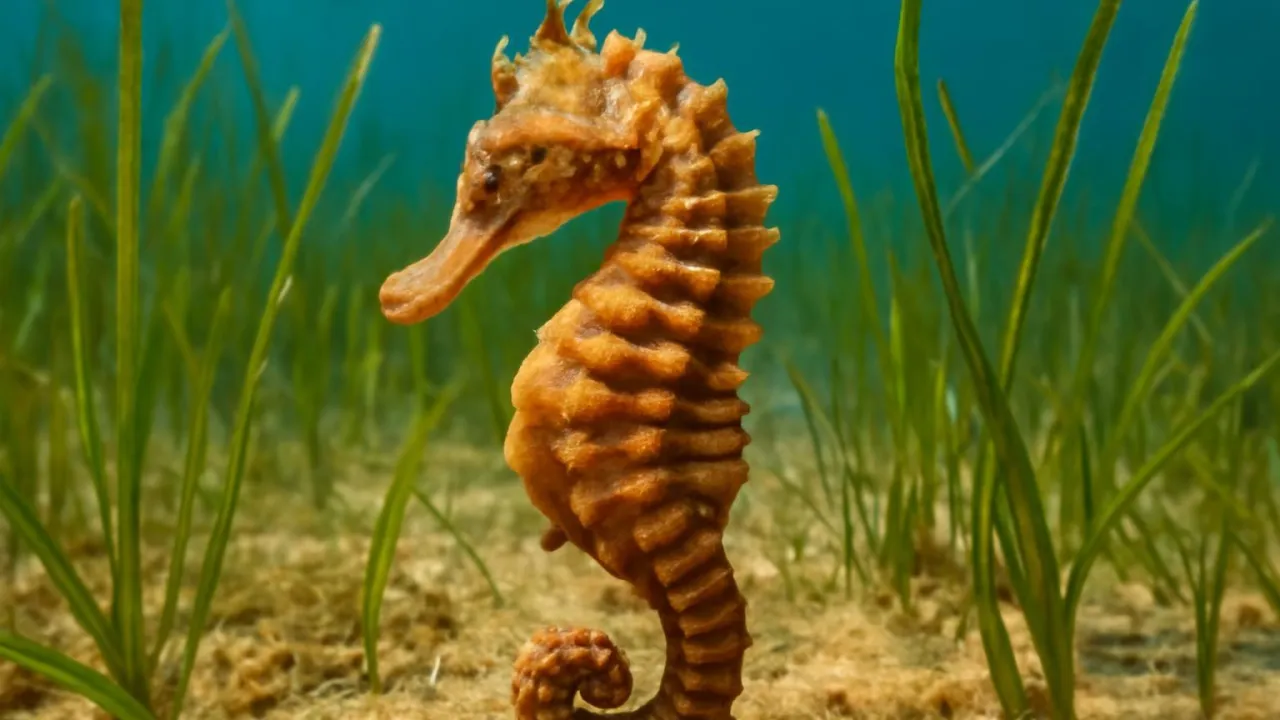
Lined seahorses can change their color to match their home plants perfectly!
✨ Word Sparks (Grade 2 Glossary)
Tap 🔊 to hear
camouflage
Colors that help hide an animal
predator
An animal that hunts other animals
coral
Hard, colorful ocean animals that look like rocks
🪝
Have you ever seen a fish that looks like a plant?
1
How It Holds On
The lined seahorse uses its curled tail to hold on to sea plants. It wraps its tail tightly around the plants. This helps it stay safe from strong waves and .
2
Where It Lives
This seahorse lives in warm, shallow waters near the coast. It likes to stay where there are lots of plants and . These places give it good hiding spots.
3
Its Cool Stripes
The lined seahorse has brown and yellow stripes on its body. These stripes help it blend in with sea plants. This protects it from animals that want to eat it.
1. Why does the seahorse hold on to plants with its tail?
2. What do the stripes on the seahorse do?
🤯 Mind-Blowing Fact • Grade 3
Male lined seahorses carry babies in a pouch until they are ready to swim alone!
✨ Word Sparks (Grade 3 Glossary)
Tap 🔊 to hear
prehensile
Able to grasp or hold tightly
camouflage
Colors that help hide an animal
larvae
Young animals that look different from adults
🪝
How does a tiny fish like the lined seahorse survive in the big ocean?
1
Amazing Tail Adaptation
The lined seahorse has a tail that curls tightly around seaweed or coral. This tail helps it stay anchored in strong currents and avoid predators. By gripping plants, it avoids being swept away by waves. This adaptation is essential for its survival in ocean habitats.
2
Camouflage for Protection
Its body is covered with brown and yellow stripes that provide excellent . This coloring helps the seahorse blend into the plants and coral around it. Camouflage protects it from predators like larger fish. It is a clever way to stay safe in its environment.
3
What It Eats and How
The lined seahorse feeds on tiny crustaceans and plankton by sucking them through its long snout. It uses slow movements to sneak up on prey. Because it has no teeth, it swallows food whole. This feeding method helps it get enough nutrients to survive.
4
Life Cycle and Growth
Lined seahorses go through several growth stages starting as tiny . The male carries the eggs in a special pouch until they hatch. This unique reproductive behavior is rare among fish. After hatching, young seahorses must quickly learn to and feed.
2. Who carries the seahorse eggs until they hatch?
🤯 Mind-Blowing Fact • Grade 4
Lined seahorses use their camouflage to hide from predators and help keep coral reefs healthy!
✨ Word Sparks (Grade 4 Glossary)
Tap 🔊 to hear
prehensile
A tail that can grasp and hold tightly
brood pouch
A pouch where male seahorses carry eggs
ecosystem
A community of plants and animals living together
🪝
What makes the lined seahorse a master of disguise in its watery world?
1
Tail Gripping and Survival
The lined seahorse’s tail allows it to grasp sea plants firmly, preventing it from drifting away in strong ocean currents. This gripping ability is vital because it helps the seahorse stay hidden among plants and avoid predators that roam the reefs. Without this adaptation, the seahorse would be swept into open water where it is vulnerable.
2
Camouflage and Ecosystem Role
Its striped coloration provides camouflage that blends seamlessly with coral and seaweed, which helps it avoid predators. By hiding effectively, the seahorse plays a role in the reef by controlling tiny crustacean populations. This balance supports healthy coral reefs and benefits many other marine species.
3
Reproduction and Life Cycle
Male lined seahorses carry fertilized eggs in a until the young hatch, a rare example of male pregnancy in the animal kingdom. This reproductive strategy increases the survival rate of offspring by protecting them during early development. After birth, the juveniles must quickly adapt to their environment to avoid predators.
4
Geographic Distribution and Habitat
Lined seahorses inhabit warm coastal waters from Nova Scotia to northern South America, favoring shallow seagrass beds and coral reefs. These habitats provide shelter and abundant food sources. Human activities like pollution and habitat destruction threaten these areas, impacting seahorse populations.
1. How does the seahorse’s tail help it survive strong currents?
2. Why is the male seahorse’s brood pouch important?
🤯 Mind-Blowing Fact • Grade 5
Male lined seahorses are one of the few animals where males get pregnant and give birth to live young!
✨ Word Sparks (Grade 5 Glossary)
Tap 🔊 to hear
Syngnathidae
Family of fish with tube-shaped mouths
brood pouch
Special pouch where male seahorses carry eggs
prehensile tail
Tail that can grasp and hold tightly like a hand
🪝
How does the lined seahorse’s unique biology help it thrive in coastal ecosystems?
1
Taxonomy and Scientific Classification
The lined seahorse, scientifically named Hippocampus erectus, belongs to the family , which includes pipefish and seadragons. This family is characterized by elongated bodies and fused jaws forming a tubular snout. The genus name Hippocampus means 'horse sea monster' in Greek, reflecting the seahorse’s distinctive head shape. Understanding its taxonomy helps scientists study evolutionary relationships.
2
Physiological Mechanics and Adaptations
The lined seahorse has a that functions like a fifth limb, allowing it to grasp seagrass and coral firmly. Its body is covered with bony plates instead of scales, providing protection from predators. The seahorse moves by fluttering its dorsal fin rapidly, reaching speeds up to 0.5 miles per hour. Its eyes can move independently, enabling it to scan for food and danger simultaneously.
3
Reproductive Biology and Conservation
Male lined seahorses exhibit a rare reproductive trait by carrying fertilized eggs in a for about two to four weeks. This male pregnancy increases offspring survival rates by providing oxygen and nutrients. Unfortunately, habitat destruction and the aquarium trade have caused population declines. Conservation efforts focus on protecting habitats and regulating trade to ensure species survival.
4
Ecological Role and Geographic Range
Found along the western Atlantic coast from Nova Scotia to northern South America, lined seahorses inhabit shallow seagrass beds, mangroves, and coral reefs. They play a crucial role in controlling small crustacean populations, maintaining ecosystem balance. Their camouflage and slow movements make them vulnerable to habitat changes caused by pollution and climate change, threatening their ecological niche.
5
Quantitative Comparisons and Interesting Facts
Lined seahorses grow up to 8 inches (20 centimeters) long and weigh about 0.1 pounds (45 grams). Their dorsal fin beats approximately 30 to 40 times per second, allowing precise movement in water. They can change color within minutes to match their surroundings, a rapid adaptation for camouflage. These unique traits make the lined seahorse a fascinating subject for marine biology studies.