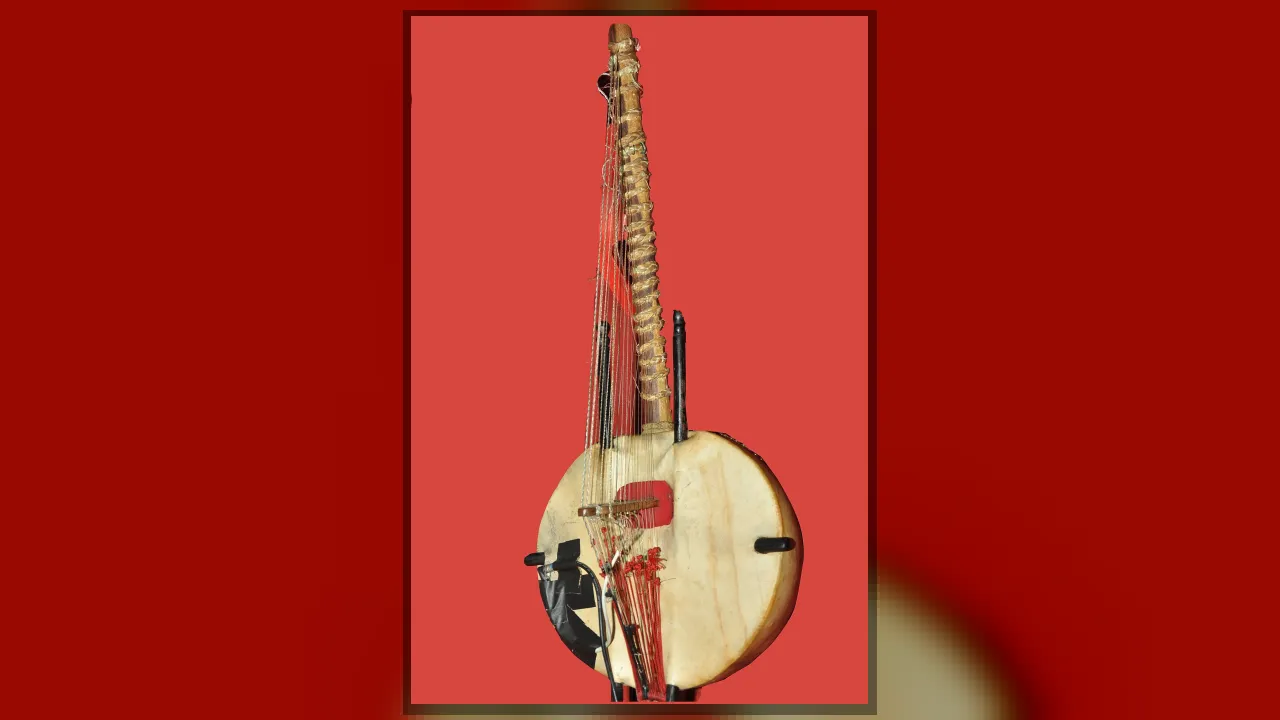
1. What natural plant forms the big round body of a kora?
2. Which fingers actually pluck the twenty-one strings on a kora?
🤯 Mind-Blowing Fact • Grade 2
A second musician sometimes taps gentle drum rhythms right onto the rounded back of the calabash gourd while the kora player plucks!
✨ Word Sparks (Grade 2 Glossary)
Tap 🔊 to hear
griot
West African historian, poet, and praise-singing musician.
calabash
Large bottle-gourd vine grown for bowls and instruments.
notch
Small V-shaped groove carved to hold strings.
🪝
Why does a kora player sit facing the strings instead of holding it sideways like a guitar?
1
Living Libraries of Music
Cascade—groove—chime! Sit beneath a shady baobab tree in Senegal, Mali, or The Gambia and listen to music that remembers kings and heroes from seven hundred years ago! Hereditary musicians called jali—or —preserve whole centuries of family history using the kora.
2
Two Ladders of Strings
Standing over four feet tall, a polished rosewood neck pierces a wide gourd covered in tight cowhide. Twenty-one strings climb in two neat vertical rows—eleven on the left and ten on the right—through in a tall upright bridge!
3
Handles Built for Balance
Sitting face-to-face with the strings, the player grips two wooden side posts with their middle, ring, and pinky fingers while thumbs and index fingers fly!
1. How are the twenty-one strings divided across the kora's tall bridge?
2. What important role do 'jali' or 'griot' musicians serve in West African communities?
🤯 Mind-Blowing Fact • Grade 3
Check the right side of a traditional kora's cowhide top and you will spot a neat round soundhole called 'konkondiro'—where appreciative listeners traditionally slip gift coins to honor the jali!
✨ Word Sparks (Grade 3 Glossary)
Tap 🔊 to hear
jali
Mandinka hereditary musician and oral historian.
kumbengo
Steady, repeating bass-and-chord groove on the kora.
birimintingo
Dazzling solo melodic runs improvised over grooves.
🪝
Why do musical scientists call the kora both a harp and a lute at the exact same time?
1
Two Instruments in One!
Thump-plink-ripple-sing! Deep thumb basslines pulse steadily underneath shimmering waterfall runs that sound like two harps conversing at once! Across the Mandinka heartlands of West Africa, the majestic kora bridges two whole branches of the string family.
2
Why Harp Meets Lute
Like a lute, its long rosewood neck passes through a skin-covered calabash resonator. Yet unlike a guitar where strings lie flat parallel to the soundboard, kora strings stand in two vertical planes perpendicular to the skin across a tall notched bridge—just like a double harp!
3
Braided Leather Tuning Rings
Traditionally, builders tuned all twenty-one strings by sliding tight braided cowhide rings called konso up or down the round neck, though many concert koras today use geared wooden or metal pegs.
4
Kumbengo and Birimintingo
Four plucking fingers weave two musical layers simultaneously: steady interlocking rhythmic grooves called , crowned by dazzling solo flourishes called !
1. How were traditional koras tuned before modern geared pegs were added?
2. In Mandinka kora music, what is the difference between 'kumbengo' and 'birimintingo'?
🤯 Mind-Blowing Fact • Grade 4
On some traditional koras from southern Senegal's Casamance region, up to four extra deep bass strings are added at the bottom—creating a twenty-five-string powerhouse!
✨ Word Sparks (Grade 4 Glossary)
Tap 🔊 to hear
syncopated
Accenting lively off-beats between main musical pulses.
hemispherical
Shaped like an exact half of a sphere.
lineage
Family line passing skills down through generations.
🪝
How does alternating notes left-and-right across a tall notched bridge unlock blinding melodic speed with just four fingers?
1
Echoes of the Mali Empire
What would happen if one seated musician could lay down a funky bassline, ripple harp-like chords, and spin lightning-fast jazz-like improvisations using only two thumbs and two index fingers? Since the thirteenth-century era of Sundiata Keita and the Mali Empire, Mandinka jali across The Gambia, Senegal, Mali, and Guinea have passed down the art of the twenty-one-string kora.
2
Anatomy of a Bridge-Harp
Scholars classify the kora precisely as a spike bridge-harp. A seasoned African rosewood shaft (kosi) pierces a large calabash gourd covered in shaved, raw cowhide pinned down with decorative brass tacks. Flanking the central shaft, two smooth hardwood hand-posts (bulukondingo) give the outer six fingers a rock-solid grip while supporting the instrument upright.
3
Alternating Ranks for Blazing Speed
Instead of climbing sequentially up one side, scale notes zig-zag between the left rank of eleven strings and the right rank of ten strings notched into an upright hardwood bridge (bato). Because adjacent notes of a scale belong to opposite hands, left and right index fingers never trip over each other—unlocking cascading cross-rhythmic runs at breathtaking speed!
4
Four Classic Tuning Modes
Traditional repertoire revolves around four seven-note tuning systems—Tomora ba, Hardino, Sauta, and Tomora mesengo—each evoking its own unmistakable emotional atmosphere, from majestic praise songs to meditative moonlight reflections.
1. Why does alternating consecutive scale notes between the left and right string ranks help kora players play so fast?
2. What are Tomora ba, Hardino, Sauta, and Tomora mesengo in traditional Mandinka kora music?
🤯 Mind-Blowing Fact • Grade 5
Historically reserved strictly for fathers and sons within hereditary jali families, kora mastery broke new ground in the twenty-first century when Gambian-rooted virtuoso Sona Jobarteh became the first internationally acclaimed female griot kora soloist!
✨ Word Sparks (Grade 5 Glossary)
Tap 🔊 to hear
polyrhythm
Two or more contrasting rhythms played together.
heptatonic
A musical scale containing seven notes per octave.
ostinato
A repeating musical pattern anchoring a piece.
🪝
How do perpendicular bridge-harp physics, interleaved bilateral string topology, and modern lever innovations propel the 21-string kora onto global stages?
1
Polyrhythmic Counterpoint from Four Plucking Digits
Seated before an upright forest of twenty-one gleaming nylon filaments rising out of a cowhide-stretched gourd, a West African kora virtuoso sounds effortlessly like three musicians performing in telepathic lockstep. Spanning over three diatonic octaves—typically from F2 (87.3 hertz) to C6 (1,046.5 hertz)—this towering bridge-harp anchors more than seven centuries of Mande griot (jali) oral historiography, diplomacy, and chamber artistry.
2
Organology of the Spike Bridge-Harp
In the Hornbostel-Sachs taxonomy, the kora occupies the specialized category 322.2—arched or spike bridge-harps—because it fuses lute construction with harp string geometry. A stout one-hundred-twenty-centimetre shaft of dense West African rosewood (Pterocarpus erinaceus, locally keno) transfixes a forty-five-centimetre hemispherical calabash gourd (Lagenaria siceraria) cloaked in wet-stretched cowhide that dries taut as a timpani head. Crucially, its twenty-one strings pass through staggered bilateral notches cut into a free-standing vertical hardwood bridge (bato) resting on a cloth-wrapped cushion pad: because string planes stand perpendicular to the skin table rather than parallel, organologists classify its acoustic action as a double harp.
3
Interleaved Bilateral Ergonomics and Konso Collars
Gripping twin lateral stabilizer posts with digits three, four, and five, the performer devotes both thumbs to bass and inner voices while both index fingers articulate upper melodies. Below the lowest four left-hand bass strings, pitches interleave across left (eleven strings) and right (ten strings) ranks so ascending scales alternate hands seamlessly, allowing overlapping campanella sustain and complex 3-against-2 or 4-against-3 . Historically, players tuned twisted antelope-hide cords via braided leather friction collars (konso) before adopting monofilament nylon and hardwood machine pegs.
4
Modal Temperament: Silaba, Hardino, Sauta, and Tomora
Classical Mande repertoire organizes around four modal tunings: Hardino (resembling Ionian major), Sauta (featuring a raised Lydian fourth), Tomora ba (a neutral-interval mode revered for ancient epics), and Tomora mesengo.
5
Chromatic Levers and Contemporary Global Dialogues
In recent decades, innovative luthiers at Senegal's Keur Moussa Abbey fitted Celtic-style semitone sharping levers onto kora necks, while hereditary icons such as Toumani Diabate, Ballake Sissoko, and Sona Jobarteh—renowned as the first internationally celebrated female griot kora virtuoso—have united Mande polyphony with symphonies, flamenco, and chamber ensembles worldwide.
1. Why does the Hornbostel-Sachs classification system place the kora in the 'bridge-harp' family rather than classifying it strictly as a guitar-like lute?
2. What mechanical innovation introduced at Senegal's Keur Moussa Abbey expanded the kora's ability to change keys mid-song?