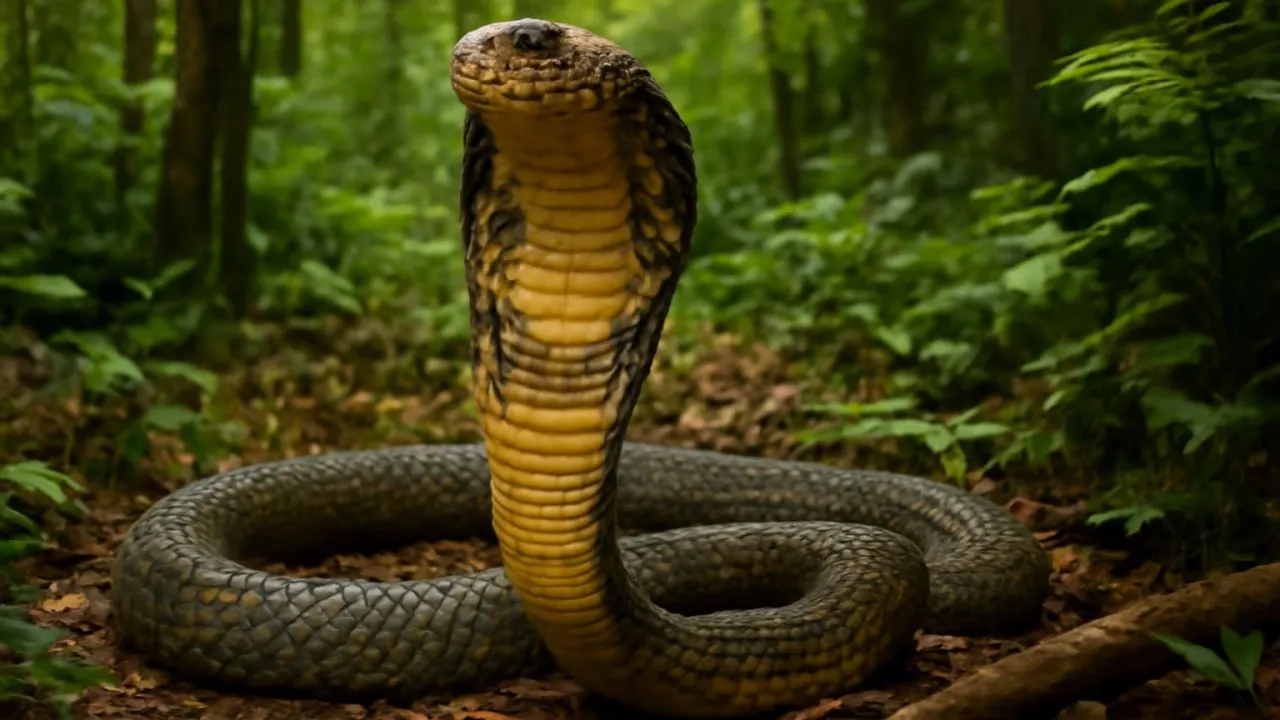
A king cobra’s venom is strong enough to kill a large animal quickly!
✨ Word Sparks (Grade 2 Glossary)
Tap 🔊 to hear
venom
Poison that helps a snake catch and eat food
habitat
The natural home where an animal lives
predator
An animal that hunts other animals for food
🪝
Have you ever seen a snake that can stand up and look very tall?
1
Amazing Appearance
The king cobra can grow very long and stand tall. It spreads its hood wide to scare other animals. Its skin is brown with some pale bands. It looks powerful and dangerous.
2
Home Sweet Home
King cobras live in warm forests and plains in Asia. They like to hide under leaves and fallen logs. They avoid cold places and like humid spots. These snakes are mostly found in Southeast Asia.
3
Hungry Hunter
King cobras mainly eat other snakes, even venomous ones. They use their to catch and kill prey quickly. Sometimes they eat small animals like lizards or rodents. Their hunting skills help them survive well.
King cobras can deliver enough venom in one bite to kill an elephant!
✨ Word Sparks (Grade 3 Glossary)
Tap 🔊 to hear
camouflage
Colors or patterns that help animals hide
neurotoxin
Poison that attacks the nervous system
predator
An animal that hunts other animals to eat
🪝
Did you know the king cobra is the longest venomous snake in the world?
1
Physical Features
The king cobra can grow up to 13 feet long, making it the longest venomous snake. It has a wide hood that it spreads when threatened to appear larger. Its scales are smooth and usually brown or olive with pale bands. This hood helps it scare and rivals.
2
Habitat and Adaptations
King cobras live in dense forests and open plains mainly in Southeast Asia. They prefer humid, warm environments where they can find shelter under leaves or fallen trees. Their excellent helps them blend into the forest floor to avoid . This adaptation also helps them sneak up on prey.
3
Diet and Hunting
King cobras are that mainly eat other snakes, including venomous ones. They use venom to quickly immobilize prey, which helps reduce injury risk. Sometimes they eat lizards, birds, or small mammals when snakes are scarce. Their venom contains that affect the nervous system.
4
Survival and Behavior
When threatened, a king cobra raises its body and spreads its hood to warn enemies. It can also hiss loudly as a warning sound. Unlike many snakes, king cobras build nests for their eggs and guard them until they hatch. This behavior increases the chances of survival for their young.
King cobras can detect prey from far away using their forked tongue to sense chemical trails!
✨ Word Sparks (Grade 4 Glossary)
Tap 🔊 to hear
ecosystem
A community of plants and animals living together
deforestation
Cutting down trees that animals need for homes
parental care
When parents protect and help their babies grow
🪝
How does the king cobra’s unique hood help it survive in the wild?
1
Hood and Defense
The king cobra’s hood is a special adaptation that makes it appear larger and more threatening to predators and rivals. When it feels threatened, it raises the front part of its body and flares the hood, which is made of loose skin supported by ribs. This display often scares away enemies without a fight. The hood also plays a role in communication with other snakes.
2
Ecological Role and Diet
As a top predator, the king cobra controls populations of other snakes, including venomous ones, maintaining balance in its . It primarily feeds on snakes but will also consume lizards, birds, and small mammals when necessary. By hunting venomous snakes, it reduces threats to other animals and humans. This role makes it a vital part of the food web.
3
Geographic Range and Habitat
King cobras are found across Southeast Asia, including India, China, and the Philippines, thriving in tropical forests and open plains. They prefer warm, humid environments with dense vegetation for cover. Human activities like threaten their habitats, causing population declines in some areas. Conservation efforts focus on protecting these habitats to preserve the species.
4
Reproduction and Behavior
Unlike most snakes, king cobras build nests for their eggs and fiercely guard them until they hatch, showing unusual . Females may stay near the nest for several weeks, protecting the eggs from predators. This behavior improves hatchling survival rates. Additionally, king cobras communicate using hisses and body language to avoid unnecessary fights.
2. What human activity threatens king cobra habitats?
🤯 Mind-Blowing Fact • Grade 5
The king cobra’s venom can kill a human in less than 30 minutes without antivenom treatment!
✨ Word Sparks (Grade 5 Glossary)
Tap 🔊 to hear
neurotoxin
A poison that stops nerves from working properly
apex predator
The top hunter with no natural enemies
deforestation
Cutting down forests that animals need to live
🪝
What fascinating adaptations make the king cobra an apex predator in Southeast Asia?
1
Taxonomy and Scientific Context
The king cobra, scientifically named Ophiophagus hannah, belongs to the Elapidae family, which includes venomous snakes with fixed front fangs. It is the longest venomous snake globally, reaching lengths up to 18 feet, though typically 10 to 13 feet. Its genus name means 'snake eater,' reflecting its specialized diet. This species occupies a unique ecological niche as a top predator in its habitat.
2
Physiological Mechanics and Venom
The king cobra’s venom is a potent that disrupts nerve signals, causing paralysis and respiratory failure in prey. It delivers venom through hollow, fixed fangs during a rapid strike. Its hood is formed by elongated ribs that expand the loose skin, a mechanical adaptation for intimidation. The snake’s forked tongue collects chemical cues, enabling precise prey detection over long distances.
3
Conservation and Human Impact
King cobras face threats from habitat loss due to , urbanization, and agricultural expansion. They are protected under various wildlife laws, but illegal poaching for skin and traditional medicine persists. Conservation programs emphasize habitat preservation and public education to reduce human-snake conflicts. Population studies show declines in some regions, highlighting the need for continued protection.
4
Behavior and Reproductive Strategies
Unlike most snakes, female king cobras build nests from leaves and soil, exhibiting parental care by guarding eggs until hatching. This behavior increases offspring survival rates significantly. Males use complex body language and hissing to establish dominance and avoid combat. Their ability to stand upright and spread the hood is both a defensive and communicative behavior.
5
Quantitative Comparisons and Records
King cobras can reach speeds up to 12 miles per hour in short bursts, faster than many other snakes. Their venom can kill an adult elephant within hours if untreated, demonstrating extreme potency. Average weight ranges from 20 to 30 pounds, with some large specimens exceeding 40 pounds. They prefer temperatures between 75 and 85 degrees Fahrenheit, thriving in tropical climates.