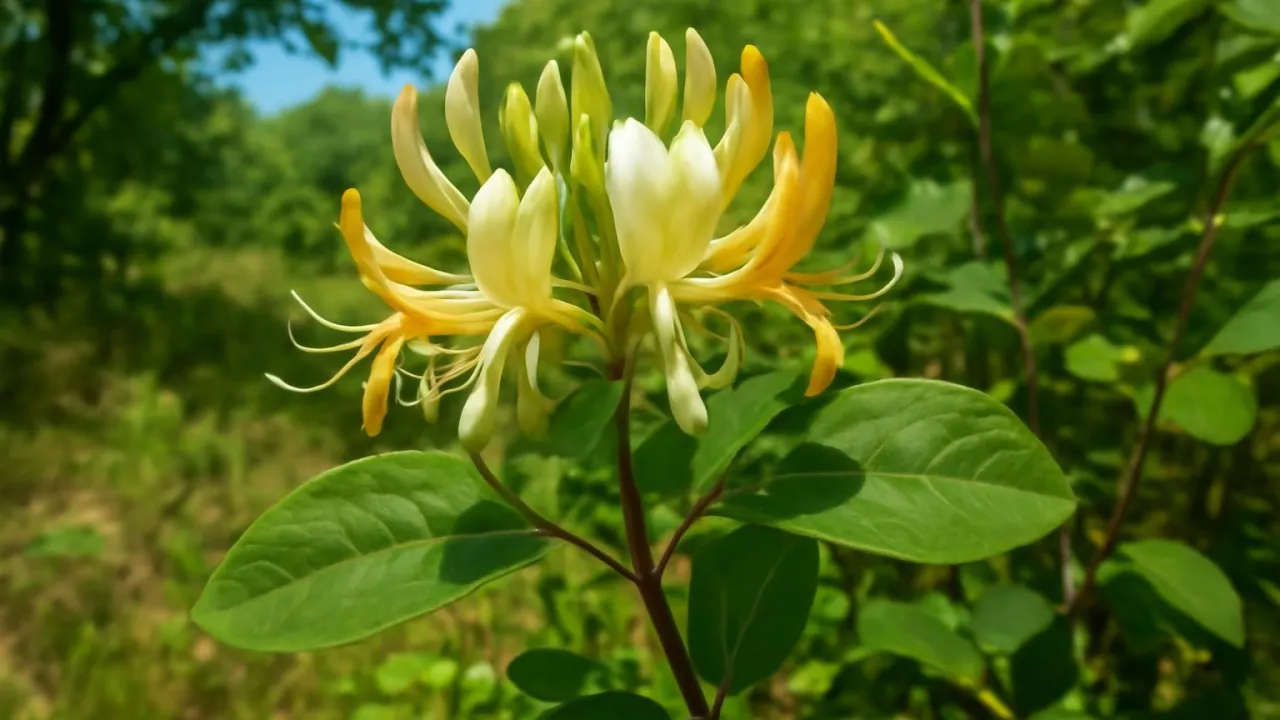
Honeysuckle flowers open at night to attract moths with their sweet smell!
✨ Word Sparks (Grade 2 Glossary)
Tap 🔊 to hear
nectar
Sweet juice inside flowers
clusters
Groups of flowers or fruits
perfumery
Making smells for perfumes
🪝
Have you ever smelled a flower that smells like candy?
1
Colors and Shapes
Honeysuckle flowers are bright red, yellow, or white, and they look like small tubes. Bees and hummingbirds visit these flowers often because they love the sweet inside. The flowers grow in on vines or bushes that climb around trees or fences.
2
Sweet Smell and Nectar
The sweet smell of honeysuckle flowers fills the air in the evening and morning. This scent helps attract bees, butterflies, and hummingbirds to drink the . The nectar is a sugary juice that the animals love. People sometimes use honeysuckle scent in perfumes.
3
Where It Grows
Honeysuckle grows in temperate places with enough sun and water. It can climb on trees, fences, or grow as a bush. The plant needs well-drained soil and moderate watering to grow healthy and strong. It blooms mostly in spring and summer seasons.
Honeysuckle vines can climb over 20 feet high to reach sunlight!
✨ Word Sparks (Grade 3 Glossary)
Tap 🔊 to hear
pollination
When pollen helps flowers make seeds
nectar
Sweet juice inside flowers
adaptation
A change that helps plants survive
🪝
Did you know honeysuckle flowers use sweet smells to survive?
1
Bright Colors and Shape
Honeysuckle flowers have bright colors like red, yellow, and white, which help attract pollinators such as bees and hummingbirds. Their tubular shape is perfect for these animals to reach the sweet inside. This shape also protects the nectar from rain and wind. The flowers grow in clusters along twisting vines or bushes.
2
Sweet Smell and Pollination
The sweet scent of honeysuckle flowers is strongest in the evening, which helps attract night pollinators like moths. happens when animals carry pollen from one flower to another, helping the plant make seeds. This increases the chance of reproduction. The inside provides energy for pollinators.
3
Growing and Habitat
Honeysuckle plants grow in temperate regions where they get enough sunlight and water. They prefer well-drained soil and can climb on trees or fences using their twining stems. This climbing ability helps them reach sunlight and avoid ground predators. The plant blooms mainly in spring and summer.
4
Survival Adaptations
The honeysuckle’s sweet attracts helpful pollinators, while its climbing vines help the plant reach light. Its tubular flowers protect nectar and pollen from rain. These help honeysuckle survive and reproduce in competitive environments. The plant also provides food and shelter for many animals.
2. Why do honeysuckle vines climb trees or fences?
🤯 Mind-Blowing Fact • Grade 4
Honeysuckle’s scent is strongest at night to attract nocturnal pollinators like moths!
✨ Word Sparks (Grade 4 Glossary)
Tap 🔊 to hear
pollination
When pollen helps flowers make seeds
ecosystem
All living and nonliving things in one place
invasive
A plant that spreads and harms other plants
🪝
How does honeysuckle’s sweet scent affect its place in nature?
1
Colors, Shapes, and Pollinators
Honeysuckle flowers display bright reds, yellows, and whites, which serve to attract a variety of pollinators such as bees, hummingbirds, and moths, enabling effective . Their tubular flower shape is an adaptation that allows these animals to access nectar while protecting the nectar from rain and wind. This design also helps the plant reproduce by ensuring pollen transfer between flowers. The flowers often grow in clusters on climbing vines or shrubs.
2
Ecosystem Roles and Relationships
Honeysuckle plays an important role in food webs by providing nectar for pollinators and berries for birds and small mammals. Its climbing vines can create shelter for insects and animals, but in some regions, honeysuckle species can crowd out native plants, affecting biodiversity. Humans sometimes cultivate honeysuckle for its fragrant flowers and use it in gardens to attract beneficial wildlife.
3
Growth Habits and Habitat
Honeysuckle thrives in temperate climates across North America, Asia, and Europe, preferring well-drained soils with moderate moisture. Its twining stems allow it to climb trees, fences, or shrubs to reach sunlight, which is crucial for photosynthesis and survival. The plant blooms mainly during spring and summer, producing flowers that later develop into red or orange berries eaten by wildlife.
4
Cause and Effect in Survival
The sweet scent of honeysuckle causes pollinators to visit frequently, which increases the plant’s chances of reproduction through . In turn, the plant provides food and habitat for many species, supporting health. However, when honeysuckle becomes , it can reduce native plant diversity and alter habitats, showing how its growth impacts ecosystems both positively and negatively.
Honeysuckle’s scent changes daily, peaking at dusk to attract night pollinators efficiently!
✨ Word Sparks (Grade 5 Glossary)
Tap 🔊 to hear
circadian rhythm
A daily cycle like sleep and wake times
thigmotropism
Plant growth response to touch or contact
invasive species
Non-native plants that harm local ecosystems
🪝
What makes honeysuckle a fascinating flower in plant biology and ecology?
1
Scientific Classification and Diversity
Honeysuckle belongs to the genus Lonicera within the Caprifoliaceae family, comprising over 180 species worldwide. These species range from deciduous shrubs to climbing vines, adapted to temperate regions of North America, Europe, and Asia. The genus name honors Adam Lonicer, a German botanist. This diversity reflects evolutionary adaptations to different ecological niches and pollinator types.
2
Physiological Mechanics and Pollination
Honeysuckle flowers have tubular corollas that accommodate long-tongued pollinators such as hummingbirds and moths, facilitating efficient nectar access and pollen transfer. Their sweet fragrance intensifies at dusk to attract nocturnal pollinators, demonstrating a in scent production. The plant’s twining stems exhibit , allowing it to climb supports by sensing touch stimuli.
3
Ecological Impact and Conservation
While native honeysuckle species contribute positively to ecosystems by supporting pollinators and wildlife, some introduced species have become invasive, outcompeting native flora and disrupting habitats. Conservation efforts focus on controlling invasive populations and restoring native plant communities to maintain biodiversity. Additionally, honeysuckle has cultural importance in traditional medicine and horticulture.
4
Botanical History and Human Uses
Historically, honeysuckle has been valued for its fragrant flowers and medicinal properties, including treatments for respiratory ailments. Its sweet nectar has inspired folklore and poetry across cultures. Today, honeysuckle is widely cultivated in gardens for ornamental purposes and to attract pollinators, enhancing urban biodiversity and ecological education.
5
Quantitative Comparisons and Adaptations
Honeysuckle vines can grow over 20 feet (6 meters) tall, climbing at rates of several inches per day depending on conditions. Their nectar sugar concentration ranges between 20 to 40 percent, providing high-energy food for pollinators. The flowers bloom primarily between April and August, with scent emission peaking at dusk to optimize pollinator visits. These adaptations enable honeysuckle to thrive in competitive temperate ecosystems.