🎵 INSTRUMENTS
🎶 Struck Tuned Steel Idiophone
VA Music, Fine Arts & Sound Physics SOL 5.5
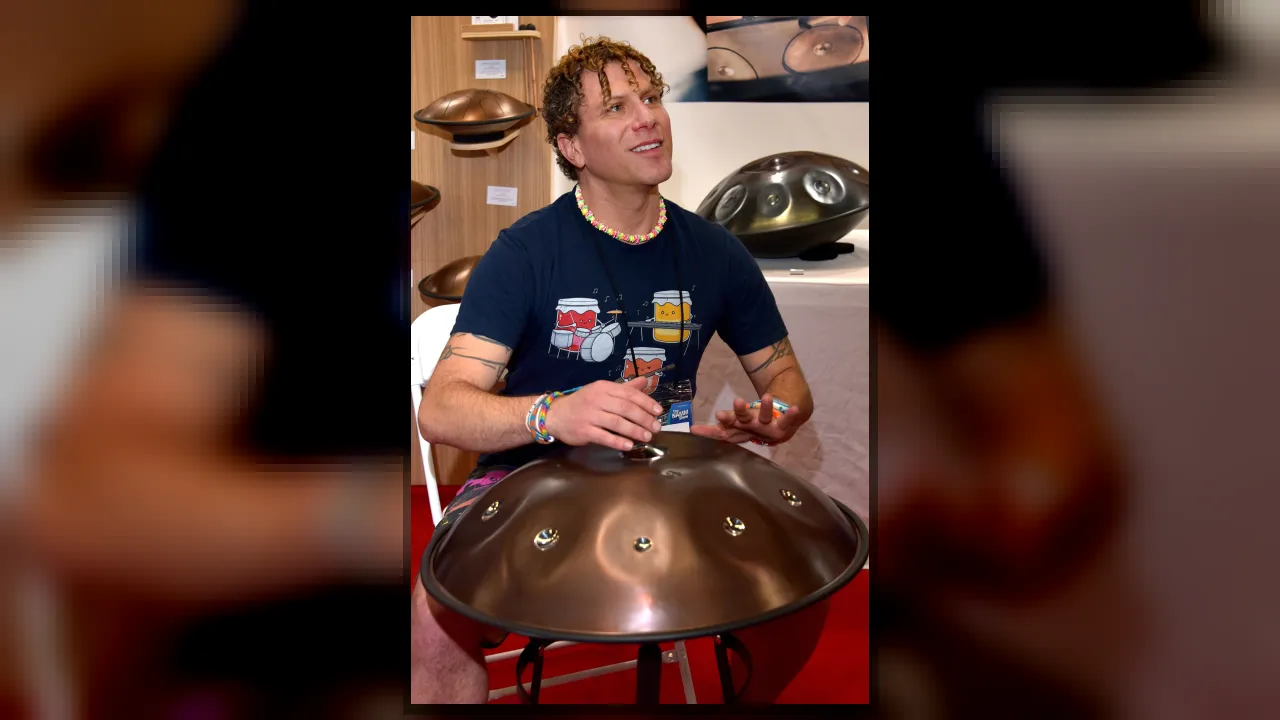
Handpan (Hang Drum)
A Singing Steel Saucer Played Barehanded
Grade 1 • Early Reader • 70 words
🎶 Instrument Family & OriginIdiophone family; Bern, Switzerland (original PANArt Hang invented in 2000)
🪵 Materials & RangeTwo bonded nitrided-steel hemispheres (~53 cm wide) with 8–10 tone fields; ~145–700 Hz
🔊 How Sound Is MadeGentle bare-finger taps vibrate oval steel dimples tuned in 1:2:3 harmonics over a Helmholtz air port
⚡ Signature Sound SparkBlends dreamy harp-like overtones with clay-pot bass warmth in a scale where every note harmonizes
🤯 Mind-Blowing Fact • Grade 1
In the Swiss German dialect of Bern, the original name 'Hang' simply means 'hand'—reminding everyone to play gently with bare fingers!
✨ Word Sparks (Grade 1 Glossary)
Tap 🔊 to hear
saucer
A curved round dish shaped like discs
dimple
A small smooth dip hammered into metal
gentle
Soft and light instead of rough
🪝
Can a shiny metal flying saucer sing dreamy lullabies?
1
Hum, Ring, Glow!
Hum, ring, glow! Soft warm bells float out of a round metal shell. It looks just like a shiny flying !
2
Dimples All Around
Rest the smooth steel shell on your lap. One big bump sits right on top. Smaller oval circle all around it.
3
Gentle Finger Taps
Never use hard sticks on this shell! Bounce light fingertips off each . Every single note blends into peaceful music! Makers in Switzerland invented this calm sound!
1. What does a handpan look like when resting on a player's lap?
2. How should you strike a handpan to wake up its best ringing sound?
🤯 Mind-Blowing Fact • Grade 2
Striking a handpan too hard actually makes it sound worse and knocks its careful hammer-tuning out of place, so softer taps ring much prettier!
✨ Word Sparks (Grade 2 Glossary)
Tap 🔊 to hear
hemisphere
Half of a hollow round sphere shape
scale
Family of musical notes sounding good together
harmonious
Blending smoothly into pleasing musical sounds
🪝
What would happen if you turned a Caribbean steelpan upside down and glued a second bowl underneath?
1
A Brand-New Sound for a New Century
Boooong, ting-shimmer! Sitting cross-legged in a quiet park, a musician taps a bronze-colored steel lens, and dreamy waves of sound wrap around every listener. Amazingly, this peaceful instrument did not exist until the year 2000!
2
Meet the Ding and the Gu
Two inventors in Bern, Switzerland, bonded two curved steel half-shells together into one hollow saucer. On top rises a central bass bump called the Ding, circled by seven or eight oval note dimples. Underneath hides a smooth round hole called the Gu that breathes out deep bass pulses.
3
Every Note Is a Friend
All the dimples belong to one matching musical , so no matter which notes your fingers tap together, the melody always sounds sweet and ! Beginners can invent soothing songs during their very first minute of play!
1. In what year was the very first Hang—parent of all modern handpans—invented in Switzerland?
2. Why is it almost impossible to play a clashing, sour note on a single handpan?
🤯 Mind-Blowing Fact • Grade 3
If a tuner sprinkles fine sand onto a handpan note and vibrates it, the sand dances into crisp oval and cross-shaped lines that map out the invisible sound waves!
✨ Word Sparks (Grade 3 Glossary)
Tap 🔊 to hear
tone field
Hammered oval zone producing a tuned note
nitrogen
Natural gas baked into steel for hardness
ghatam
Traditional South Indian percussion clay pot
🪝
How did an Indian clay pot and a Trinidadian steelpan inspire a Swiss musical invention?
1
Two Worlds Meet in a Workshop
One afternoon in Switzerland, a visiting percussionist who played the —a resonant clay pot from southern India—wished aloud for a melodic steelpan he could play with bare hands instead of rubber sticks. Inspired by that spark, Swiss makers Felix Rohner and Sabina Schärer engineered a lens-shaped idiophone in the year 2000.
2
Three Notes Hiding Inside One Dimple
Why does a single fingertip tap sound as rich as a harp chord? Each oval surrounds a shallow central dimple. Master tuners hammer the steel until three frequencies ring together inside every note: the main pitch, an octave twice as fast, and a fifth above that octave!
3
Bottle-Blowing Bass Underneath
Flip the shell over and you see the round Gu opening. Just like blowing across an empty glass bottle makes trapped air hum, tapping near the Gu excites air resonance around eighty hertz. Lifting the shell slightly off your knees bends that deep bass pitch up and down!
4
Armor Against Rust and Wear
Baking the steel shells in hot gas hardens the metal surface against rust, giving modern handpans bronze, blue, or gold colors while locking their shimmering overtones steadily in tune.
1. Which two older instruments directly inspired the creation of the first Hang in Switzerland?
2. How many harmonically tuned frequencies are hammered into every single handpan tone field?
🤯 Mind-Blowing Fact • Grade 4
A single handpan tone field can receive thousands of tiny, precise hammer taps from a master maker because shifting metal thickness by even a hair's breadth changes all three internal harmonics at once!
✨ Word Sparks (Grade 4 Glossary)
Tap 🔊 to hear
nitriding
Infusing hot steel with nitrogen for stiffness
corrosion
Gradual rusting or wearing away of metal
modal
Built on a specific mood-setting musical scale
🪝
How does baking steel in nitrogen gas and trapping air inside a hollow lens create both bell chimes and deep bass?
1
Turning the Steelpan Inside Out
Imagine sitting beside an Alpine lake as warm, liquid chimes ripple across the water—each note blooming with the clarity of a crystal bell and the earthy thump of a clay drum. When Swiss steelpan builders Felix Rohner and Sabina Schärer set out in Bern to craft a finger-played melodic shell, they flipped traditional steelpan geometry inside out: mounting convex tone fields onto an upward-domed top hemisphere called the Ding side and sealing it onto a smooth bottom hemisphere.
2
The Chemistry of Gas-Nitrided Steel
Plain mild steel dents easily and rusts as soon as salty sweat from bare fingertips touches it. To solve both challenges at once, Rohner and Schärer patented a metallurgical process called gas : heating deep-drawn steel shells inside a furnace filled with nitrogen-rich gas. Nitrogen atoms diffuse into the outer layer of iron, creating an elastic, springy ceramic-metal skin that resists and transforms dull clanks into warm, lingering sustain.
3
Helmholtz Resonance Inside the Hollow Lens
Inside that fifty-three-centimeter flying-saucer cavity lives a second acoustic engine. Air trapped between the two steel bowls acts like a bouncy cushion vented through the round bottom port known as the Gu—the exact physics principle called a Helmholtz resonator. Whenever fingertips strike the top dome or palm heels pulse the rim, internal air oscillates around seventy-five to ninety hertz, surrounding shimmering melodies with velvety sub-bass warmth.
4
Modal Scales for Meditative Flow
Because eight or nine tone fields cannot hold every chromatic sharp and flat without crowding and acoustic crosstalk, makers tune each handpan to a single evocative mode—such as D Celtic minor, Kurd, or Hijaz—inviting street performers, film composers, and music therapists into effortless improvisation.
1. What two major benefits does gas-nitriding bring to a handpan's steel shell?
2. Why is each handpan usually tuned to one seven- or eight-note modal scale instead of all twelve chromatic notes?
🤯 Mind-Blowing Fact • Grade 5
Skilled handpan players can mute a tone field's main pitch with the tip of one thumb along an invisible nodal line and tap the edge to make pure octave or twelfth harmonics ring out like crystal flutes!
✨ Word Sparks (Grade 5 Glossary)
Tap 🔊 to hear
orthogonal
Intersecting or vibrating at exact right angles
nodal
Still line where vibrating surfaces stay motionless
luthier
Skilled craftsperson who builds fine musical instruments
🪝
How do orthogonal dipolar bending modes and an 82-hertz Helmholtz cavity transform two bonded steel domes into a self-harmonizing acoustic synthesizer?
1
Birth of the Hang and Global Handpan Movement
Brush the pad of an index finger briskly against the rim of a dimpled steel dome and release within milliseconds: three phase-locked frequencies blossom simultaneously in midair while a subterranean bass pulse sighs from beneath your knees. Introduced in 2000 in Bern, Switzerland, by Felix Rohner and Sabina Schärer of PANArt after decades of steelpan acoustics research—and sparked by percussionist Reto Weber's quest for a finger-played melodic ghatam—the original Hang catalyzed a worldwide family of convex tuned idiophones now known as handpans.
2
Nitrided Metallurgy and Compressive Stress
Whereas Caribbean steelpans cold-sink note facets inside a concave basin, a handpan bonds two deep-drawn, one-millimeter low-carbon steel hemispheres (~53 centimeters in diameter) along an equatorial elastomer seam. Prior to tuning, shells undergo gas nitriding at roughly 500 to 580 degrees Celsius, diffusing nitrogen atoms into iron crystal lattices to form hard iron-nitride precipitates. This surface case-hardening elevates elastic modulus and traps compressive boundary stress around each hammered tone field, isolating neighboring notes without chiselled grooves.
3
Orthogonal Modal Geometry in a 1:2:3 Ratio
At the apex sits the central bass boss, the Ding (commonly D3 at 146.8 hertz on a D-Kurd layout), encircled by seven to nine elliptical tone fields ascending into the fifth octave (up to F5 at 698.5 hertz). Every elliptical field is peened around a central inverted dimple so three normal modes align in an exact 1:2:3 harmonic series: the axisymmetric (0,1) fundamental, the longitudinal (1,1) dipole mode at twice the frequency along the long axis, and the transverse (1,1) dipole mode at three times the frequency across the short axis.
4
Finger-Strike Impedance and Helmholtz Coupling
Because fleshy human fingertips exhibit soft mechanical impedance and ~3-to-5-millisecond contact duration, light off-center taps selectively excite those 1:2:3 modes while suppressing harsh high-frequency plate clatter; musicians can even isolate the octave or compound fifth harmonic by lightly touching lines on the opposite rim! Simultaneously, the enclosed air volume vents through the bottom Gu port as a tuned Helmholtz resonator (~78–86 hertz), coupling acoustically with the lowest tone fields.
5
Contemporary Makers and Expressive Frontiers
After PANArt retired the original Hang in 2013, independent across Europe, Asia, and the Americas pioneered resonant stainless-steel alloys, bottom-mounted mutant notes, and multi-pan polyphonic concert works. Today, that marriage of Swiss metallurgy and global percussion heritage echoes everywhere from acoustic street corners to orchestral film soundtracks.