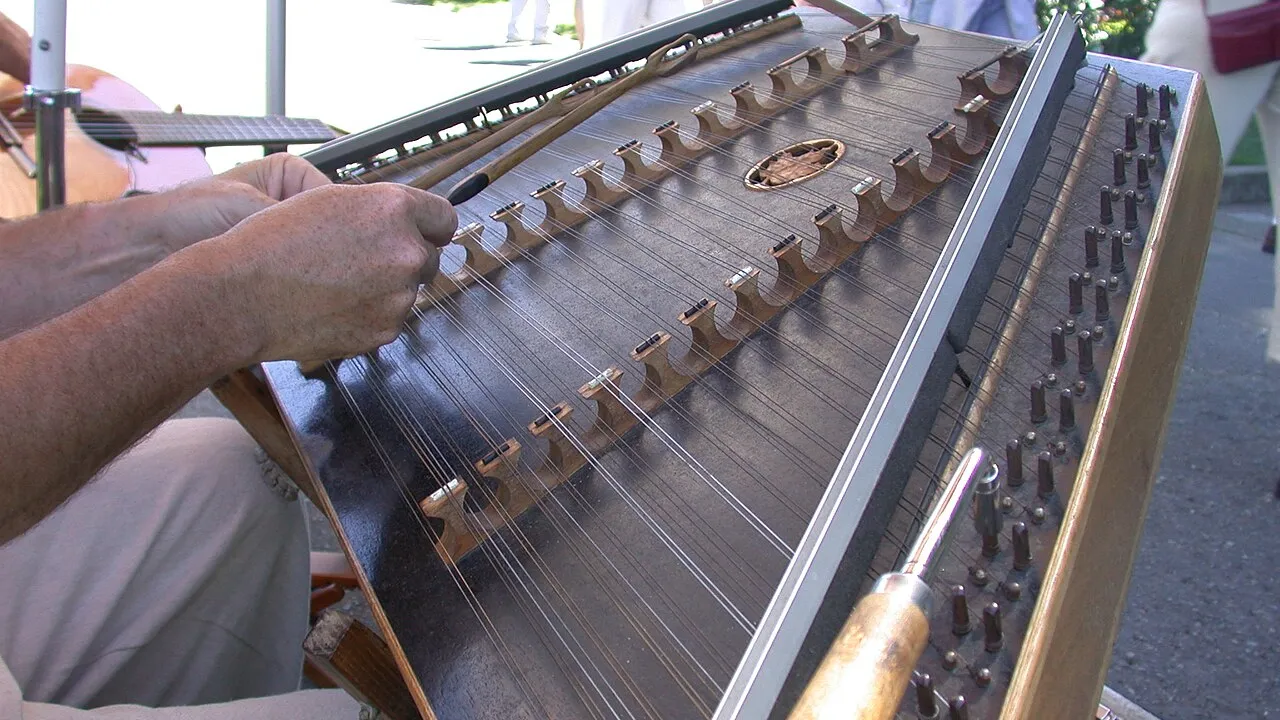
1. How does a musician make sound on a hammered dulcimer?
2. Which famous keyboard instrument got its string-striking idea from the hammered dulcimer?
🤯 Mind-Blowing Fact • Grade 2
Cousins of the hammered dulcimer are played all around the globe—called the santur in Iran, the santoor in India, the yangqin in China, and the cimbalom in Hungary!
✨ Word Sparks (Grade 2 Glossary)
Tap 🔊 to hear
treble
Higher-pitched musical notes above middle range.
rebound
To bounce cleanly away after striking strings.
santur
Ancient Persian hammered zither ancestor.
🪝
How can one single string play two completely different notes on the left and right of its bridge?
1
Bells Dancing on a Wooden Wing
Ting-a-ling-shimmer! Close your eyes and it sounds like a crystal music box as big as a table! Tilted toward the musician on a sturdy wooden stand, the trapezoidal hammered dulcimer holds seventy to over one hundred gleaming metal strings.
2
Two Notes on Every Treble String
Look at the long bridge standing near the middle like a row of chess pieces! Because it divides each string course unevenly, tapping just to the left of that bridge rings out a higher note than tapping to the right!
3
Two-Sided Wooden Hammers
Players cradle slender, curved hardwood hammers lightly between thumb and forefinger so each strike naturally. Many hammers glue soft leather onto one side and bare wood on the other for two magical voices!
1. What clever trick does the hammered dulcimer's treble bridge perform?
2. Why do many dulcimer hammers have bare hardwood on one face and soft leather on the flip side?
🤯 Mind-Blowing Fact • Grade 3
Around the year 1700 in Florence, Italy, instrument maker Bartolomeo Cristofori combined hammered dulcimer mallets with harpsichord keys to invent the very first piano!
✨ Word Sparks (Grade 3 Glossary)
Tap 🔊 to hear
ratio
Comparison showing how two lengths relate mathematically.
yangqin
Chinese bamboo-mallet cousin of the hammered dulcimer.
damper
Felt pad used to quiet vibrating strings.
🪝
Why do white Delrin markers dot the bridges of a hammered dulcimer like secret trail signs?
1
A Global Family of Struck Strings
Chime—cascade—glow! Dozens of overlapping bronze and steel wires keep ringing together like sunlit church bells, because traditional hammered dulcimers have no to stop the sound! Over a thousand years ago in Persia, musicians played the santur—an invention that traveled west across Europe and east along trade routes to China as the .
2
Criss-Crossing Over and Under
How do up to one hundred strings fit cleanly onto one trapezoidal soundboard? Alternating string courses weave over the left treble bridge and through open tunnels cut into the right bass bridge, while bass courses cross over the bass bridge and duck safely under the treble bridge!
3
The Magical Three-to-Two Ratio
Positioned off-center in a precise three-to-two length , the treble bridge divides every treble course into two harmonious pitches exactly a perfect fifth apart!
4
Road Map Dots
Inlaid white markers highlight 'do-fa' scale starting points, guiding flying hammers effortlessly from key to key!
1. When the treble bridge divides a string in a 3:2 length ratio, what musical interval separates its two sides?
2. How do treble strings avoid crashing into the bass bridge on the right side of the soundboard?
🤯 Mind-Blowing Fact • Grade 4
Add up the pull of every taut steel and bronze wire on a large concert hammered dulcimer and the frame is holding roughly three thousand five hundred pounds—as heavy as a family car!
✨ Word Sparks (Grade 4 Glossary)
Tap 🔊 to hear
isomorphic
Keeping identical playing patterns across different keys.
cimbalom
Large concert Hungarian hammered dulcimer with dampers.
transpose
To shift a song higher or lower.
🪝
How does nearly two tons of combined wire tension stay balanced across a thin wooden soundboard?
1
Pythagoras's Math Made Playable
What would happen if you laid out seventy-two gleaming strings in neat geometric symmetry so the exact same hand pattern played major scales in four different keys? Watch a hammered dulcimer soloist dance two featherlight cherrywood hammers across a redwood soundboard: shimmering arpeggios bloom and overlap in a golden cloud of natural sustain.
2
Holding Back Two Tons of Pull
Grouping two, three, or four unison steel and phosphor-bronze wires into each course creates tremendous cumulative tension—often between two thousand five hundred and four thousand pounds of pull across a concert instrument! To prevent the soundbox from folding like a taco, builders anchor thick laminated maple pinblocks at both slanted rails and brace the interior with sturdy tone bars beneath a floating spruce, cedar, or redwood top.
3
Isomorphic Scale Boxes
Unlike a piano where every key requires a new black-and-white fingering, a modern American '16/15' hammered dulcimer arranges fifth-tuned bridges into symmetrical four-note ladders. Moving the exact same left-right hammer pattern up three courses any tune cleanly up a fourth—say from D major to G major to C major—without relearning a single stroke!
4
Cimbaloms, Santurs, and Cristofori's Piano
In Central Europe, nineteenth-century Hungarian builder Vencel Jozsef Schunda added four sturdy legs and a foot-operated felt damper bar to create the concert —starred in orchestral scores by Zoltan Kodaly and Igor Stravinsky—just as dulcimer hammers had earlier inspired Bartolomeo Cristofori's 1700 gravicembalo col piano e forte!
1. Why is changing keys ('transposing') between D major, G major, and C major so natural on a hammered dulcimer?
2. What special upgrade did Hungarian maker Vencel Jozsef Schunda add to create the orchestral cimbalom?
🤯 Mind-Blowing Fact • Grade 5
On India's classical Kashmiri santoor—a close cousin of the hammered dulcimer—three or four unison strings across twenty-five to thirty-one bridges can total over one hundred gleaming strings on a compact lap-sized box!
✨ Word Sparks (Grade 5 Glossary)
Tap 🔊 to hear
kilonewton
Metric unit measuring powerful pulling or pushing force.
tetrachord
Four-note scale building block spanning a fourth.
pianoforte
Original Italian name meaning 'soft-loud' for pianos.
🪝
How do 3:2 bridge acoustics, interleaved viaduct stringing, and hammer-rebound physics unite the ancient Persian santur with the modern piano?
1
Luminous Sustain Across Three and a Half Octaves
Poised on a scissor stand at a gentle ergonomic tilt, a concert chromatic hammered dulcimer shimmers with over a hundred steel and phosphor-bronze strings grouped into paired or triple unison courses. Struck near their acoustic sweet spots by two balanced five-gram hardwood hammers, notes bloom from whisper-soft pianissimo to bell-like fortissimo across three and a half to four octaves—spanning roughly E2 (82.4 hertz) to G6 (1,568 hertz).
2
Millennial Diffusion: Santur, Yangqin, Cimbalom, and Piano
Cataloged under Hornbostel-Sachs 314.122-4 as a trapezoidal box zither sounded by hammers, the instrument crystallized around the tenth century CE in the Persian santur. Radiating outward across Eurasia, it evolved into the hundred-string Kashmiri santoor, the rubber-clad bamboo-mallet Chinese yangqin, the Alpine hackbrett, the pedal-damped Hungarian concert cimbalom, and British-American folk dulcimers—ultimately inspiring Bartolomeo Cristofori in Florence around 1700 to mechanize struck-string expression inside the first .
3
Compressive Bracing Against Fifteen Kilonewtons of Load
Supporting seventy to over one hundred twenty taut wires exerts upwards of fifteen —more than one and a half metric tons—of compressive force between the angled laminated hard-maple pinblocks! Master luthiers engineer internal stability through arched soundboard crowns of quarter-sawn Sitka spruce, Western red cedar, or sinker redwood supported by longitudinal compression struts, allowing thin soundboards to radiate crisp transients without structural creep.
4
Viaduct Interleaving and 3:2 Quintal Topology
Rather than assigning one string course per pitch, American 16/15 and chromatic dulcimers employ interleaved viaduct bridges—individual slotted hardwood pedestals or continuous arched rails—so alternating courses pass over the central treble bridge while ducking through tunnels beneath the right-hand bass bridge, and vice versa. Dividing treble courses at an exact 2:3 speaking-length ratio yields two pitches separated by a pure perfect fifth (3:2 frequency ratio), arranging diatonic into repeating isomorphic 'boxes' marked by white Delrin caps.
5
Hammer Impulses, Partial Excitation, and Dampening
Held loosely at a fulcrum point between thumb and index finger, curved flexible shafts convert wrist flicks into rapid double-stroke rolls (flams and paradiddles). Striking closer to a bridge excites bright upper partials; flipping from bare jatoba wood to padded suede attenuates high harmonics; and modern hand or pedal dampers sculpt crisp contrapuntal phrasing.