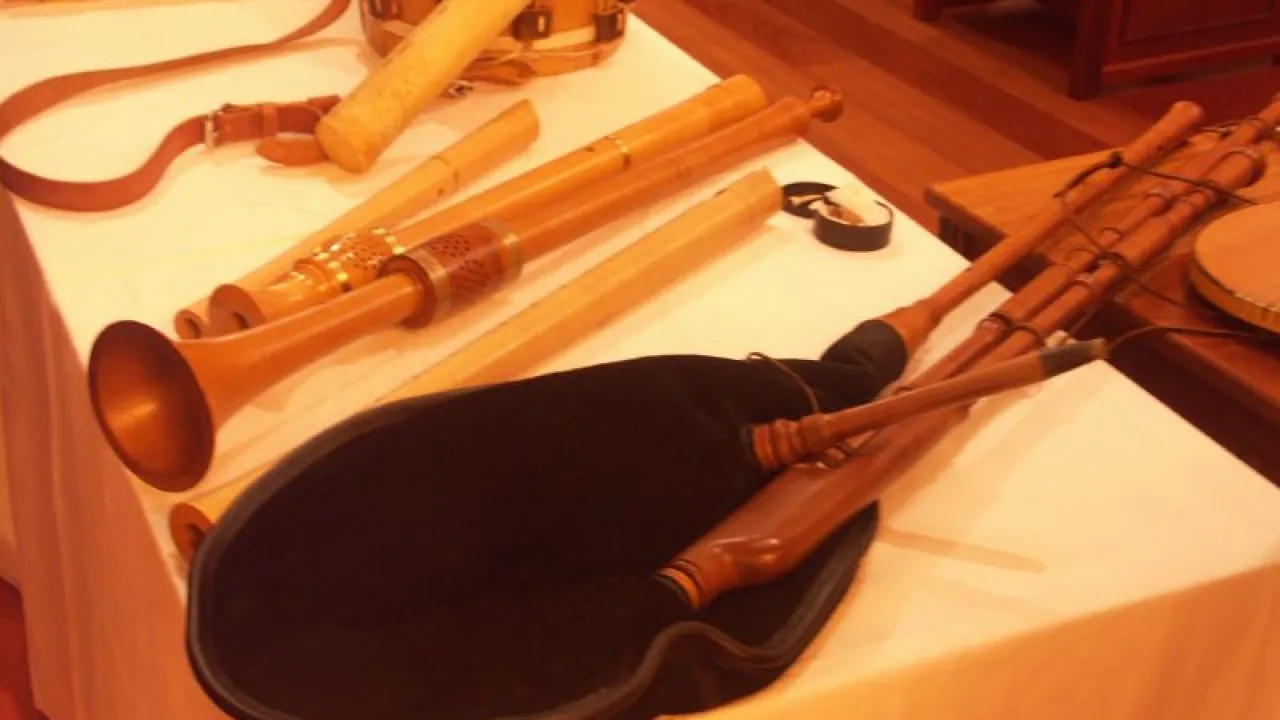
1. Why does the music keep playing while a bagpiper stops blowing to breathe in?
2. Where do the three long drone pipes rest while someone plays?
🤯 Mind-Blowing Fact • Grade 2
In Gaelic, Scotland's Great Highland Bagpipes are called piob mhor, which simply means the Great Pipe!
✨ Word Sparks (Grade 2 Glossary)
Tap 🔊 to hear
valve
Flap allowing air to flow one way
chanter
Fingered bagpipe tube that plays melodies
glen
Narrow green valley between steep hills
🪝
What keeps all the air inside a bagpipe from rushing backward into the player's mouth?
1
Built for Open Skies
Long ago in misty Scottish , communities needed music bold enough to carry over wind and hills. When a piper inflates the bag and strikes in, four wooden pipes roar to life together.
2
The One-Way Trapdoor
Air enters through a blowpipe fitted with a clever little leather flapper at its base. When the piper inhales, air pressure inside the bag snaps that trapdoor shut so wind can only escape through the reeds!
3
Chanter and Shoulder Drones
Two hands finger fast melodies on the downward pipe called the . Meanwhile, two tenor drones and one long bass drone hum rich octave harmonies overhead. Together, they sound like a whole marching band carried by one proud player!
1. What stops stored air in the bag from rushing back up the blowpipe?
2. Which part of the bagpipes has finger holes for playing the melody?
🤯 Mind-Blowing Fact • Grade 3
Beginners never start on full bagpipes—they spend months mastering tricky finger ornaments on a quiet wooden tube called a practice chanter!
✨ Word Sparks (Grade 3 Glossary)
Tap 🔊 to hear
reservoir
Storage chamber holding a steady supply
gracenote
Split-second extra note decorating or separating tones
tenor
Mid-high musical voice above deep bass
🪝
How can a bagpiper play two identical notes in a row if the airflow never stops for a single millisecond?
1
Four Reeds, Two Designs
Imagine balancing four buzzing engines with one steady arm hug! Hidden inside the stocks of the Great Highland Bagpipes sit two different kinds of reeds. The chanter uses a powerful cane double reed for bright projection, while the three cylindrical shoulder drones hum on single-bladed reeds.
2
Tuning by Sliding Joints
Before playing a tune, a piper listens closely for wavering beats between the drones. Sliding the upper sections of the two drones and tall bass drone up or down lengthens or shortens each tube until all three lock into pure octaves.
3
Lightning Finger Gracenotes
On a flute or trumpet, your tongue briefly pauses the air to separate repeated notes. Because bagpipe air never stops, two identical notes would blur into one long tone! Pipers solve this by flicking a high finger open and shut in a split second to slice notes crisply apart.
4
Dense Blackwood Craft
Turned from ultra-dense African blackwood and trimmed with silver or imitation-ivory mounts, these rugged outdoor pipes withstand mist, parades, and spirited Highland games around the world.
1. How does a bagpiper separate two repeated notes of the exact same pitch?
2. How does a piper tune the three shoulder drones before a performance?
🤯 Mind-Blowing Fact • Grade 4
Modern Highland bagpipe chanters are pitched so high—around 476 to 484 hertz—that their written 'A' actually sounds closer to a B-flat on a piano!
✨ Word Sparks (Grade 4 Glossary)
Tap 🔊 to hear
decibel
Unit measuring how loud a sound is
Mixolydian
Musical scale featuring a lowered seventh note
piobaireachd
Classical Scottish bagpipe theme-and-variation art music
🪝
Why does a Scottish Highland pipe band sound mysteriously sharper and brighter than a modern symphony orchestra?
1
Pressure-Fed Outdoor Power
Stand ten paces from a solo piper striking in on a misty hillside and you physically feel over one hundred of sound vibrate your chest. That immense output comes from pairing a high-pressure underarm reservoir with a steeply conical chanter bore and a stiff cane double reed.
2
Nine Notes and a Rising Pitch
Unlike chromatic orchestral winds, the Highland chanter spans just nine un-overblown pitches—from low G up to high A—voiced in a bold scale with a naturally flattened seventh step. Over the past century, competitive pipe bands gradually shortened chanter dimensions, pushing Highland 'A' upward from 440 hertz to roughly 480 hertz, nearly a full whole step sharper than concert pianos!
3
Acoustic Architecture of Drones
Anchored into wooden stocks tied tightly into the bag, two tenor drones sound one octave below the chanter's low A while the towering bass drone resonates two octaves below. Their cylindrical bores and single-tongued reeds generate dense upper overtones that weave a shimmering harmonic blanket behind the melody, rewarding spotless tuning with a thrilling ring.
4
Ceol Mor: Classical Highland Art
Beyond lively reels, strathspeys, jigs, and military marches lies —Scotland's ancient classical theme-and-variation art music. Across fifteen-minute performances, cascades of intricate multi-finger ornaments called doublings, grips, and birls transform nine fixed notes into majestic musical architecture.
1. Why does a modern Highland bagpipe sound higher in pitch than a piano playing the same written note 'A'?
2. How do the three drones relate musically to the chanter's low A?
🤯 Mind-Blowing Fact • Grade 5
Before written bagpipe music became common, Scottish masters taught complex compositions through canntaireachd—sung nonsense syllables whose vowels represent pitches and consonants represent finger ornaments!
✨ Word Sparks (Grade 5 Glossary)
Tap 🔊 to hear
idioglottal
Reed cut directly from its tube body
just intonation
Tuning based on pure whole-number frequency ratios
canntaireachd
Traditional Scottish sung chant teaching bagpipe melodies
🪝
How does a nine-note aerophone incapable of dynamic swells or tongued articulation sustain one of Europe's most intricate classical traditions?
1
Isobaric Aerodynamics of the Bag
First come the low, growling drones awakening one by one, locking into beatless alignment before a blazing conical chanter slices across the valley. Organologically a mouth-blown reservoir reedpipe (Hornbostel-Sachs 422.112 / 422.22), the Great Highland Bagpipe relies on constant gauge pressure maintained between the piper's lungs and left ribcage. Any fluctuation in arm squeeze shifts pitch instantly, demanding ironclad pressure stability so all four reeds remain locked in harmonic resonance.
2
Divergent Bore Geometries: Chanter vs. Drones
Turned primarily from dense Dalbergia melanoxylon (African blackwood), the instrument unites two opposing acoustic pipes. Its melody chanter features a wide, rapidly expanding conical bore driven by a stiff Arundo donax double reed without overblowing, projecting a piercing nine-note compass from G4 to A5. Conversely, the two tenor drones and two-jointed bass drone house narrow cylindrical bores excited by cane or composite single reeds, functioning as quarter-wave resonators rich in odd-numbered partials.
3
Just Intonation Against Drone Overtones
Rather than conforming to equal temperament, Highland chanter tone holes are bored in tuned directly against the harmonic series of the low-A drones (today pitched near 480 hertz, placing the bass drone fundamental near 120 hertz). Intervals such as the pure major third (C-sharp) and natural seventh (G) fuse effortlessly with upper drone harmonics without acoustic beating.
4
Illusion of Articulation via Ornamentation
Deprived of silence, staccato, or dynamic shading, Highland piping developed a dazzling vocabulary of micro-temporal finger articulations. Single gracenotes lasting mere tens of milliseconds—combined into compound ornaments like doublings, grips, taorluaths, crunluaths, and rapid little-finger birls—create crisp percussive transients that fool the human auditory cortex into perceiving distinct rhythmic attacks.
5
Highland Heritage from Glen to Globe
Codified by hereditary piping dynasties such as the MacCrimmons of Dunvegan on the Isle of Skye through an oral syllable notation called , the classical piobaireachd (ceol mor) repertoire endures alongside championship pipe bands and snare-drum corps worldwide as a monument to acoustic ingenuity.