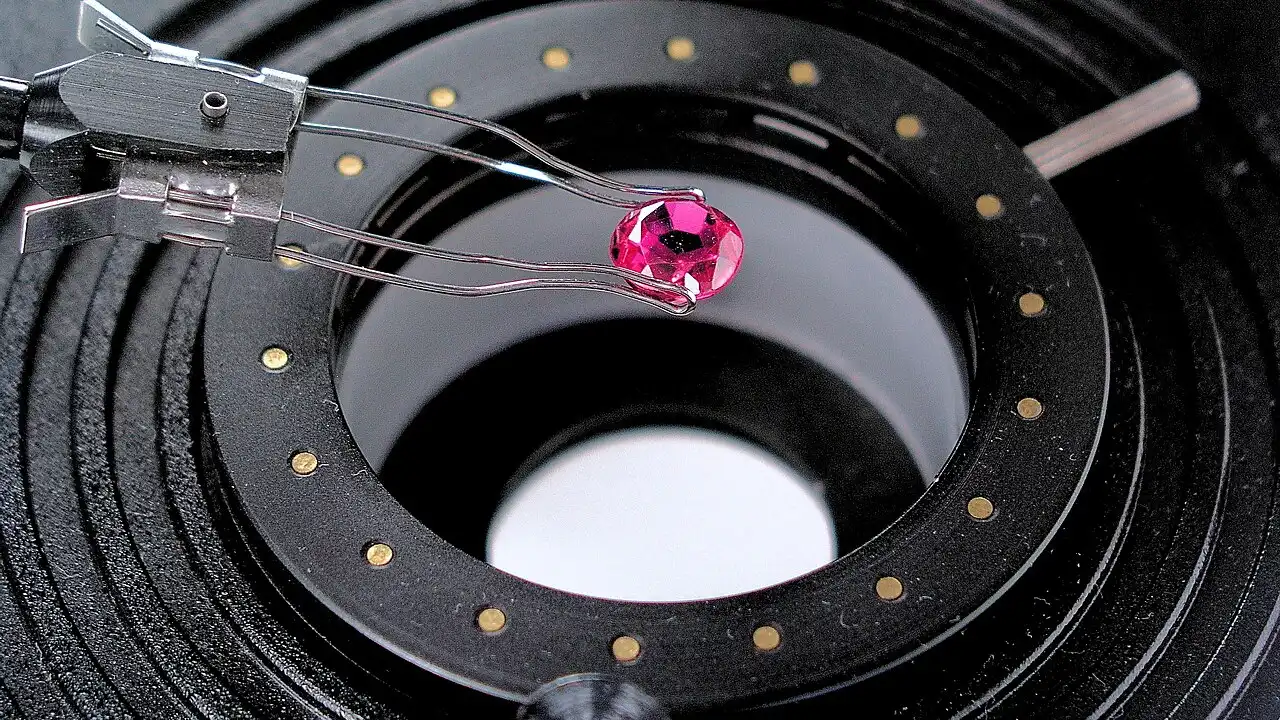
1. What small magnifying tool does a gemologist hold near one eye to peek inside a gem?
2. Why does a gemologist shine bright light through a gemstone?
🤯 Mind-Blowing Fact • Grade 2
One metric carat weighs just one-fifth of a gram—about the same as a single small paperclip!
✨ Word Sparks (Grade 2 Glossary)
Tap 🔊 to hear
Inclusion
Tiny crystal or bubble trapped inside gems
Carat
Unit of weight used to measure gemstones
Amber
Golden gem formed from ancient tree resin
🪝
What secret 'birthmarks' hide inside natural emeralds and sapphires?
1
Tiny Worlds Inside a Crystal
Click goes the microscope lamp, lighting up a green crystal like a glowing lantern! A gemologist peers inside to spot tiny trapped bubbles, mineral needles, or feather shapes. These inner marks are called , and they tell the story of how the gem grew.
2
Testing Without Scratching
Geologists in the field sometimes scratch rocks to test hardness, but gemologists never scratch a polished jewel! Instead, they use gentle light machines and super sensitive scales that weigh stones in tiny units called .
3
Pearls, Amber, and Crystals
Gemologists also study organic treasures made by living things, such as ocean pearls from oysters and golden formed from ancient tree resin.
1. Why do gemologists avoid scratching a finished gemstone to test it?
2. Which gem studied by gemologists comes from ancient tree resin rather than rock crystals?
🤯 Mind-Blowing Fact • Grade 3
Natural diamonds form roughly ninety to one hundred twenty miles beneath Earth's surface and rocket upward inside ancient volcanic pipes!
✨ Word Sparks (Grade 3 Glossary)
Tap 🔊 to hear
Facet
Flat polished face cut onto a gemstone
Refractometer
Tool measuring how much gems bend light
Clarity
How clear a gem is inside
🪝
How can a gemologist tell a natural diamond grown deep underground from one grown in a laboratory?
1
Optical Detective Work
Two sparkling clear stones sit side by side in silver tweezers, looking identical to the naked eye. A gemologist uses physics and mineralogy to uncover each stone's true identity, whether working in a museum vault, a gem lab, or a jewelry studio.
2
Bending Beams With a Refractometer
When light enters a crystal, it slows down and bends at a specific angle. By placing a stone's flat on an instrument called a , the gemologist reads its refractive index—an optical fingerprint unique to quartz, topaz, tourmaline, or sapphire.
3
Natural Versus Lab-Grown Clues
Under a powerful microscope, natural gems often hold tiny mineral inclusions trapped millions of years ago inside Earth's crust. Lab-grown gems have the same crystal chemistry, yet show curved growth lines or microscopic metallic specks from laboratory chambers.
4
Grading the Four Cs
When evaluating diamonds, gemologists measure four famous traits—cut, color, , and carat weight—writing detailed lab reports that buyers and museums trust.
1. What does a refractometer measure to help identify a mystery gem?
2. Which set of traits makes up the 'Four Cs' used by gemologists to grade diamonds?
🤯 Mind-Blowing Fact • Grade 4
Trace chromium atoms turn aluminum oxide bright red to create a ruby, yet those exact same chromium atoms turn beryl crystal deep green to create an emerald!
✨ Word Sparks (Grade 4 Glossary)
Tap 🔊 to hear
Pleochroism
Showing different colors from different viewing angles
Specific gravity
Density of a gem compared to water
Spectroscope
Tool showing which rainbow colors gems absorb
🪝
Why does a single crystal of tanzanite or tourmaline flash two completely different colors when rotated in your hand?
1
Where Earth Science Meets Light Physics
Deep inside cooling magma pockets and high-pressure metamorphic rocks, atoms stack into repeating geometric crystals. Gemologists study these rare mineral survivors to verify authenticity, detect heat or dye treatments, and trace geographic origins. Even Virginia has famous gem history: lush green amazonite crystals mined in Amelia County sit in museum collections worldwide.
2
Double Refraction and Pleochroism
Cubic crystals like garnet and diamond bend light equally in every direction. Most other gems—such as emerald, peridot, and sapphire—split an incoming light beam into two separate rays! Gemologists view stones through a calcite tool called a dichroscope to observe , where a crystal absorbs different wavelengths along different axes, flashing violet-blue from one angle and burgundy from another.
3
Specific Gravity and Spectroscopy
To test an uncut rough crystal without flat facets, a gemologist weighs it first in air and then suspended underwater. Comparing those two weights reveals —how dense the stone is compared to water. Meanwhile, a handheld splits transmitted light into a rainbow bar code, showing dark lines where trace elements like chromium—the coloring agent in both red ruby and green emerald—absorb light.
4
Museum Stewardship and Ethical Sourcing
Today's gemologists curate historic crown jewels, safeguard customers from synthetic imitations, and help trace responsibly mined gemstones from mountain quarries to finished settings.
1. How does weighing a gemstone in air and then underwater help a gemologist?
2. What optical property causes gems like tourmaline and tanzanite to show different colors from different directions?
🤯 Mind-Blowing Fact • Grade 5
The Hope Diamond in Washington, D.C. glows fiery orange-red for over a minute after ultraviolet lights turn off—a rare boron-linked phosphorescence studied by museum gemologists!
✨ Word Sparks (Grade 5 Glossary)
Tap 🔊 to hear
Refractive index
Ratio showing how strongly crystal slows light
Corundum
Hard aluminum-oxide mineral forming rubies and sapphires
Phosphorescence
Continued glowing after ultraviolet light switches off
🪝
How can tiny mineral inclusions inside a sapphire reveal not only whether Earth forged it, but which mountain range on the planet it came from?
1
Non-Destructive Analytical Mineralogy
When a curator at the Smithsonian Institution examines a priceless faceted sapphire, scraping powder for a chemical test is unthinkable. Research gemologists rely entirely on non-destructive optical, spectroscopic, and laser instruments to decode atomic lattices. Every gemstone belongs to one of seven crystal systems—isometric, tetragonal, hexagonal, trigonal, orthorhombic, monoclinic, or triclinic—governing how light slows, splits, and polarizes inside.
2
Refractive Index and Critical Angles
Diamond owes its unmatched 'fire' and brilliance to a towering of 2.417, meaning light slows to less than half its vacuum speed upon entering the carbon lattice! Because its critical angle is just 24.4 degrees, a precision-cut pavilion reflects nearly all entering light back up through the crown like a hall of mirrors, whereas quartz (refractive index 1.544) leaks light if cut to diamond proportions.
3
Detecting Enhancements and Synthetics
Modern gemological laboratories pair classical tools—polariscopes, ultraviolet lamps, and immersion microscopes—with Raman micro-spectroscopy and laser-induced breakdown spectroscopy. When gem dealers heat pale past 1,600 degrees Celsius to deepen blue color, tiny internal rutile silk needles partially melt into dotted trails, instantly alerting a trained gemologist that the stone was thermally enhanced.
4
Geologic Origin Fingerprinting
Trace-element ratios of gallium, iron, titanium, and vanadium—combined with three-phase fluid inclusions containing liquid brine, carbon dioxide gas, and salt crystals—let lab gemologists distinguish Colombian emeralds formed in sedimentary hydrothermal veins from Zambian emeralds formed in metamorphic schists.
5
Global Science and Supply Integrity
Working across international grading institutes, natural history museum vaults, geological surveys, and ethical supply-chain audits, gemologists turn microscopic geological time capsules into verified scientific records—protecting collectors, preserving historic treasures, and supporting responsible mineral stewardship worldwide.