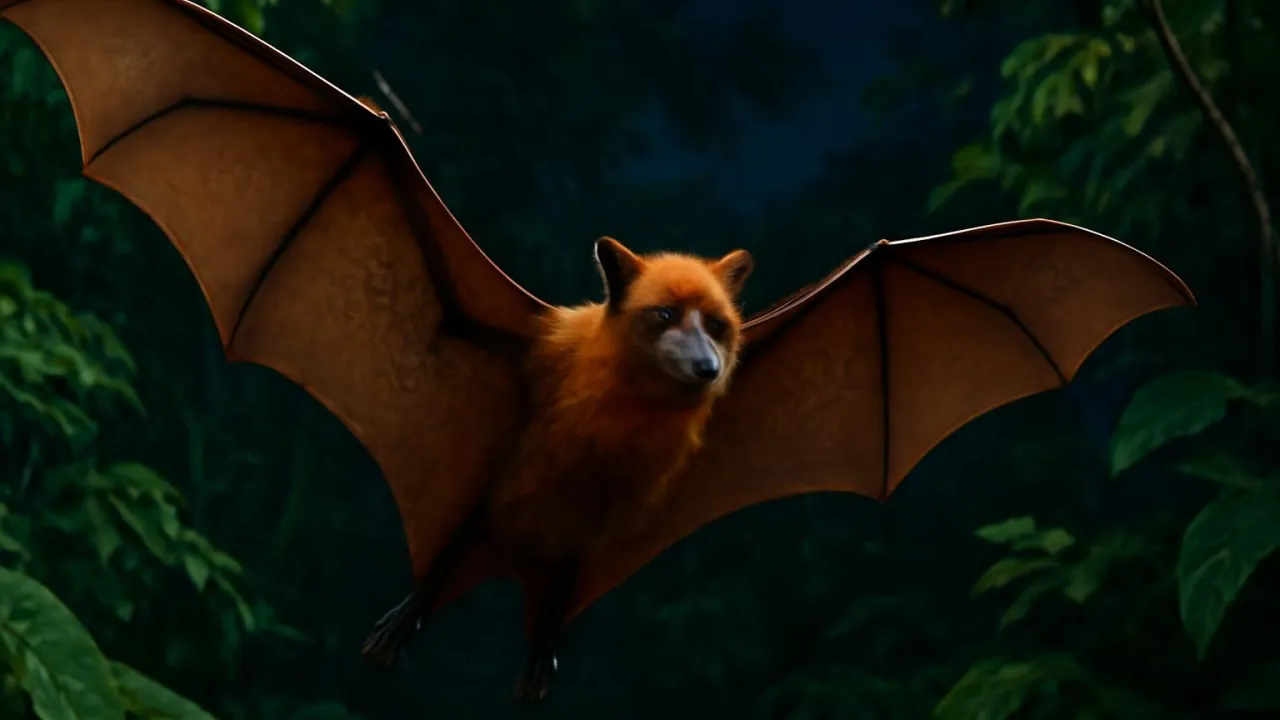
Flying foxes can have wingspans up to 5 feet, wider than most birds!
✨ Word Sparks (Grade 2 Glossary)
Tap 🔊 to hear
colony
A big group of animals living together
nectar
Sweet juice inside flowers
glide
To fly smoothly without flapping wings
🪝
Have you ever seen a bat as big as a small dog?
1
Huge Wings
Flying foxes have huge wings that help them fly far at night. They flap slowly but powerfully. Their wings are covered with soft brown fur. These big wings help them silently through the air.
2
Fruit Lovers
They eat fruit like mangoes and bananas. Flying foxes use their sharp teeth to bite fruit. They also drink sweet from flowers. Their diet helps plants grow by spreading seeds.
3
Where They Live
Flying foxes live in warm forests in Asia and Australia. They sleep hanging upside down in tall trees. At night, they fly out to find food. They like to live in groups called colonies.
Flying foxes are one of the largest bats, with wingspans wider than some eagles!
✨ Word Sparks (Grade 3 Glossary)
Tap 🔊 to hear
adaptation
A body change that helps survival
pollination
Moving pollen to help plants grow
colony
A group of animals living together
🪝
Did you know flying foxes help plants grow by spreading seeds?
1
Amazing Wings
Flying foxes have large wingspans that can reach up to five feet. Their wings are covered with soft fur that helps them fly silently. This allows them to avoid predators while hunting at night. Their slow, steady wing beats let them glide long distances efficiently.
2
Fruit and Pollination
Flying foxes eat fruit and nectar, which provides them with essential nutrients. As they feed, they spread pollen between flowers, helping plants reproduce. This is vital for many tropical trees and crops. Their role in seed dispersal helps maintain healthy forest ecosystems.
3
Habitat and Behavior
These bats live in tropical forests across Asia and Australia, often roosting in large colonies. They hang upside down during the day to rest and become active after sunset. Their social behavior helps protect them from predators. Flying foxes communicate with loud calls within their groups.
4
Survival Adaptations
Flying foxes have sharp teeth to bite through tough fruit skins easily. Their keen sense of smell helps them locate ripe fruit in dense forests. Their large eyes improve night vision, aiding navigation in the dark. These allow them to thrive in their challenging environment.
Flying foxes can travel over 30 miles in one night searching for food!
✨ Word Sparks (Grade 4 Glossary)
Tap 🔊 to hear
symbiosis
A helpful relationship between living things
deforestation
Cutting down many trees in forests
pollination
Moving pollen to help plants grow
🪝
How do flying foxes shape the forests where they live?
1
Silent Flight and Defense
Flying foxes have large wings covered with soft fur, which allows them to fly silently and avoid predators effectively. Their slow wing beats enable them to glide long distances with minimal energy use. This silent flight is crucial for hunting fruit at night without alerting enemies. Their ability to hang upside down also helps them rest safely during the day.
2
Key Role in Ecosystems
By eating fruit and nectar, flying foxes help pollinate many tropical plants, which supports biodiversity in their habitats. Their seed dispersal allows forests to regenerate and grow healthy trees. This symbiotic relationship benefits both the bats and the plants. Humans also benefit because many crops rely on flying fox .
3
Habitat and Distribution
Flying foxes inhabit tropical and subtropical forests across Asia, Australia, and some Pacific islands. They prefer dense forests where fruit is abundant and roost in large colonies for safety. and habitat loss threaten their populations in many areas. Conservation efforts focus on protecting their natural habitats to maintain ecosystem balance.
4
Social Behavior and Communication
These bats are highly social animals that communicate with loud calls and body language within their colonies. Their group living provides protection against predators and helps share information about food sources. Flying foxes also display grooming behaviors to strengthen social bonds. Understanding their behavior helps scientists protect them better.
1. Why is seed dispersal by flying foxes important?
2. What threatens flying fox habitats?
🤯 Mind-Blowing Fact • Grade 5
Flying foxes can fly silently over 30 miles each night, helping spread seeds far and wide!
✨ Word Sparks (Grade 5 Glossary)
Tap 🔊 to hear
echolocation
Using sound to find things in the dark
pollination
Moving pollen to help plants grow
conservation
Protecting animals and their homes
🪝
How do flying foxes, among the largest bats, influence tropical ecosystems and human agriculture?
1
Taxonomy and Scientific Classification
Flying foxes belong to the genus Pteropus within the family Pteropodidae, known as fruit bats. They are among the largest bats, with wingspans reaching 1.5 meters or more. Unlike microbats, flying foxes do not use but rely on keen eyesight and smell. Their classification highlights their unique evolutionary adaptations among Chiroptera.
2
Physiological Adaptations for Flight and Feeding
Their large membranous wings, supported by elongated finger bones, allow silent and energy-efficient flight over long distances. Flying foxes possess sharp, strong teeth to pierce tough fruit skins and extract nectar efficiently. Their large eyes provide excellent night vision, compensating for the absence of . These physiological traits enable them to forage widely in tropical forests.
3
Ecological Roles and Conservation Challenges
Flying foxes play a critical role in and seed dispersal, maintaining tropical forest biodiversity and regeneration. They support the reproduction of economically important plants, such as durian and mango trees, benefiting agriculture. Habitat destruction and hunting have caused population declines, prompting programs focused on habitat protection and public education.
4
Historical and Cultural Significance
Historically, flying foxes have been part of indigenous cultures in Asia and Oceania, featuring in folklore and traditional diets. Their ecological importance is increasingly recognized in modern science. Balancing cultural practices with species protection remains a challenge in some regions. Scientific studies continue to reveal their vital environmental contributions.
5
Quantitative Comparisons and Flight Capabilities
Flying foxes can reach wingspans of up to 5 feet (1.5 meters) and weigh between 1.1 to 2.6 pounds (0.5 to 1.2 kilograms). They can fly distances over 30 miles (50 kilometers) in a single night while searching for food. Their flight speed averages around 20 miles per hour (32 kilometers per hour). These impressive capabilities make them key nocturnal pollinators and seed dispersers.