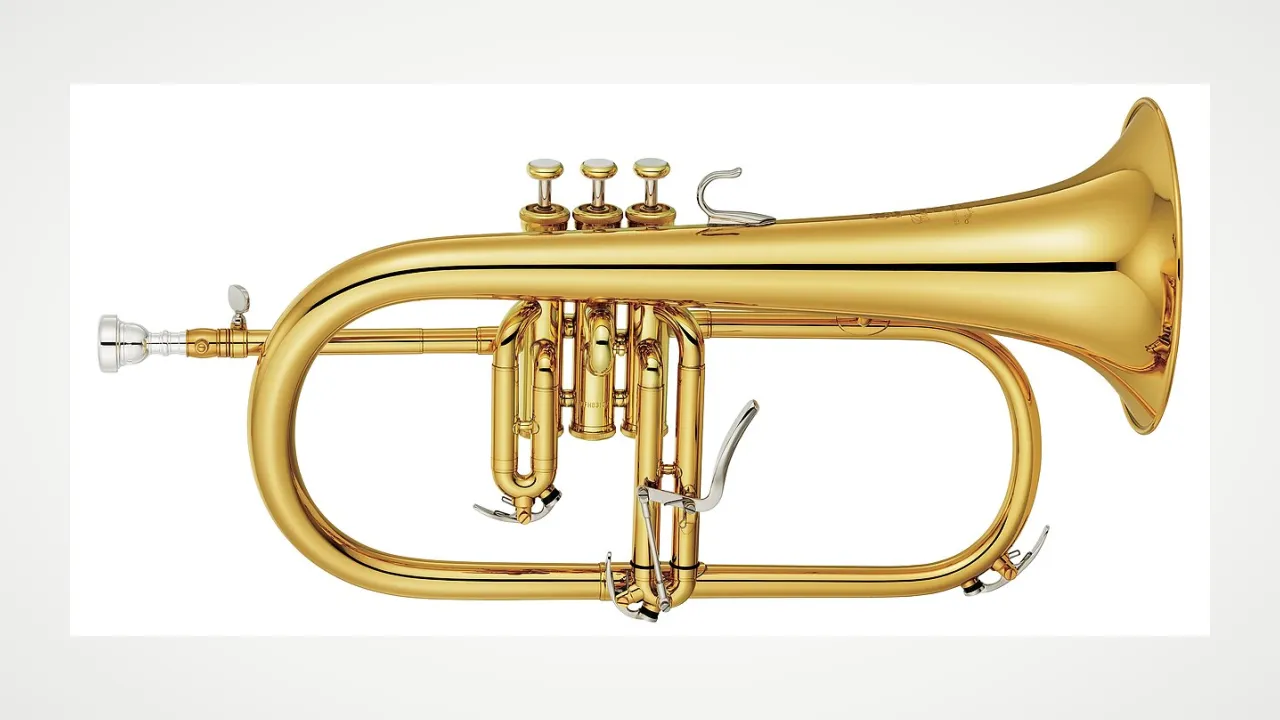
1. How does a flugelhorn look different right away when placed next to a trumpet?
2. What does the German part 'Flugel' in flugelhorn mean?
🤯 Mind-Blowing Fact • Grade 2
Chuck Mangione's sunny 1977 instrumental song 'Feels So Good' made the flugelhorn a top-five radio hit across America!
✨ Word Sparks (Grade 2 Glossary)
Tap 🔊 to hear
ballad
Slow, expressive song telling a tender story
buttery
Rich, smooth, and free of harshness
flare
Spread steadily wider toward the open bell
🪝
Why does a jazz trumpeter suddenly set down their trumpet on a stand and pick up a bigger, rounder horn for a slow song?
1
Valves Added to a Bugle
Picture an old-fashioned camp bugle with wide, sweeping curves and a generous bell. In the 1830s, Austrian and German makers added three valves to that wide bugle, creating the warm-voiced flugelhorn!
2
Same Notes, Different Personality
Surprise—a B-flat flugelhorn plays the exact same low-to-high note range as a B-flat trumpet and cornet! Because its brass tube wide so quickly, sharp metallic buzzes melt away into dark, tones.
3
Star of Quiet Ballads
Whenever a jazz band slows down for a tender lullaby or evening , trumpeters reach for the flugelhorn so every note glows softly like warm candlelight across the room.
1. How does a B-flat flugelhorn's pitch range compare to a B-flat trumpet's pitch range?
2. Which valveless brass horn is the direct ancestor of the flugelhorn?
🤯 Mind-Blowing Fact • Grade 3
Some custom flugelhorns have a fourth piston valve on the side that unlocks deep, cello-like pedal notes below the normal trumpet range!
✨ Word Sparks (Grade 3 Glossary)
Tap 🔊 to hear
funnel
Deep cone shape narrowing smoothly into tube
bore
Interior hollow pathway inside a wind tube
saxhorn
Conical valved brass family by Adolphe Sax
🪝
Why does using a regular shallow trumpet mouthpiece ruin a flugelhorn's magical dark sound?
1
Three B-Flat Siblings Compared
Line up a trumpet, a cornet, and a flugelhorn on a velvet table. All three unroll to about four feet ten inches and read the exact same sheet music! Their secret difference is shape: narrow cylinder on the trumpet, medium cone on the cornet, and wide-open bugle cone on the flugelhorn.
2
Deep Funnel Mouthpiece
Peek inside an authentic flugelhorn mouthpiece and you will not see a rounded bowl-shaped cup—you will see a deep V-shaped , much like a miniature French horn mouthpiece! That deep funnel strips away bright sizzle right where the lips buzz.
3
Adolphe Sax's Favorite Soprano
Before inventing the saxophone, Belgian genius Adolphe Sax built a whole family of conical brass horns called , crowning the top voice with the flugelhorn's design.
4
Jazz Ballads and Brass Bands
Every British championship brass band reserves one special solo seat for a lone flugelhorn, using its mellow velvet glow as a musical bridge between bright cornets and deeper alto horns.
1. What shape is the inside of a true flugelhorn mouthpiece?
2. Which famous Belgian inventor used the flugelhorn's wide conical design at the top of his saxhorn family?
🤯 Mind-Blowing Fact • Grade 4
Jazz great Art Farmer fell so deeply in love with the flugelhorn's dark poetry that he had maker David Monette build him a custom hybrid 'flumpet' blending trumpet projection with flugelhorn warmth!
✨ Word Sparks (Grade 4 Glossary)
Tap 🔊 to hear
trade-off
Giving up one trait to gain another
bell throat
Widening neck leading into a horn's bell
lyricism
Expressive, song-like musical warmth and grace
🪝
Why does a wide-throated flugelhorn radiate warm low notes effortlessly yet fight back if you try to blast screaming high notes?
1
Acoustic Trade-Off of the Wide Cone
Every acoustic design involves a fascinating ! Because a flugelhorn's tubing begins widening almost immediately after the valve block and swells into a generous six-inch , low- and mid-frequency waves glide smoothly out into the room. However, wide flare weakens the crisp high-frequency reflections that normally bounce back to help a player's lips 'lock' onto extreme high notes.
2
Trigger Levers for Delicate Tuning
Wide conical horns are notoriously sensitive to pitch shifts across registers. Look beside a professional flugelhorn's third valve casing and you will spot a spring-loaded mechanical lever operated by the left pinky or ring finger, sliding the main third-valve tuning bow smoothly outward to keep low D and C-sharp centered.
3
Symphonic Moments of Mystery
Orchestral composers call on this smoky voice for unforgettable moments: Ralph Vaughan Williams opened the slow movement of his Ninth Symphony with a haunting flugelhorn solo, Igor Stravinsky wove it into Threni, and Gustav Mahler featured a dreamy offstage part often played on flugelhorn in his Third Symphony.
4
Architects of Cool Jazz and Bossa Nova
Jazz innovators Shorty Rogers, Clark Terry, Miles Davis (on the classic Gil Evans orchestral album 'Miles Ahead'), Burt Bacharach's studio ensembles, Freddie Hubbard, and Art Farmer proved that dark, intimate speaks far more deeply than sheer brass volume.
1. Why are screaming extreme high notes harder to lock onto on a flugelhorn than on a cylindrical trumpet?
2. What does the spring-loaded lever near the left hand on a concert flugelhorn control?
🤯 Mind-Blowing Fact • Grade 5
Spectral analyzers show that on a softly played flugelhorn note, over eighty percent of the sound energy lives in just the first three harmonics—nearly as pure and mellow as a human humming!
✨ Word Sparks (Grade 5 Glossary)
Tap 🔊 to hear
cutoff frequency
Pitch threshold where bell stops reflecting waves
spectral envelope
Overall balance of low and high harmonics
buccina
Curved ancient Roman brass horn ancestor
🪝
What cutoff-frequency physics gives a B-flat flugelhorn the dark spectral envelope of a miniature French horn?
1
Apex of the Conical Bugle Lineage
Under dimmed jazz-club lights, a smoky contralto-like brass sigh hangs suspended in air, devoid of metallic bite. Classified under Hornbostel-Sachs 423.233 (valved conical-bore labrosones / bugles), the B-flat flugelhorn emerged in 1830s Vienna and Germany when builders fitted rotary or piston valves to the eighteenth-century semicircular Halbmond hunting bugle and Joseph Halliday's 1810 keyed bugle.
2
Bell Cutoff Frequency and Spectral Rolloff
Sharing the exact 148-centimeter nominal tube length of the B-flat trumpet and cornet (sounding concert E3 at 164.8 hertz to B-flat5 at 932.3 hertz, or down to F2 near 87 hertz on four-valve models), the flugelhorn typically inserts its tuning slide directly into a tapered leadpipe before the valve block (~10.5–11 millimeters), expanding steeply past the pistons into a 150-to-160-millimeter bell. In brass acoustics, a gentler, wider flare lowers the bell's ''—causing harmonics above roughly 1,200 to 1,500 hertz to radiate inefficiently as diffuse warmth while failing to reflect back down the bore. Without strong high-frequency standing-wave feedback or cylindrical shock-steepening, fundamental and second/third harmonics dominate over eighty percent of total acoustic power!
3
Deep Conical Cup Coupling
Crucially, true flugelhorn mouthpieces omit the cylindrical throat bottleneck of trumpet mouthpieces, tapering cleanly in a deep V-funnel on a dedicated Morse/French-style receiver taper. Lowering cup Helmholtz resonance near 600 hertz reinforces low-order partials and yields dark, breathy vowel-like formants.
4
German Rotary Kuhlohorn vs. French Perinet Tradition
Two structural branches coexist globally: the oval-wrapped German rotary-valve Flugelhorn—including Johannes Kuhlo's ultra-mellow soprano Kuhlohorn built for Protestant Posaunenchor brass choirs and Central European Blasmusik wind bands—and the French-American three- or four-piston Perinet design standardized from Adolphe Sax's soprano saxhorn.
5
Indispensable Modern Colorist
From Igor Stravinsky's Threni, Ralph Vaughan Williams's Ninth Symphony, and Ottorino Respighi's Pines of Rome (evoking ancient Roman horns) to Miles Davis, Chet Baker, Clark Terry, Kenny Wheeler, and Roy Hargrove, no other soprano brass instrument whispers with deeper human intimacy.