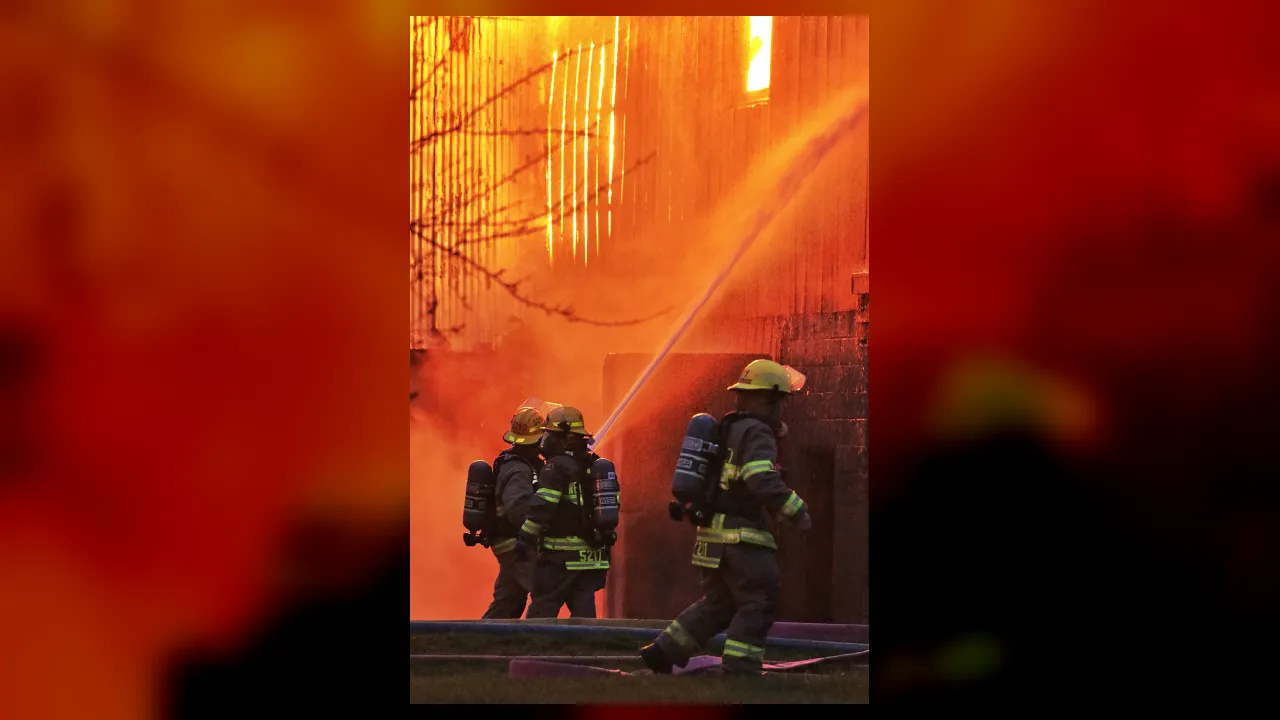
⚡ Everyday Impact SparkStops fast-moving fires, rescues trapped neighbors, and delivers urgent medical aid in minutes
🤯 Mind-Blowing Fact • Grade 1
Full fire safety gear, boots, helmet, and air tank can weigh more than fifty pounds—as heavy as a first grader!
✨ Word Sparks (Grade 1 Glossary)
Tap 🔊 to hear
hose
a strong tube that sprays high water
smoke alarm
a beeping sensor that warns of smoke
helmet
a hard hat that protects the head
🪝
What happens inside a fire station the very second the loud alarm bell rings?
1
Clang! Time to Roll!
Clang, clang! The station bell rings loud and clear. Boots step fast into thick yellow pants. Big red doors roll open, and the shiny fire truck roars out!
2
Water, Ladders, and Air Masks
Brave helpers pull heavy that spray strong streams of water. Tall ladders reach high windows. Air tanks help them breathe clean air in thick smoke.
3
Helping Pets and Neighbors
They save people and scared pets too. On quiet days, they visit schools to teach kids how keep homes safe!
1. What helps a responder breathe clean air inside a smoky building?
2. How do fire crews help schools on days when there is no fire?
🤯 Mind-Blowing Fact • Grade 2
Before motor trucks were invented, spotted Dalmatian dogs ran beside horse-drawn fire wagons to calm the horses and guard the gear!
✨ Word Sparks (Grade 2 Glossary)
Tap 🔊 to hear
bunker gear
fireproof coat and pants worn for protection
thermal camera
a tool that sees heat through smoke
hydrant
a street pipe supplying water to hoses
🪝
How can a fire crew go from cooking dinner to rolling down the street in less than sixty seconds?
1
Sixty Seconds to Suit Up
Lights flash across the firehouse bay as a dispatch voice announces an address over the speaker. Every responder keeps tall boots tucked right inside rolled-down bunker pants beside the truck, allowing the whole crew to dress and buckle in within one minute!
2
Seeing Through Thick Smoke
Inside a burning building, black smoke can block flashlights completely. Crews carry handheld that sense body heat, helping them spot trapped people, pets, or hidden hotspots behind walls while hoses cool the flames.
3
More Than Fighting Flames
Most firehouse calls are actually medical emergencies or car crashes! Trained in first aid, crews bandage injuries, free stuck doors with hydraulic rescue tools, and inspect neighborhood .
1. How do fire crews find people hidden inside dark, thick smoke?
2. Why do crews leave their boots standing inside rolled-down bunker pants?
🤯 Mind-Blowing Fact • Grade 3
A modern fire pumper truck can blast 1,500 gallons of water every single minute—enough to fill thirty bathtubs in sixty seconds!
✨ Word Sparks (Grade 3 Glossary)
Tap 🔊 to hear
ignition
the exact moment something catches on fire
firebreak
a strip of cleared land stopping wildfires
apparatus
specialized rescue equipment or emergency fire vehicles
🪝
Why do fire crews break the 'Fire Triangle' in three completely different ways depending on what is burning?
1
Breaking the Fire Triangle
Sirens wail as an engine company and ladder truck race toward rising smoke. To defeat any blaze, crews use science! Every fire needs three ingredients—heat, fuel, and oxygen—known as the Fire Triangle. Remove just one side of that triangle, and the flames go out.
2
Water, Foam, and Wildland Lines
Pumping hundreds of gallons of water per minute cools burning wood below its point, removing heat. Yet spraying water on burning grease or jet fuel only spreads flames, so crews blanket liquid fires with thick foam to block oxygen. Out in dry forests, wildland teams dig bare-dirt to clear away fuel.
3
Life-Support Gear on Their Backs
Turnout coats are stitched from three tough layers, including heat-resistant synthetic fibers originally used in space suits. Because smoke contains toxic gases, responders wear a Self-Contained Breathing , or SCBA, supplying crisp compressed air.
4
All-Hazard Community Responders
Across cities and towns, fire departments also serve as emergency medical technicians. Whether performing CPR, rescuing hikers on steep trails, or checking school sprinkler systems, teamwork keeps neighborhoods safe around the clock.
2. Why do crews spray thick foam instead of water on burning fuel or grease?
🤯 Mind-Blowing Fact • Grade 4
Turnout coats woven from Nomex and Kevlar fibers protect crews against sudden flame bursts topping 1,000 degrees Fahrenheit while blocking steam burns!
✨ Word Sparks (Grade 4 Glossary)
Tap 🔊 to hear
flashover
sudden ignition of superheated gases in rooms
ventilation
releasing trapped smoke and heat from buildings
hydraulic
powered by pressurized liquid pushing strong pistons
🪝
From Benjamin Franklin's bucket brigades to modern hydraulic jaws and thermal sensors, how did firefighting become a high-tech science?
1
From Leather Buckets to Engineered Engines
In 1736, Benjamin Franklin helped organize the Union Fire Company in Philadelphia after realizing that neighbors passing leather water buckets in chaotic lines needed disciplined teamwork. Nearly three centuries later, career and volunteer fire departments across Virginia and the nation operate mobile command centers packed with fluid-dynamics pumps, 100-foot aerial ladders, and satellite maps.
2
Reading Smoke and Taming Flashover
Before stepping through a doorway, experienced officers 'read' the color, speed, and thickness of smoke escaping from eaves. Turbulent dark smoke warns that superheated gases near the ceiling are approaching 1,000 degrees Fahrenheit—the threshold for , when an entire room ignites at once. By coordinating rooftop or window with high-pressure fog nozzles, crews release trapped heat while advancing safely along low floor levels.
3
Technical Rescue, Hazmat, and EMS
Today roughly two-thirds of 911 fire dispatches involve emergency medical care or technical rescues rather than structure fires. Certified as Emergency Medical Technicians or Paramedics, crews restart hearts with defibrillators and stabilize trauma patients before ambulances arrive. At highway collisions, spreaders and cutters—famous as the Jaws of Life—slice steel pillars with thousands of pounds of force, while hazardous-materials teams seal chemical leaks.
4
Twenty-Four-Hour Readiness and Fire Prevention
Living together on twenty-four-hour shifts builds unbreakable trust. Between alarms, crews pressure-test hoses, practice rope rescues, inspect building fire codes, and teach families escape plans—proving the best rescue is preventing tragedy first.
1. Who helped start one of America's earliest organized volunteer fire companies in 1736?
2. Why do crews crawl low near the floor inside a burning structure?
🤯 Mind-Blowing Fact • Grade 5
Positive-pressure SCBA masks hold compressed air at 4,500 pounds per square inch—more than one hundred times the air pressure inside a car tire!
✨ Word Sparks (Grade 5 Glossary)
Tap 🔊 to hear
backdraft
sudden fiery blast when oxygen enters smoke
convective
transferring heat through rising hot gases
triage
sorting injured patients by medical urgency first
🪝
How do modern fire scientists use thermodynamics, air-flow physics, and incident command systems to outsmart fast-moving disasters?
1
Thermodynamics on the Modern Fireground
Modern residential fires burn dramatically faster than blazes fifty years ago because synthetic foams and plastics release heat energy far more rapidly than solid oak or cotton. Within three minutes, ceiling temperatures can surge past 600 degrees Celsius, consuming available oxygen until the room enters a ventilation-limited state. Stepping into this environment requires fire professionals who understand combustion chemistry and airflow physics—knowing that breaking a window prematurely can rush fresh oxygen inward and trigger an explosive .
2
Multi-Layer PPE and Positive-Pressure Breathing
To survive extreme radiant and heat, responders wear three-layer turnout ensembles engineered from meta-aramid and para-aramid polymers (Nomex and Kevlar): an abrasion-resistant outer shell, a breathable moisture barrier that blocks scalding steam, and a quilted thermal liner. Paired with a positive-pressure Self-Contained Breathing Apparatus (SCBA) holding compressed air at 4,500 pounds per square inch, the facepiece maintains slightly higher internal pressure than the surrounding room so toxic carbon monoxide and hydrogen cyanide cannot seep inside.
3
Pump Hydraulics and Wildland-Urban Interface Strategy
Outside at the engine panel, the pump operator calculates friction loss and elevation pressure in real time—adding roughly half a pound per square inch for every vertical foot water climbs up a high-rise standpipe—so interior nozzle teams receive exact flow rates without dangerous hose whip. Meanwhile, in forested mountain regions, wildland hotshot crews analyze relative humidity, canyon wind topography, and fuel moisture models, using drip torches for controlled backburns and coordinating aerial retardant drops.
4
Incident Command, Urban Search, and Pre-Hospital Medicine
Large emergencies run under the National Incident Management System (NIMS), assigning clear roles for interior search, rapid intervention backup teams, medical , and structural safety monitoring. Dual-trained firefighter-paramedics interpret twelve-lead electrocardiograms, administer intravenous medications, and deploy acoustic listening sensors and fiber-optic cameras during collapsed-structure rescues.
5
Fire Engineering, Code Enforcement, and Civic Service
Long after embers cool, fire marshals and investigators analyze char patterns and electrical arcs to uncover root causes, feeding real-world evidence back into national building codes, flame-retardant standards, and automated sprinkler designs that save thousands of lives every decade.