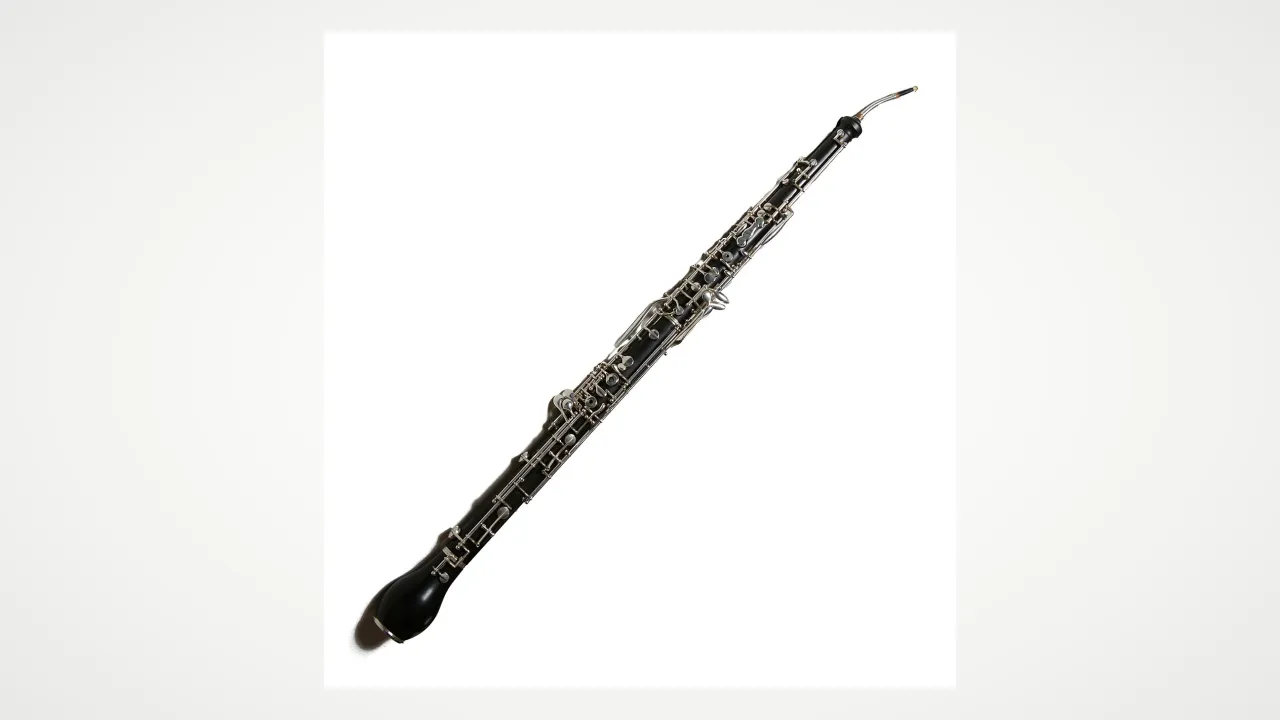
1. What special shape sits at the bottom end of an English horn?
2. Which instrument family does the English horn actually belong to?
🤯 Mind-Blowing Fact • Grade 2
Most orchestral oboists keep an English horn resting on a dual stand right beside their chair so they can switch instruments mid-concert!
✨ Word Sparks (Grade 2 Glossary)
Tap 🔊 to hear
nostalgic
Gentle feeling of remembering faraway cozy places
cor anglais
French name used in orchestral sheet music
crook
Bent small pipe connecting reed to body
🪝
How did a wooden oboe cousin end up with the most puzzling name in the orchestra?
1
Music Like Warm Golden Light
Close your eyes as the orchestra grows hushed and a mellow, melody drifts across the quiet stage. That velvety alto voice belongs to a longer cousin of the oboe that speaks five notes deeper.
2
Curved Metal Crook and Pear Bell
Measuring nearly three feet long, its dark wood body wears two unmistakable clues. At the top, a bent metal pipe called a bocal brings the double reed comfortably to the lips; at the bottom, a hollow pear-shaped bell softens every note.
3
Angled Horn, Not English!
Centuries ago in Central Europe, early versions curved like angel horns or bent bows. In French, cor anglé meant angled horn, which sounded just like —meaning English horn!
1. How did this instrument likely get the word English in its name?
2. How does its pitch compare to a standard oboe?
🤯 Mind-Blowing Fact • Grade 3
An oboist can pick up a cor anglais and use almost the exact same fingerings—every note automatically comes out a fifth lower!
✨ Word Sparks (Grade 3 Glossary)
Tap 🔊 to hear
perfect fifth
Musical interval spanning five diatonic scale steps
pastoral
Music evoking peaceful countryside hills and shepherds
Silesia
Central European region where bulb-bell oboes arose
🪝
What happens inside a pear-shaped wooden bulb when double-reed sound waves pass through it?
1
A Shepherd's Call Across Quiet Hills
Imagine standing on a misty hilltop at dawn while a distant, soulful melody floats across the valley. Whenever composers want to paint wide horizons, homesickness, or peaceful sunrise scenes, they reach for the rich alto voice of the cor anglais.
2
Bocal and Liebesfuss
Stretch an oboe to eighty-two centimeters and two smart design features appear. At the top, a curved metal tube called a bocal angles a slightly wider double reed toward the musician's embouchure. At the bottom, a hollow bulb bell—historically nicknamed Liebesfuss—rounds off bright edges.
3
Solved: A Three-Hundred-Year Name Mystery
Around 1720 in , Central European makers attached bulb bells to curved hunting oboes. Because curved tubes resembled horns held by painted angels, German players called it engellisches Horn—angelic horn—which French speakers translated as cor anglais!
4
Unforgettable Symphonic Solos
Pitched in F, a below the oboe, it stars in Antonín Dvořák's famous Largo from his New World Symphony and Rossini's calm sunrise in the William Tell Overture.
1. Which famous symphony features a beloved, homesick Largo solo written for this instrument?
2. What job does the curved metal bocal do at the top of the instrument?
🤯 Mind-Blowing Fact • Grade 4
Acousticians found that swapping the pear-shaped bulb bell for a flared oboe bell barely changes the lowest notes, because fingered notes actually radiate mostly from open side holes!
✨ Word Sparks (Grade 4 Glossary)
Tap 🔊 to hear
formant
Boosted frequency band shaping vowel-like tone color
oboe da caccia
Curved Baroque hunting oboe ancestor
damping
Softening or reducing sharp sound vibrations
🪝
Why does swelling a woodwind's bell into a hollow pear filter out bright sharpness and leave behind pure warmth?
1
Twilight in the Woodwind Choir
When the brasses fall silent and strings murmur softly like evening wind, a solitary voice rises from the center of the orchestra—darker than an oboe, clearer than a clarinet, and aching with vocal warmth. Few instruments in Western music conjure solitude, memory, or vast landscapes as instantly as this alto double reed.
2
Cavity Resonance Inside the Bulb Bell
Measuring roughly 82 centimeters from reed tip to bottom opening, this F-transposing cousin of the oboe sounds a perfect fifth lower than written, spanning concert E3 to C6. Its secret weapon sits at both ends of its narrow conical grenadilla bore: a precision-tapered metal bocal up top and the pear-shaped Liebesfuss bulb bell below. Acoustically, that bulbous chamber with its constricted rim acts as a resonant filter, reinforcing warm mid-low around 500 to 1,100 Hz while gently shrill high partials.
3
From Curved Hunting Horns to Straight Hardwoods
Around 1720, Silesian craftsman Johann Tischer mated a bulbous bell to the curved, leather-wrapped used in Johann Sebastian Bach's sacred passions. In Middle High German, engellisch meant both angelic and English, and because curved instruments mirrored angels' horns in church frescoes, French musicians adopted cor anglais—later straightened in nineteenth-century Paris by Guillaume Triébert and François Lorée.
4
Iconic Voices Across Opera and Symphony
Hector Berlioz championed its melancholy poetry in Symphonie fantastique, Richard Wagner gave it an unforgettable unaccompanied shepherd's lament in Tristan und Isolde, Jean Sibelius glided it over dark strings in The Swan of Tuonela, and Antonín Dvořák immortalized its warm glow in his New World Symphony.
1. How does the hollow pear-shaped bulb bell shape the instrument's tone color?
2. Which Baroque ancestor preceded the straight nineteenth-century design?
🤯 Mind-Blowing Fact • Grade 5
Acoustic tests reveal that swapping just the tiny curved metal bocal at the top alters pitch response and tone color across every note more dramatically than removing the pear-shaped bell!
✨ Word Sparks (Grade 5 Glossary)
Tap 🔊 to hear
impedance
How strongly an air column resists wave motion
attenuate
To weaken or reduce high sound energy
organology
Scientific and historical study of musical instruments
🪝
How do a tiny bent metal bocal and a constricted pear-shaped cavity sculpt the orchestra's most haunting vowel-like timbre?
1
An Etymological Paradox With an Unmistakable Soul
Voltaire once joked about titles that contradict every word they contain, and organologists love pointing to the orchestra's supreme example: an instrument neither English in origin nor a brass horn in construction. Yet the moment its veiled, vocal alto line floats out over hushed strings, terminology vanishes behind one of music's most deeply expressive timbres.
2
Conical Bore Geometry and Formant Filtering
Classified as a double-reed conical aerophone pitched in F—sounding a perfect fifth (seven semitones) below notation—the modern instrument measures roughly 81 to 84 centimeters and spans concert E3 (~164.8 Hz) to C6 (~1,046.5 Hz). Vibrations begin in two gouged and scraped Arundo donax blades mounted directly onto a curved, steeply tapered metal crook called the bocal, which acts as the crucial initial segment of the conical bore. At the opposite end sits the Liebesfuss ('foot of love'), a bulbous grenadilla chamber with an inward-curving lip. Acoustic studies show this Helmholtz-like cavity creates a distinctive formant peak near 900–1,100 Hz—closely matching the human 'aw' and 'oh' sung vowels—while attenuating piercing frequencies above 3,000 Hz.
3
Why the Bocal Matters Even More Than the Bulb
Because sound waves escape primarily through the uppermost open tone holes on fingered notes rather than traveling all the way out the bell, acousticians discovered a surprising truth: the bocal's internal taper, wall thickness, and alloy (silver, brass, or gold) influence pitch stability and tonal warmth across the entire compass even more strongly than the bulb bell!
4
From Silesian Angels to Parisian Workshops
Emerging around 1720 in Silesia when builders like Johann Tischer fitted bulb bells onto curved oboi da caccia, the angled silhouette echoed celestial horns in religious art, inspiring the German term engellisches Horn ('angelic horn'). Spoken identically to 'English' in Middle High German, the name crossed into French as cor anglais. Between the 1830s and 1880s, Parisian masters Guillaume Triébert and François Lorée replaced awkward curved wooden bodies with straight Conservatoire-system grenadilla joints.
5
Poet of Longing in Symphonic Literature
Hector Berlioz praised its 'melancholy, dreamy, and noble' character in his 1844 orchestration treatise after pairing it with an offstage oboe in Symphonie fantastique. Whether mourning across desolate seas in Wagner's Tristan und Isolde, gliding dark waters in Sibelius's The Swan of Tuonela, or singing Dvořák's iconic Largo in Symphony No. 9, it remains the orchestra's supreme voice of reflection.