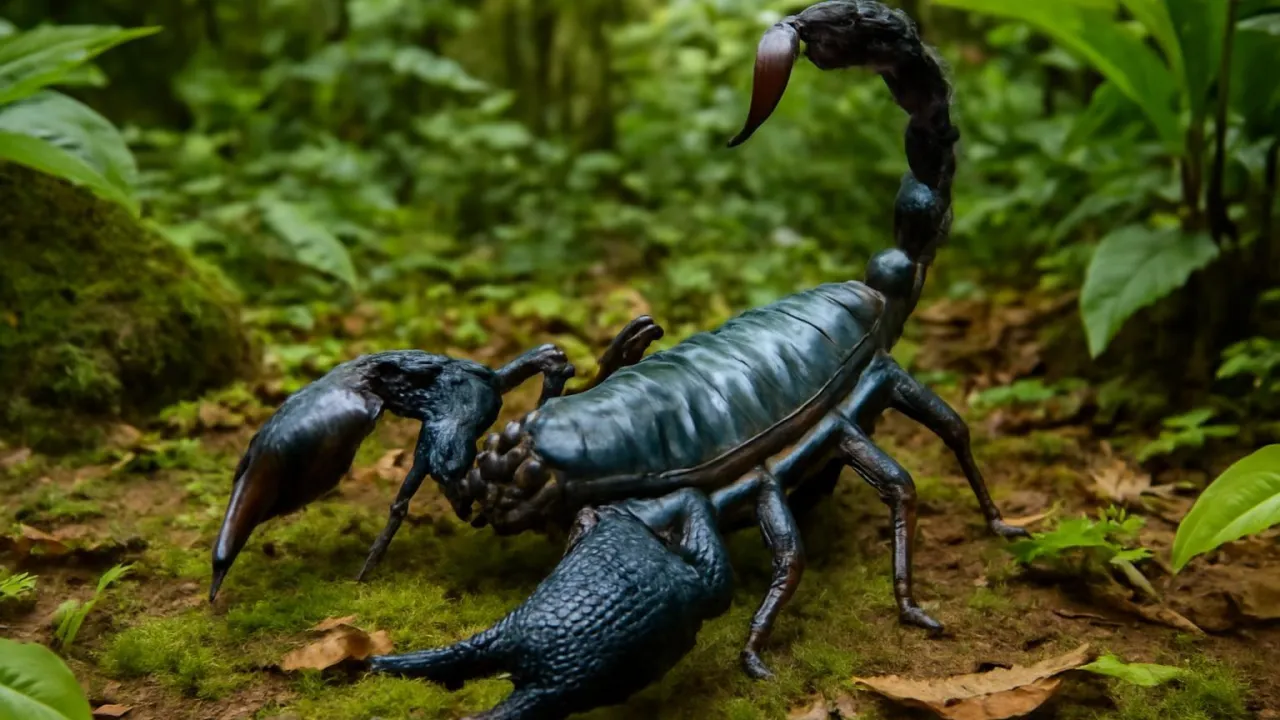
Emperor scorpions can glow green-blue when ultraviolet light shines on their armor!
✨ Word Sparks (Grade 2 Glossary)
Tap 🔊 to hear
prey
Animals that are hunted for food
ultraviolet
A special light that we cannot see
savanna
A warm, grassy land with few trees
🪝
Have you ever seen a scorpion glow in the dark at night?
1
Big Scorpion with Shiny Armor
The emperor scorpion is one of the largest scorpions in the world. It has shiny black armor that protects its body. It walks on eight strong legs and uses big pincers to catch .
2
Where It Lives and Hides
This scorpion lives in warm rainforests and of West Africa. It hides under rocks, logs, and leaves during the day. It comes out at night when it is cooler to hunt for food.
3
What It Eats and How It Defends
The emperor scorpion eats insects and small animals like worms. It uses its pincers to grab food and stings with its tail to protect itself from enemies. It glows green-blue under light, which is very cool.
1. Where does the emperor scorpion hide during the day?
2. What special light makes the scorpion glow?
🤯 Mind-Blowing Fact • Grade 3
The emperor scorpion’s glowing shell may help it find mates or avoid predators at night.
✨ Word Sparks (Grade 3 Glossary)
Tap 🔊 to hear
exoskeleton
Hard outer shell that protects some animals
nocturnal
Active at night and sleeps during day
camouflage
Colors or patterns that help hide animals
🪝
Did you know the emperor scorpion uses its glowing shell to help it survive?
1
Large Scorpion with Protective Armor
The emperor scorpion is one of the largest scorpions found in West Africa. Its shiny black acts as armor to protect it from predators. This hard shell also helps prevent water loss in dry environments. Its powerful pincers are used to catch prey and defend itself.
2
Habitat and Nocturnal Behavior
Emperor scorpions live in rainforests and savannas where they hide under logs and rocks. They are , meaning they come out at night to hunt. This behavior helps them avoid daytime heat and predators. Their dark color provides in the shadows.
3
Diet and Hunting Techniques
They mainly eat insects, spiders, and small animals, using pincers to grab prey. Their venomous sting helps subdue prey and defend against predators. The scorpion’s slow movements help it sneak up on food without being noticed. It relies on its strong sense of touch to find prey in the dark.
4
Glowing Ability and Survival
Under ultraviolet light, the emperor scorpion’s shell glows a bright green-blue color. Scientists believe this glow may help scorpions find each other or confuse predators. This glowing trait is a special adaptation that helps them survive in their environment. It is caused by chemicals in their reacting to UV light.
2. What might the glowing shell help the scorpion do?
🤯 Mind-Blowing Fact • Grade 4
The emperor scorpion’s glowing shell may help it communicate or scare off predators in its habitat.
✨ Word Sparks (Grade 4 Glossary)
Tap 🔊 to hear
ecosystem
All living things and their homes working together
nocturnal
Active at night and sleeps during the day
predator
Animal that hunts other animals for food
🪝
How does the emperor scorpion’s glowing shell affect its role in the ecosystem?
1
Physical Features and Adaptations
The emperor scorpion can grow up to eight inches long and has a tough exoskeleton that protects it from and harsh environments. Its large pincers help it catch prey and defend itself, while its dark color provides camouflage in the forest floor’s shadows. The glowing shell under ultraviolet light is thought to be a form of communication or predator deterrence.
2
Habitat and Behavior Patterns
This scorpion inhabits the rainforests and savannas of West Africa, where it hides under rocks and logs during the day to avoid heat and . It is , hunting insects and small animals at night when temperatures are cooler. Its slow and careful movements help it sneak up on prey, playing an important role in controlling insect populations in its .
3
Ecosystem Role and Human Impact
As a , the emperor scorpion helps balance insect populations, which benefits plants and other animals in the food web. It also serves as prey for larger animals, contributing to the ’s diversity. Unfortunately, habitat loss and collection for the pet trade threaten some populations, showing how human activities can impact this species.
4
Geographic Distribution and Conservation
The emperor scorpion is native to West African countries such as Ghana, Togo, and Ivory Coast. Conservation efforts focus on protecting its natural habitat and regulating trade to prevent over-collection. Understanding its glowing ability and behavior helps scientists develop better strategies to conserve this fascinating species.
1. What role does the emperor scorpion play in its ecosystem?
2. Why is the emperor scorpion’s glowing shell important?
🤯 Mind-Blowing Fact • Grade 5
Emperor scorpions glow because chemicals in their exoskeleton react to ultraviolet light, a rare trait among arthropods.
✨ Word Sparks (Grade 5 Glossary)
Tap 🔊 to hear
fluorescence
Light glow caused by special chemicals
sexual dimorphism
Differences in size or shape between males and females
mechanoreceptors
Body parts that sense touch and movement
🪝
How do the emperor scorpion’s unique features and glowing ability help it survive in West Africa?
1
Scientific Classification and Physical Traits
The emperor scorpion, scientifically named Pandinus imperator, belongs to the family Scorpionidae and order Scorpiones. It is among the largest scorpions, reaching lengths up to eight inches (20 centimeters). Its exoskeleton is composed of chitin, providing both protection and structural support. The species exhibits , with males generally smaller and more slender than females.
2
Physiological Mechanics and Behavior
This scorpion’s exoskeleton contains fluorescent chemicals that react to ultraviolet light, causing it to glow bright green-blue. The glow’s exact biological function remains under study, but hypotheses include mate attraction, predator deterrence, and UV protection. Emperor scorpions are nocturnal predators, relying on and chemoreceptors in their pincers and legs to detect prey. Their venom is relatively mild to humans but effective in subduing insects.
3
Ecological Role and Conservation Challenges
Emperor scorpions play a vital role in their ecosystem by controlling insect populations and serving as prey for larger animals such as birds and mammals. Habitat destruction due to deforestation and collection for the exotic pet trade threaten their populations. Conservation efforts include habitat preservation and regulated trade to ensure sustainable populations in the wild.
4
Botanical History and Cultural Significance
The emperor scorpion has fascinated humans for centuries, appearing in folklore and traditional medicine across West Africa. Its impressive size and glowing ability have made it a popular species in exotic pet keeping worldwide. Scientific studies of its physiology have contributed to understanding arthropod and venom composition.
5
Quantitative Comparisons and Environmental Adaptations
Emperor scorpions can weigh up to 30 grams and move at speeds around 0.4 miles per hour (0.6 kilometers per hour). They thrive in temperatures ranging from 75 to 90 degrees Fahrenheit (24 to 32 degrees Celsius). Their thick exoskeleton minimizes water loss, an essential adaptation for survival in both humid rainforests and drier savannas.