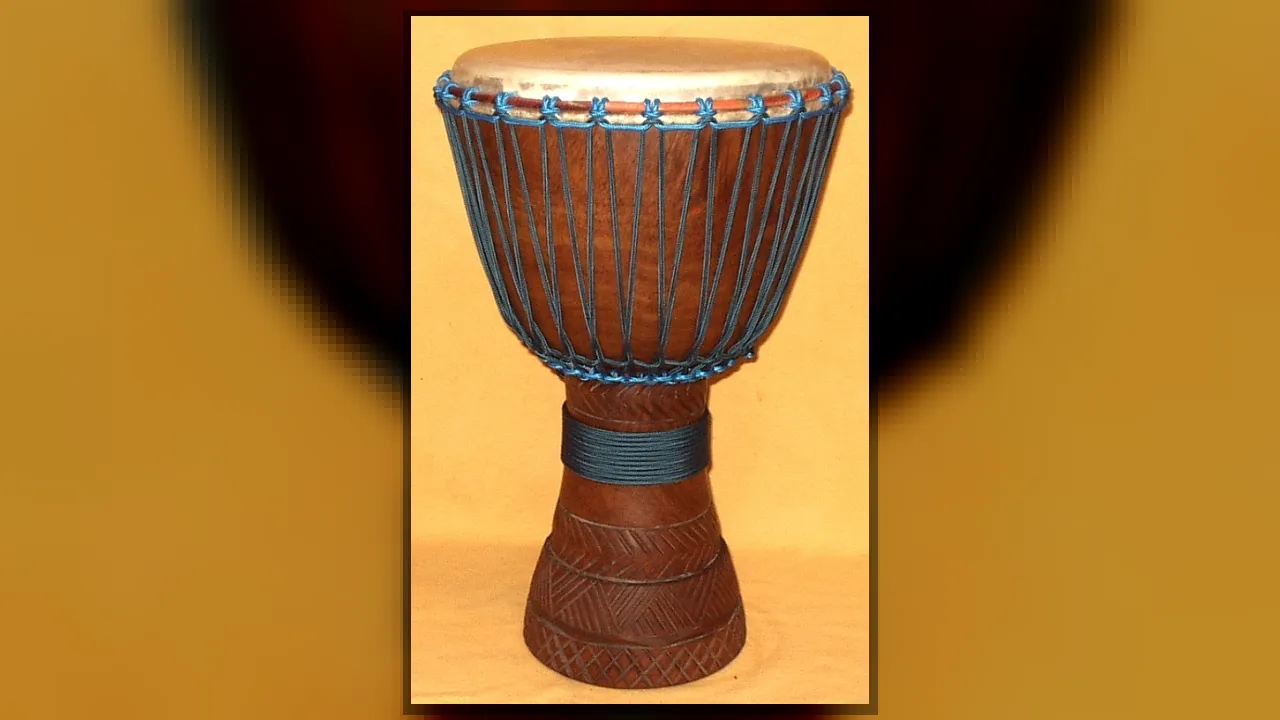
1. Where do you hit a djembe with your open hand to get its deepest 'boom' sound?
2. What peaceful message is linked to the West African name 'djembe'?
🤯 Mind-Blowing Fact • Grade 2
Traditional West African djembes sometimes wear detachable metal ears called sege-sege dotted with tiny iron rings that sizzle and buzz on every drumbeat!
✨ Word Sparks (Grade 2 Glossary)
Tap 🔊 to hear
slap
Sharp, high cracking stroke near the rim
goatskin
Tough, thin animal hide stretched as drumhead
flare
Widen outward smoothly like a trumpet bell
🪝
Why must a player tilt a djembe slightly instead of resting its bottom flat against the ground?
1
Three Voices in Two Bare Hands
Gung—go-do—PAHT! Stand in a sunlit West African courtyard as a master drummer's hands blur across a goblet-shaped wooden drum! Without using a single stick, the djembe unleashes thunderous bass, singing middle tones, and whip-sharp .
2
One Tree Trunk, Open at the Bottom
Artisans carve each djembe shell from a single piece of dense West African hardwood, then stretch shaved tightly over the bowl using three iron rings and dozens of braided vertical ropes. Unlike closed bucket drums, the narrow stem opens wide at the very bottom!
3
Let the Sound Escape!
If you set the open bottom flat on the floor, the deep bass gets trapped inside! Players tilt the drum slightly between their knees—or hang it from a strap—so booming air waves rush freely out the bottom!
1. Why does a seated drummer tilt a djembe slightly forward instead of pressing its base flat onto the floor?
2. What are the three classic strokes every djembe student learns to play with bare hands?
🤯 Mind-Blowing Fact • Grade 3
In the Mandinka language of West Africa, a person who gives life to the djembe by playing it is honored with the title djembefola!
✨ Word Sparks (Grade 3 Glossary)
Tap 🔊 to hear
djembefola
Skilled musician who brings the djembe alive
throat
Narrow middle passage connecting bowl and base
dunun
Stick-played West African bass drum accompanying djembes
🪝
Why is a djembe carved like a giant drinking goblet instead of a straight tube?
1
Outdoor Megaphone of West Africa
Gung-paht, go-do-paht! Long before microphones or speakers existed, a single master djembe player—called a —could project crisp, dancing rhythms from one West African village hillside all the way to the next! Every curve of its carved wooden body works as natural acoustic science.
2
Bowl, Narrow Throat, and Flared Foot
Why carve a goblet shape from solid lenke hardwood? First, the wide round bowl underneath the goatskin head acts as a deep air chamber that enriches low bass strokes. Next, the narrow waist—or —squeezes rushing air waves and filters out muddy echoes. Finally, the flared lower stem acts just like a megaphone horn, launching tremendous volume outward!
3
The Ingenious 'Mali Weave' Tuning Knot
To make rim slaps crack like lightning, the thin shaved goatskin must sit under enormous tension. Drummers weave horizontal rope twists sideways through pairs of vertical ropes—a clever knot pattern called the Mali weave—ratcheting the skin drum-tight without a single metal screw!
4
Eight Centuries of Mandinka Heritage
Created over eight hundred years ago in the Mali Empire by skilled numu blacksmith-woodcarvers across Guinea, Mali, Senegal, and Ivory Coast, the djembe traditionally interlocks with three deep cylindrical bass drums called .
1. How does the flared bottom stem of a goblet-shaped djembe help its sound?
2. How do traditional drummers tighten a djembe's goatskin head without metal tuning bolts?
🤯 Mind-Blowing Fact • Grade 4
Carvers deliberately leave faint spiral chisel grooves or smooth high-density hardwood inside a djembe's throat to manage air turbulence as high-speed pressure waves rocket out the bottom!
✨ Word Sparks (Grade 4 Glossary)
Tap 🔊 to hear
decibels
Units measuring how powerful or loud sound is
turbulence
Swirling, tumbling motion in fast-moving air
ensemble
Group of musicians performing woven parts together
🪝
How can bare human hands make an unamplified wooden drum louder than 105 decibels—matching a power saw?
1
Acoustic Powerhouse of the Mali Empire
Stand ten meters in front of a West African percussion in Conakry or Bamako when the lead djembefola unleashes a solo break: whip-crack slaps sting your ears above 105 while sub-bass pulses thump right in your sternum! Few hand drums on Earth span such an extreme pitch and volume range.
2
Helmholtz Bowl Meets Exponential Horn
Acoustically, the goblet shell unites two powerful resonators inside one solid log of ultra-dense lenke or dugura hardwood. When a relaxed open palm rebounds off the center of the head, the wide upper bowl and narrow cylindrical throat behave like a Helmholtz resonator—the same physics that makes blowing across a big glass jug boom around 65 to 80 hertz! Meanwhile, striking near the rim with stiff, aligned fingers produces focused mid-tones (~350–450 hertz), whereas letting relaxed fingertips whip just inside the rim under high goatskin tension unleashes razor-sharp high overtones above 1,000 hertz, projected cleanly by the dense, non-absorbent hardwood interior and flared foot.
3
Interlocking Polyrhythms With the Dunun Trio
In authentic Mandinka celebration music, a djembe never plays alone! Behind the soloists stand three two-headed cylindrical bass drums—kenkeni (high), sangban (middle), and doundounba (low)—played with wooden sticks in one hand and iron bells in the other, weaving hypnotic 12/8 and 4/4 polyrhythmic conversations with dancers' footsteps.
4
Les Ballets Africains to Global Fame
Guarded for centuries by hereditary West African artisans and musicians, the djembe astonished world audiences in the 1950s when Guinean choreographer Fodéba Keïta's Les Ballets Africains—featuring legendary master Papa Ladji Camara—toured Europe and the Americas.
1. Why is dense tropical hardwood like lenke so prized for carving concert djembes compared to soft pine?
2. Which trio of stick-and-bell bass drums traditionally anchors West African Mandinka djembe ensembles?
🤯 Mind-Blowing Fact • Grade 5
A fully tensioned concert djembe places over 1,000 kilograms (more than a metric ton!) of combined downward rope force onto its wooden shell rim—all tightened purely by hand-pulled braided knots without a single metal bolt!
✨ Word Sparks (Grade 5 Glossary)
Tap 🔊 to hear
impedance
How smoothly sound energy transfers into open air
ostinato
Short musical pattern repeating steadily underneath solos
axisymmetric
Vibrating evenly all around a center point
🪝
How do Helmholtz cavity resonance, thin-membrane tension mechanics, and Mandinka polyrhythmic architecture make the goblet-carved djembe one of humanity's widest-spectrum hand drums?
1
Eight Centuries of West African Organology
Forged during the thirteenth-century rise of Sundiata Keita's Mali Empire by hereditary numu blacksmith-sculptors across the Manden heartland (modern Guinea, Mali, eastern Senegal, Burkina Faso, and Côte d'Ivoire), the djembe—classified in Hornbostel-Sachs organology as a single-headed open goblet membranophone (211.261.2)—achieves a wider timbral and dynamic span than almost any unamplified hand drum on Earth.
2
Coupled Helmholtz-Horn Shell Acoustics
Hewn green from a single solid trunk of high-density hardwood such as lenke (Afzelia africana, ~750–850 kg/m³), dugura, or khadi—standing 58 to 63 centimeters tall with a 30-to-38-centimeter playing crown—the shell divides acoustically into three coupled zones: a hemispherical upper bowl, a constricted central throat (~15–18 centimeters internal diameter), and a conical flared foot. When a flat palm excites the fundamental (0,1) membrane mode at the center of the head, the enclosed bowl volume and narrow throat constriction act as a low-frequency vented Helmholtz resonator, boosting chest-shaking bass fundamentals between 60 and 85 hertz! Conversely, the rigid, resinous interior wood boundary minimizes wall absorption while the flared foot matches acoustic to outside air like an exponential horn.
3
Shaved Caprine Membrane and 'Mali Weave' Tension
Why goatskin rather than thick cowhide as on Cuban congas? Unbleached, razor-shaved West African goatskin (~0.6 to 1.0 millimeter thin) tolerates immense radial tension without excessive bending stiffness. Locked between three fabric-wrapped steel flesh-and-counter hoops and tensioned by 5-millimeter low-stretch polyester ropes, progressive horizontal 'Mali weave' twists multiply mechanical advantage across twenty-four to thirty-two vertical pairs. At concert tension, a firm closed-finger rim strike excites clear (1,1) and (2,1) harmonic-like 'tones' (~350–440 hertz), while a whip-like open-finger 'slap' launches transient partials peaking above 1,200 to 3,500 hertz at sound-pressure levels exceeding 105 decibels!
4
Polyrhythmic Dialogue and Dancer Synchronization
Anchored by the melodic- interlocking of three stick-and-bell cylindrical bass drums—kenkeni, sangban, and doundounba—in ternary (12/8) or binary (4/4) feels, the lead djembefola cues ensemble transitions ('echauffements' and 'breaks') while mirroring every accented leap of celebratory dancers in pieces such as Kuku, Yankadi, and Mendiani, often adorned with buzzing sheet-iron mirliton ears (sege-sege / kesing-kesing).
5
Global Transmission and Living Mastery
Propelled internationally following Guinea's 1958 independence by national ensembles Les Ballets Africains and Percussions de Guinée—and legendary virtuosi Papa Ladji Camara, Mamady Keïta, and Famoudou Konaté—the djembe thrives worldwide while honoring its sacred communal roots.