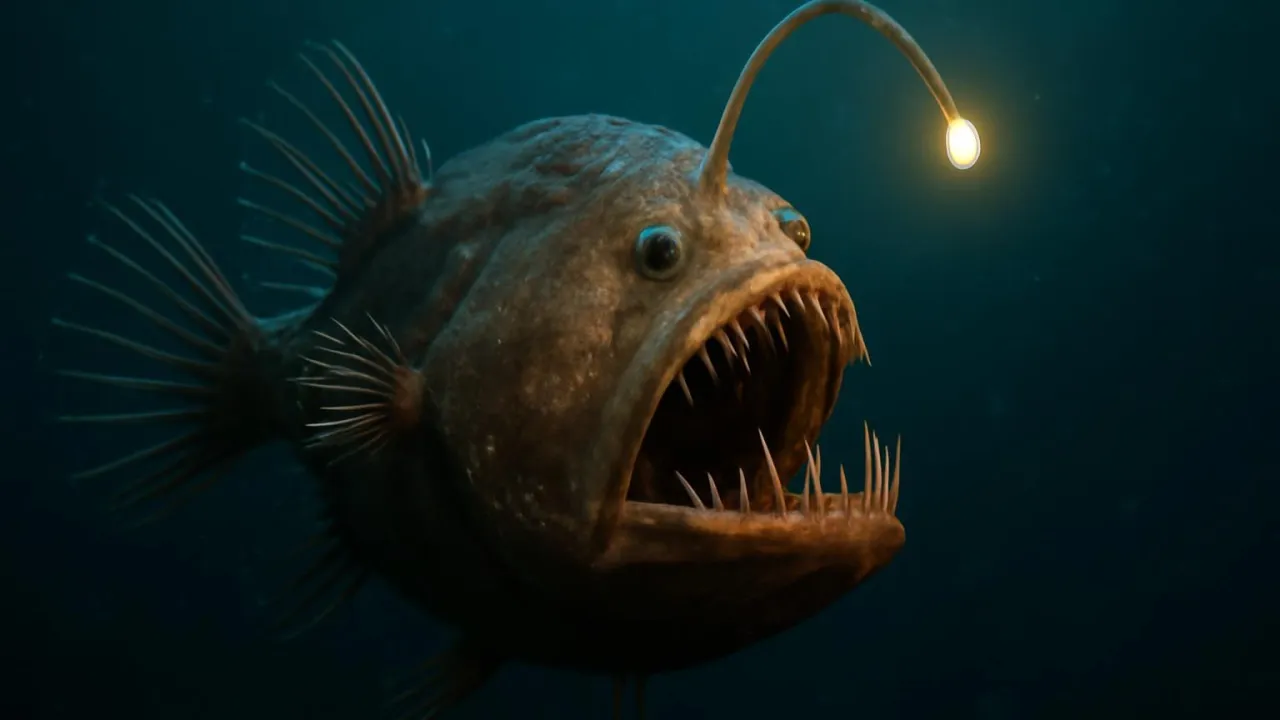
The anglerfish’s glowing lure uses tiny glowing bacteria to light up the dark ocean!
✨ Word Sparks (Grade 2 Glossary)
Tap 🔊 to hear
adapted
Changed to live well in a new place
crustaceans
Small sea animals with hard shells like crabs
lure
Something that attracts or tricks animals
🪝
How does a fish use a glowing light to hunt in dark water?
1
Living Deep in the Ocean
The deep-sea anglerfish lives very far down in the ocean where sunlight cannot reach. It stays in cold, dark water almost two thousand meters deep. This fish has to survive in this dark place. It uses a special glowing light on its head to find food.
2
A Strange and Spooky Look
The anglerfish has a round body with big, sharp teeth that help it catch prey. Its skin is dark to blend into the ocean’s blackness. It swims slowly and waits for small fish or to come close. Then it snaps them up quickly with its large mouth.
3
The Glowing Lure
The glowing on its head is made of special bacteria that shine light. This light attracts curious fish and other animals. When they come near, the anglerfish grabs them easily. This glowing lure is the anglerfish’s secret hunting tool in the deep sea.
2. What helps the anglerfish blend into its deep ocean home?
🤯 Mind-Blowing Fact • Grade 3
Male deep-sea anglerfish fuse to females and live as tiny parasites for life!
✨ Word Sparks (Grade 3 Glossary)
Tap 🔊 to hear
bioluminescent
Making light using a natural chemical process
predator
An animal that hunts and eats other animals
parasite
An animal that lives on another and gets food
🪝
What clever tricks help the deep-sea anglerfish survive in total darkness?
1
Living in the Deep Sea
The deep-sea anglerfish lives in the ocean’s midnight zone where sunlight never reaches. This environment is cold and pitch black, so the fish must adapt to survive. It uses camouflage by having dark skin that blends into the dark water. This helps it hide from and sneak up on prey.
2
The Glowing Lure
The anglerfish has a special glowing lure on its head called an esca. This lure contains bacteria that produce light to attract prey. The anglerfish waves the lure like a fishing rod to trick curious fish. This adaptation helps it catch food in the deep ocean where hunting is very hard.
3
Feeding and Hunting
The anglerfish is a that eats small fish and crustaceans. It waits patiently and uses its glowing lure to attract prey close. When prey comes near, it opens its large mouth quickly to swallow it whole. Its sharp, needle-like teeth prevent prey from escaping once caught.
4
Life Cycle and Mating
Male anglerfish are much smaller and attach to females permanently, becoming . This strange adaptation ensures mating in the dark deep sea where finding a partner is difficult. The male provides sperm while living off the female’s body. This unique life cycle helps the species survive.
The anglerfish’s glowing lure depends on bacteria living inside it, a special symbiotic partnership!
✨ Word Sparks (Grade 4 Glossary)
Tap 🔊 to hear
symbiosis
A close relationship where both help each other
abyssal
Very deep ocean zone with no sunlight
reproductive
Related to making babies or offspring
🪝
How does the deep-sea anglerfish’s glowing lure affect its role in the ocean ecosystem?
1
Adaptations for Deep Ocean Life
The deep-sea anglerfish lives in the ocean’s zone where sunlight never penetrates, forcing it to develop unique adaptations. Its bioluminescent lure attracts prey in the pitch-black environment, which is essential for its survival. The fish’s dark, camouflaged body helps it avoid predators and ambush prey effectively. These adaptations demonstrate cause and effect in its extreme habitat.
2
Role in the Food Web
As a predator, the anglerfish plays a key role in the deep-sea food web by controlling populations of small fish and crustaceans. Its glowing lure not only attracts prey but also influences the behavior of other deep-sea creatures. This symbiotic relationship with bioluminescent bacteria allows the anglerfish to thrive in an ecosystem with scarce food. Its presence helps maintain balance in the deep ocean.
3
Reproductive Strategy
Male anglerfish are tiny compared to females and permanently attach to them, becoming parasitic mates. This adaptation ensures that females have a constant sperm supply in the vast, dark ocean where encounters are rare. This unique life cycle increases the species’ chances of survival and continuation. It is an example of how environment shapes reproductive behavior.
4
Geographic Distribution and Human Impact
Deep-sea anglerfish are found worldwide in deep ocean waters, mostly between 660 and 6600 feet deep. Human activities like deep-sea fishing and pollution may threaten their habitat, although little is known about their population status. Protecting deep-sea environments helps preserve this fascinating species and the delicate balance of ocean ecosystems. Increased research is vital for conservation efforts.
1. How does the anglerfish’s glowing lure help it survive?
2. Why do male anglerfish attach to females?
🤯 Mind-Blowing Fact • Grade 5
Male deep-sea anglerfish permanently fuse to females, becoming living sperm suppliers for life!
✨ Word Sparks (Grade 5 Glossary)
Tap 🔊 to hear
bathypelagic
The deep ocean zone with no sunlight
sexual parasitism
When a male lives on a female forever
bioluminescence
Light made by living things using chemicals
🪝
What fascinating adaptations allow the deep-sea anglerfish to thrive in the darkest ocean depths?
1
Scientific Classification and Habitat
The deep-sea anglerfish, scientifically named Melanocetus johnsonii, belongs to the family Melanocetidae. It inhabits the zone of the ocean, typically between 660 and 6600 feet deep, where sunlight is absent. This species is distributed globally in temperate and tropical deep waters. Its environment is characterized by extreme pressure, near-freezing temperatures, and complete darkness.
2
Physiological Adaptations and Bioluminescence
This anglerfish exhibits remarkable physiological adaptations, including a large head, enormous jaws, and sharp, inward-pointing teeth to capture prey effectively. Its bioluminescent lure, the esca, contains symbiotic bacteria that produce light through a chemical reaction called . This light attracts prey in the pitch-black environment, enabling the anglerfish to conserve energy by ambushing rather than chasing food.
3
Unique Reproductive Strategy
Male deep-sea anglerfish are significantly smaller than females and exhibit by permanently attaching to the female’s body. This fusion allows males to obtain nutrients directly from females while providing sperm whenever reproduction is possible. This strategy ensures reproductive success in the vast, sparsely populated deep ocean, where encounters between mates are rare.
4
Conservation and Human Impact
Although the deep-sea anglerfish is not currently classified as endangered, its deep ocean habitat faces threats from human activities such as deep-sea trawling and pollution. These actions may disrupt fragile ecosystems and bioluminescent communities. Conservation efforts require more research to understand population dynamics and to protect these unique deep-sea organisms and their habitats.
5
Quantitative Comparisons and Survival Challenges
The deep-sea anglerfish grows up to 8 inches (20 centimeters) long and lives at depths reaching 2000 meters, where water pressure exceeds 200 atmospheres. Its bioluminescent lure glows with light intensity comparable to a small flashlight but uses very little energy. Survival in such extreme conditions requires specialized adaptations to low temperatures near 2 degrees Celsius and complete darkness.