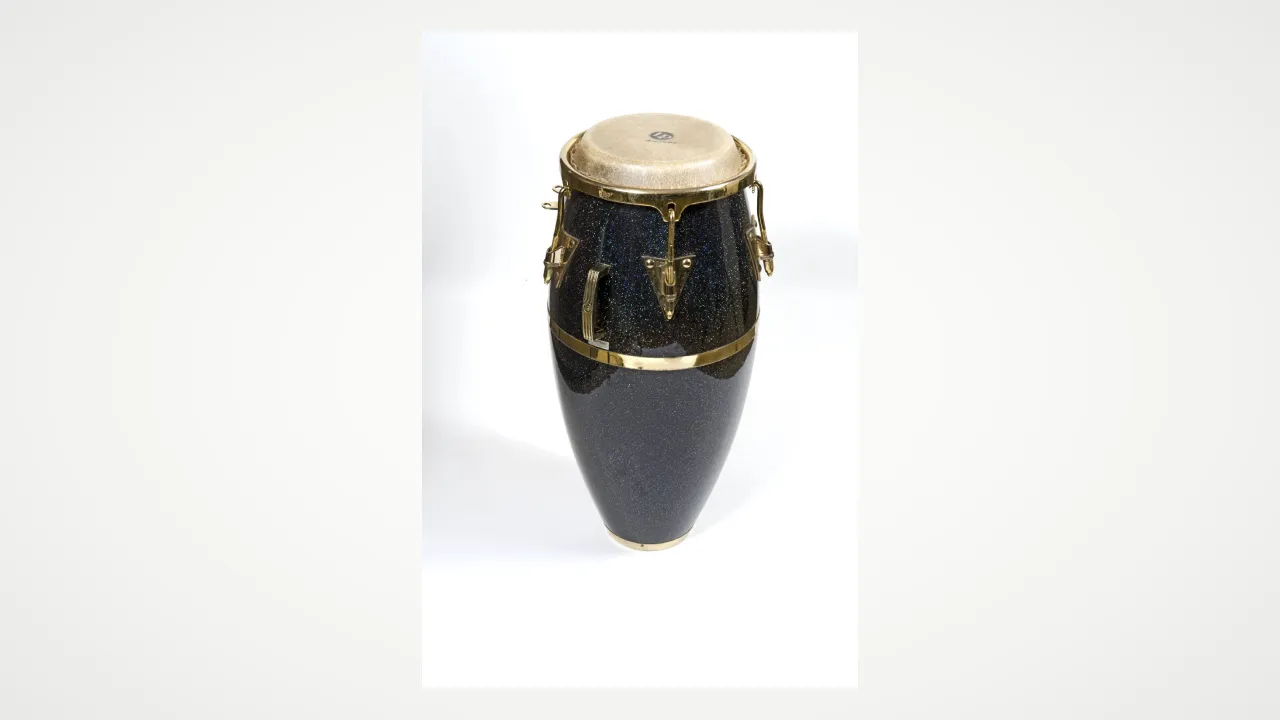
1. What do musicians usually use to strike conga drums?
2. Why is the bottom of a conga drum left open?
🤯 Mind-Blowing Fact • Grade 2
Before metal tuning wrenches were added in the 1940s, Cuban drummers tuned rawhide conga heads by warming them carefully beside glowing charcoal fires!
✨ Word Sparks (Grade 2 Glossary)
Tap 🔊 to hear
staves
Narrow wooden strips glued into curved barrels
rawhide
Tough natural animal skin dried without tanning
carnival
A joyful outdoor festival with parade music
🪝
What would happen if old wooden barrels were turned into dancing drums?
1
Heartbeat of the Street Parade
Tun-kun, pa-ka, tun-tun! Down a colorful street in Havana, Cuba, a lively rhythm gets everyone clapping in time. At the center of the band stand three tall, curving drums that shine like polished honey.
2
From Wooden Staves to Singing Skins
Long ago in Cuba, clever builders glued narrow wooden strips called into tapered barrels, much like old shipping casks. Thick stretches tightly across the top rim while metal hooks hold the tuning steady. Even though one player often plays two or three drums together, sticks stay in the bag!
3
Five Voices in Two Hands
Cupping your palm in the middle creates a deep boom, while snapping relaxed fingertips near the edge makes a sharp crack. Each hand move unlocks a brand-new musical voice!
1. How are traditional wooden conga shells constructed?
2. How does a drummer make a sharp, cracking slap sound on a conga?
🤯 Mind-Blowing Fact • Grade 3
Cuban percussion trailblazer Candido Camero was one of the first musicians to tune three conga drums to specific musical notes so he could play melodies all by himself!
✨ Word Sparks (Grade 3 Glossary)
Tap 🔊 to hear
resonance
Rich lingering sound inside a hollow space
timbre
Unique tone color distinguishing different musical sounds
quinto
Smallest highest-pitched lead drum in conga sets
🪝
Why do percussionists line up three different widths of conga drums on stage?
1
Meet the Cuban Tumbadora
Step onto a salsa concert stage and listen before the brass horns play a single note: a rolling wave of warm tones and whip-crack slaps already drives the groove. Although people worldwide call these instruments conga drums after a Cuban carnival dance, musicians in Cuba call the drum itself a tumbadora.
2
Tumba, Conga, and Quinto
Just like singers in a choir, tumbadoras come in different sizes that control their pitch. The widest drum, the tumba, rumbles with deep low . Beside it sits the mid-sized conga, while the narrowest drum, the , sings at the highest frequency so its improvised solos soar above the band.
3
Shaping Timbre with Bare Hands
By changing hand shape and contact time on the thick mule-skin or buffalo-skin membrane, one player commands five classic strokes. Leaving the hand off the skin lets an open tone ring, whereas holding the palm down muffles overtones into a dry thud.
4
The Tumbao Engine
Woven together in a steady rocking heel-toe motion called the tumbao, these contrasting lock closely with the bass guitar, powering salsa, Latin jazz, funk, and pop songs across every continent.
1. Which drum in a three-drum conga setup has the narrowest head and highest pitch for solos?
2. What happens acoustically when a drummer leaves their hand pressed down on the skin after striking?
🤯 Mind-Blowing Fact • Grade 4
Cooperage—the exact wood-bending and stave-joining craft once used to build leak-proof wooden rum barrels—gave early Cuban drum makers the blueprint for strong, resonant tumbadora shells!
✨ Word Sparks (Grade 4 Glossary)
Tap 🔊 to hear
cooperage
Traditional craft of building curved wooden barrels
polyrhythm
Two or more contrasting rhythms played together
fundamental
Lowest main pitch produced by vibrating objects
🪝
How does the curved belly of a conga shell act like a natural acoustic amplifier without electricity?
1
Roots Across the Atlantic
Close your eyes in a packed Havana dance hall and trace the rhythm pulsing beneath the piano and trumpets: heel, tip, slap, boom-boom! That unmistakable heartbeat belongs to the tumbadora, born in Cuba during the late nineteenth and early twentieth centuries. Afro-Cuban artisans blended ancestral Central African Kongo barrel-drumming traditions—such as makuta drums—with European , the barrel-making craft used for shipping sugar and wine.
2
Tapered Geometry and Air-Column Physics
Look closely at a conga's silhouette and you will notice it is neither a straight tube nor a simple cone; instead, its stave-built hardwood or fiberglass shell swells outward in the middle before narrowing toward an open bottom port. When a bare palm strikes the thick rawhide membrane, downward air pressure compresses inside that rounded chamber and accelerates through the narrower exit. Like a tuned acoustic megaphone, the tapered air column reinforces warm frequencies between 110 and 240 hertz while filtering out harsh metallic ring.
3
Mastering the Five-Stroke Vocabulary
Because drummers play without sticks, subtle shifts in hand curvature completely transform how the membrane vibrates. A flat palm in the center excites the whole head for deep bass; four firm fingers near the rim trigger a singing open tone; a cupped-finger grab traps air for a sharp, popping slap that slices through loud horn sections. Meanwhile, rocking the palm heel and fingertips creates quiet ghost notes that glue fast grooves together.
4
When Chano Pozo Electrified Jazz
In 1947, Cuban virtuoso Chano Pozo brought his tumbadora into Dizzy Gillespie's New York big band, fusing Afro-Cuban with bebop improvisation. Within a single decade, mechanical lug tuning allowed travelling percussionists to hold pitch under hot stage lights, cementing congas in soul, rock, and global pop.
1. How does the swelling middle and narrowed open bottom of a conga shell shape its sound?
2. Which partnership in 1947 famously united Afro-Cuban conga rhythms with American bebop jazz?
🤯 Mind-Blowing Fact • Grade 5
Thick mule skin has long been prized by master conga players because its dense collagen fibers resist stretching under high tension while delivering warm, rounded tones that protect bare hands during hours of intense playing!
✨ Word Sparks (Grade 5 Glossary)
Tap 🔊 to hear
syncopated
Emphasizing unexpected off-beats within a musical rhythm
partials
Individual frequency waves combining inside complex tones
aperture
An engineered opening where sound waves exit
🪝
How do membrane thickness, Helmholtz cavity coupling, and bare-hand impedance matching allow a single drumhead to speak in five distinct timbres?
1
From Afro-Cuban Comparsas to Global Concert Halls
Before a single brass chord blares across an Afro-Cuban ensemble, interlocking hand strokes establish an irresistible forward momentum known in Havana as the marcha or tumbao. Properly titled the tumbadora in Cuba—while taking its international name from la conga, the street-carnival rhythm of Cuban comparsas—this single-headed barrel membranophone synthesizes Central African Bantu drumming heritage with Caribbean acoustic engineering. Every subtle shift of palm weight or finger angle reshapes the waveform in real time, turning bare skin against rawhide into an expressive acoustic conversation.
2
Stave Architecture and Shell Materials
Standing roughly 75 centimeters tall, a concert tumbadora is traditionally coopered from eighteen to twenty-four bevel-cut staves of kiln-dried American ash, oak, or mahogany, banded internally or externally for structural strength, though modern touring players also choose molded fiberglass for brighter projection and weather stability. Stretched across the crown hoop is a thick, untanned mule, steer, or water-buffalo rawhide membrane—typically 2 to 3 millimeters thick—tensioned by hooked steel lugs to withstand forceful palm impacts while suppressing brittle high-frequency ring.
3
Coupled Membrane and Air-Cavity Acoustics
Acoustically, the tumbadora functions as a coupled two-oscillator system: the circular rawhide membrane interacts directly with the enclosed air mass inside its bulbous, tapered shell. When the center of the head is struck with an open palm, the fundamental axisymmetric mode excites the internal Helmholtz-like cavity resonance (~110–130 hertz on an 11.75-inch conga, deeper on a 12.5-inch tumba), radiating warm low-end energy through the elevated bottom . Striking four fingers near the rim, however, excites higher dipolar membrane modes that sustain as clear, pitched open tones between 160 and 240 hertz.
4
Biomechanical Control of Transient Slaps
Perhaps the instrument's most celebrated sonic signature is the open or closed slap, called the tapado. By whipping relaxed fingertips against the outer zone while the palm heel checks the center of the head, the player damps the fundamental mode and channels kinetic energy into explosive upper between 800 and 2,500 hertz. Alternating these slaps with muted heel-tip strokes lets one musician weave a continuous rhythmic tapestry.
5
Polyrhythmic Legacy Across Genres
Anchored by Afro-Cuban innovators such as Chano Pozo, Mongo Santamaría, Tata Güines, and Giovanni Hidalgo, modern multi-drum setups—often spanning three to five tumbadoras tuned in fourths and fifths—weave melodic counter-rhythms through salsa, Motown soul, funk, rock, and contemporary symphonic percussion repertoire across the globe.