2. Why do dance studios have giant mirrors on the walls?
🤯 Mind-Blowing Fact • Grade 2
Choreographers even help animate cartoon animals by filming real dancers wearing motion-capture suits covered in glowing dots!
✨ Word Sparks (Grade 2 Glossary)
Tap 🔊 to hear
formation
the group shape dancers make across a floor
eight-count
eight musical beats used to time dance steps
tempo
how fast or slow a piece of music plays
🪝
Why do dancers count to eight instead of ten when learning a new routine?
1
Counting the Musical Beat
"Five, six, seven, eight!" calls a voice at the front of the mirrored studio. Most songs group beats in sets of four or eight, so a choreographer uses like a map to organize every spin, slide, and jump.
2
Planning Shapes and Safe Spaces
Choreographers listen closely to a song's mood before inventing steps. Fast drums might inspire high leaps, while gentle piano notes fit slow, flowing turns. They also sketch floor patterns so twenty dancers never bump into each other!
3
From Studio to Spotlight
You can spot their work in musicals, animated movies, ice-skating shows, and marching bands. Step by step, they turn music into living art.
1. Why do choreographers sketch floor patterns during rehearsals?
2. Where besides a theater stage might you see a choreographer's work?
🤯 Mind-Blowing Fact • Grade 3
Dance studios use special sprung floors cushioned with foam blocks underneath so thousands of jumps do not hurt dancers' knees and ankles!
✨ Word Sparks (Grade 3 Glossary)
Tap 🔊 to hear
blocking
planned positions and paths performers take on stage
sprung floor
a slightly bouncy floor that cushions dancers' landings
gesture
a body or hand movement that shows feeling
🪝
How do thirty dancers weave across a crowded Broadway stage at top speed without colliding?
1
Architects of Human Motion
Sneakers squeak against sprung wooden floorboards as music booms from studio speakers. Watching closely from the front mirror, a choreographer pauses the track and adjusts two dancers' arm angles by just a few inches. Choreographers are movement architects who design expressive routines for stages, cameras, and arenas.
2
Translating Emotion Into Action
Every project begins with storytelling. If a musical character feels joyful, the choreographer might build buoyant leaps and wide, open ; if a scene feels mysterious, low crouched glides and sharp pauses build suspense. Styles can blend ballet, hip-hop, tap, jazz, or traditional folk dances.
3
Blocking, Spacing, and Stamina
Using grid charts or tablet apps, choreographers map stage zones called so performers weave smoothly around scenery and spotlights. They also understand muscles and balance, warming up casts carefully to prevent sprains during athletic lifts.
4
Teamwork Behind the Curtain
Before opening night, choreographers team up with costume designers to make sure jackets stretch freely and work with lighting crews so every dramatic freeze shines clearly.
1. Why does a choreographer collaborate with the costume designer before a show?
2. What is blocking in theater and dance?
🤯 Mind-Blowing Fact • Grade 4
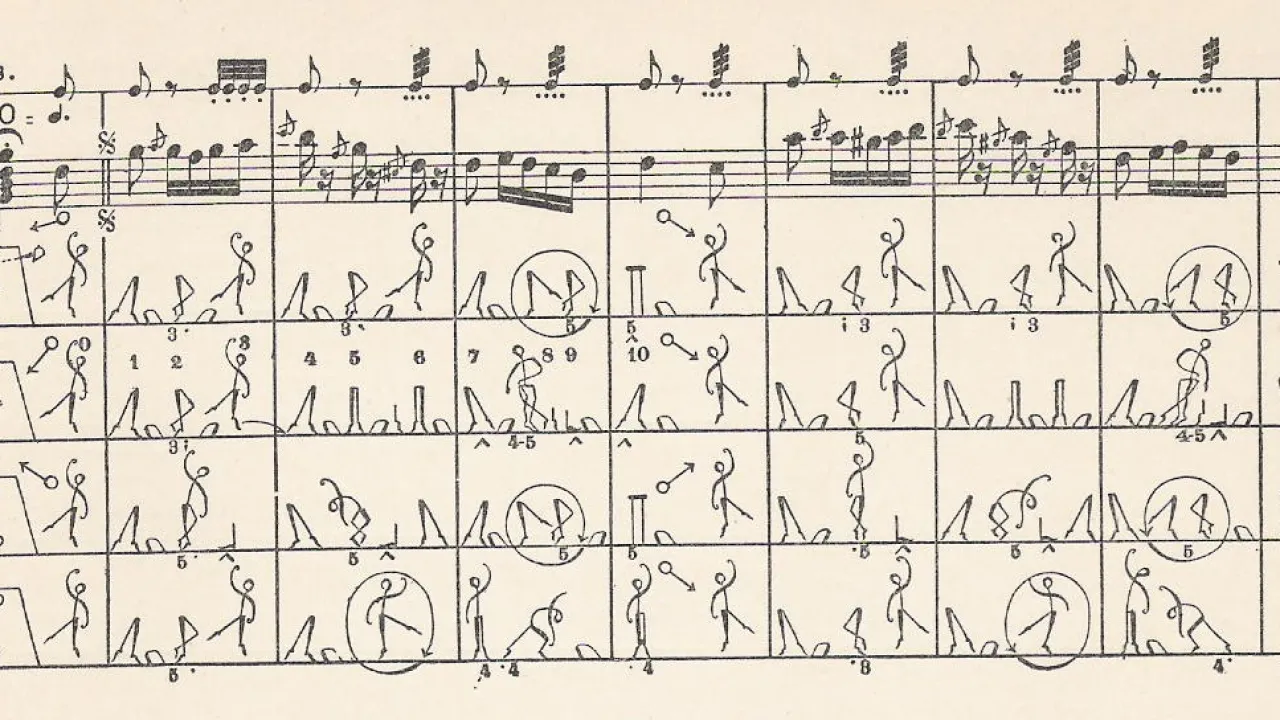
Invented in 1928, Labanotation uses tiny geometric shapes on a vertical staff to record exact movements for every joint in the human body!
✨ Word Sparks (Grade 4 Glossary)
Tap 🔊 to hear
kinesiology
the scientific study of how human bodies move
improvisation
inventing fresh movements on the spot without planning
syncopated
placing rhythmic accents on unexpected musical beats
🪝
How can a choreographer preserve a complex thirty-minute ballet on paper so dancers fifty years later can perform every step?
1
Sculpting Space and Time
Step inside a rehearsal studio where twenty dancers stand poised in silence. At the choreographer's signal, half the ensemble ripples from left to right like an ocean wave while a soloist leaps upward in slow counterpoint. Unlike painters whose canvases stay frozen on museum walls, choreographers sculpt three-dimensional shapes that exist in both space and split-second time.
2
From Improvisation to Notation
Creating an original piece often starts weeks before rehearsals begin. Choreographers study musical scores measure by measure, listening for accents and emotional shifts. In the studio, they test ideas through with dance captains, film trial runs from multiple angles, and sometimes record finished works using Labanotation—a symbolic system that maps body angles, direction, and weight shifts like musical notes.
3
Adapting for Stage Versus Screen
Designing for a 2,000-seat theater differs dramatically from filming a movie musical. Live audiences view the entire stage at once, calling for sweeping geometric formations visible from the balcony. On a film set, however, the choreographer partners with the camera operator so spins, footwork, and camera cranes glide together seamlessly.
4
Kinesiology and Cultural Storytelling
Skilled choreographers combine cultural history with —the science of human movement—honoring global dance traditions while protecting performers' joints through balanced conditioning and smart pacing.
1. What is Labanotation used for in the dance world?
2. How does film choreography differ from live theater choreography?
🤯 Mind-Blowing Fact • Grade 5
During major Olympic opening ceremonies, head choreographers use wireless earpieces and grid coordinates painted on the stadium floor to synchronize more than 1,000 performers at once!
✨ Word Sparks (Grade 5 Glossary)
Tap 🔊 to hear
biomechanics
how muscles, bones, and physics produce body motion
canon
dancers performing the same phrase one beat apart
kinetic
relating to active energy and physical motion
🪝
What do Olympic figure skating, stadium halftime spectacles, and 3D video game animations all share behind the scenes?
1
Where Biomechanics Meets Visual Poetry
Picture 400 performers rushing onto a stadium field during a live broadcast with less than six minutes to assemble kaleidoscopic patterns seen by millions. Orchestrating every stride, pivot, and synchronized ripple is a master choreographer. At its highest level, choreography fuses musical theory, spatial geometry, storytelling, and human into a single discipline that transforms athletic motion into visual poetry.
2
Compositional Tools of Movement Design
Just as composers layer melodies using , unison, and counterpoint, choreographers manipulate core elements of space, time, weight, and flow. Switching an ensemble from sharp, staccato unison into a cascading canon—where each row initiates a leap one beat after the previous row—creates mesmerizing waves. Choreographers also vary stage levels from floorwork to aerial lifts to guide the audience's eye toward focal moments.
3
Digital Pre-Visualization and Motion Capture
Modern choreography increasingly harnesses advanced technology. For arena tours, opening ceremonies, and Broadway spectacles with automated sliding sets, choreographers use 3D pre-visualization software to simulate sightlines and timing down to the tenth of a second. In animation and game studios, choreographers direct performers inside optical motion-capture volumes ringed by infrared cameras.
4
Pioneers Who Reshaped American Dance
Trailblazers such as Alvin Ailey, Martha Graham, Agnes de Mille, and Katherine Dunham revolutionized modern performance by weaving African American heritage, folkloric research, and psychological drama into concert and musical theater dance—proving movement can illuminate history as powerfully as literature.
5
Safeguarding Athlete-Artists
Because dancers endure forces up to several times their body weight upon landing jumps, professional choreographers partner with physical therapists and dance captains, balancing peak artistic daring with sustainable career longevity.