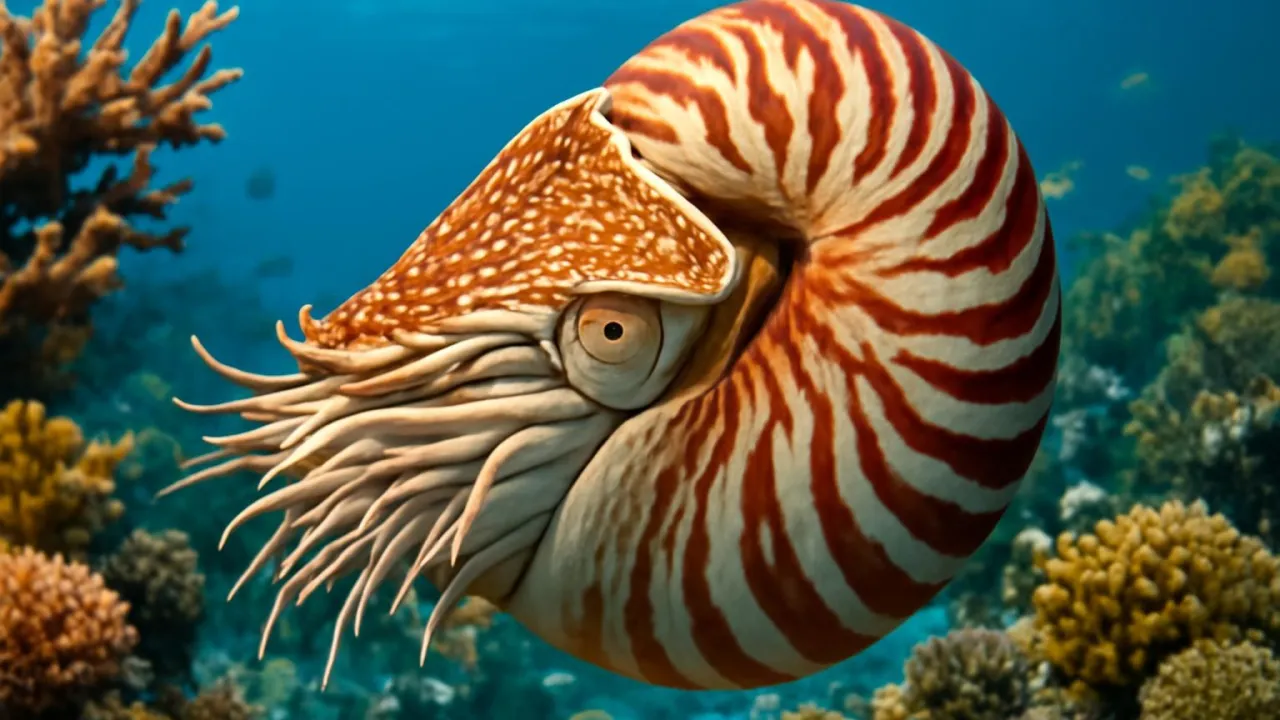
The nautilus shell has many chambers that help it float perfectly in water.
✨ Word Sparks (Grade 2 Glossary)
Tap 🔊 to hear
predator
An animal that hunts other animals
siphon
A tube that pushes water to help move
chamber
A small room inside the shell
🪝
Have you ever seen a sea creature with a shell that looks like a swirl?
1
Shell Shape and Color
The chambered nautilus has a smooth, shiny shell that spirals tightly. Its shell is white with brown stripes. This shell helps protect it from in the ocean.
2
Where It Lives
Nautiluses live deep in warm ocean waters near coral reefs. They prefer dark, quiet places during the day. At night, they swim up to hunt for food.
3
How It Moves and Eats
The nautilus moves by pushing water through a tube called a . It eats small fish and crabs using its many tentacles. Its shell has that help it float and sink easily.
The nautilus shell’s chambers act like a natural submarine ballast system.
✨ Word Sparks (Grade 3 Glossary)
Tap 🔊 to hear
buoyancy
Ability to float or sink in water
camouflage
Colors that help hide from predators
predator
An animal that hunts other animals
🪝
Did you know the chambered nautilus uses its shell chambers to float and dive like a submarine?
1
Amazing Shell Design
The chambered nautilus has a spiral shell divided into many chambers. Each chamber can fill with gas or water to control . This adaptation helps the nautilus float or sink in ocean water. The shell’s hard surface protects it from .
2
Living Deep in the Ocean
Nautiluses live in the Indo-Pacific region near coral reefs and steep slopes. They spend daylight hours in deep water to avoid . At night, they rise closer to the surface to hunt small fish and crustaceans. Their coloring helps them blend with the dark ocean.
3
How It Moves and Eats
The nautilus moves by forcing water through a siphon, propelling it backward. It uses many tentacles to catch prey and bring food to its mouth. Its slow movement helps avoid attention from . The shell’s chambers also help it maintain balance underwater.
4
Life Cycle and Growth
Nautiluses hatch from eggs laid on the ocean floor and grow by adding chambers to their shells. As they grow, they seal off old chambers and create new ones for control. This process helps them survive in changing ocean depths. They can live up to 20 years in the wild.
1. What do the nautilus shell chambers help it do?
2. Why does the nautilus hide in deep water during the day?
🤯 Mind-Blowing Fact • Grade 4
The nautilus shell’s spiral shape helps it survive ocean pressure and control buoyancy.
✨ Word Sparks (Grade 4 Glossary)
Tap 🔊 to hear
buoyancy
Ability to float or sink in water
ecosystem
All living things and their environment
jet propulsion
Moving by pushing water out fast
🪝
How does the chambered nautilus survive deep in the ocean with its unique shell?
1
Shell Structure and Survival
The chambered nautilus has a shell divided into many chambers that it fills with gas or water to control precisely. This adaptation allows it to move vertically in the ocean without using much energy. The shell’s hard exterior protects the nautilus from predators such as sharks and large fish. Its spiral shape also helps distribute pressure evenly at deep ocean depths.
2
Role in the Ecosystem
As a scavenger and predator, the nautilus plays an important role in coral reef food webs by feeding on dead animals and small prey. It helps keep the clean by eating carrion and controlling small fish populations. The nautilus also serves as prey for larger ocean animals, linking different levels of the food chain. Human fishing and habitat destruction threaten its populations in some areas.
3
Geographic Distribution and Habitat
The chambered nautilus inhabits deep slopes and coral reefs in the Indo-Pacific region, including waters near Australia, the Philippines, and Fiji. It prefers depths between 300 and 1,000 feet during the day and ascends at night to hunt in shallower waters. This daily vertical migration helps it avoid predators while accessing food sources. Its habitat is sensitive to ocean temperature and pollution changes.
4
Adaptations for Movement and Feeding
The nautilus moves by , expelling water through its siphon to glide backward efficiently. Its numerous tentacles lack suckers but have ridges to grasp prey tightly. This slow, controlled movement helps conserve energy and avoid detection by predators. Its shell chambers also provide stability and balance during swimming.
1. What helps the nautilus move up and down in the ocean?
2. Why is the nautilus important to coral reef ecosystems?
🤯 Mind-Blowing Fact • Grade 5
The chambered nautilus’s shell chambers work like a natural submarine ballast system controlling depth precisely.
✨ Word Sparks (Grade 5 Glossary)
Tap 🔊 to hear
siphuncle
Tube that moves gas in shell chambers
cephalopod
Sea animal with tentacles and a head
buoyancy
Ability to float or sink in water
🪝
Did you know the chambered nautilus is a living fossil with a shell that acts like a natural submarine ballast system?
1
Scientific Classification and Evolution
The chambered nautilus, Nautilus pompilius, belongs to the class Cephalopoda and is considered a living fossil due to its ancient lineage dating back over 500 million years. Unlike other , it retains a hard external shell divided into gas-filled chambers. This primitive design has changed little, providing scientists insight into early marine life evolution.
2
Physiology and Buoyancy Mechanics
The nautilus controls its by regulating gas and fluid in its shell chambers through a , a specialized tissue tube. This mechanism allows precise vertical movement in the water column without expending much energy. Its slow jet propulsion via the hyponome enables efficient backward swimming, while numerous tentacles without suckers grasp prey securely.
3
Conservation and Human Impact
Chambered nautilus populations face threats from overfishing for their beautiful shells and habitat degradation due to coral reef damage and pollution. Conservation efforts include monitoring populations and regulating shell trade to prevent decline. Protecting their deep reef habitats is critical to maintaining biodiversity and ecological balance in Indo-Pacific marine ecosystems.
4
Ecological Role and Behavior
Nautiluses act as scavengers and opportunistic predators, feeding on crustaceans, small fish, and carrion, thus contributing to nutrient cycling in coral reef ecosystems. Their nocturnal vertical migration reduces predation risk while allowing access to food. The shell’s spiral chambers provide both protection and control, enabling survival at depths up to 1,000 feet.
5
Quantitative Comparisons and Adaptations
The chambered nautilus shell can reach up to 10 inches (25 centimeters) in diameter, with adjustments allowing vertical movement of up to 700 feet daily. Its tentacles number around 90 and lack suckers, unlike octopuses, but have ridges for gripping prey. The species thrives in water temperatures between 59 and 86 degrees Fahrenheit (15 to 30 degrees Celsius), adapting to deep, stable ocean environments.