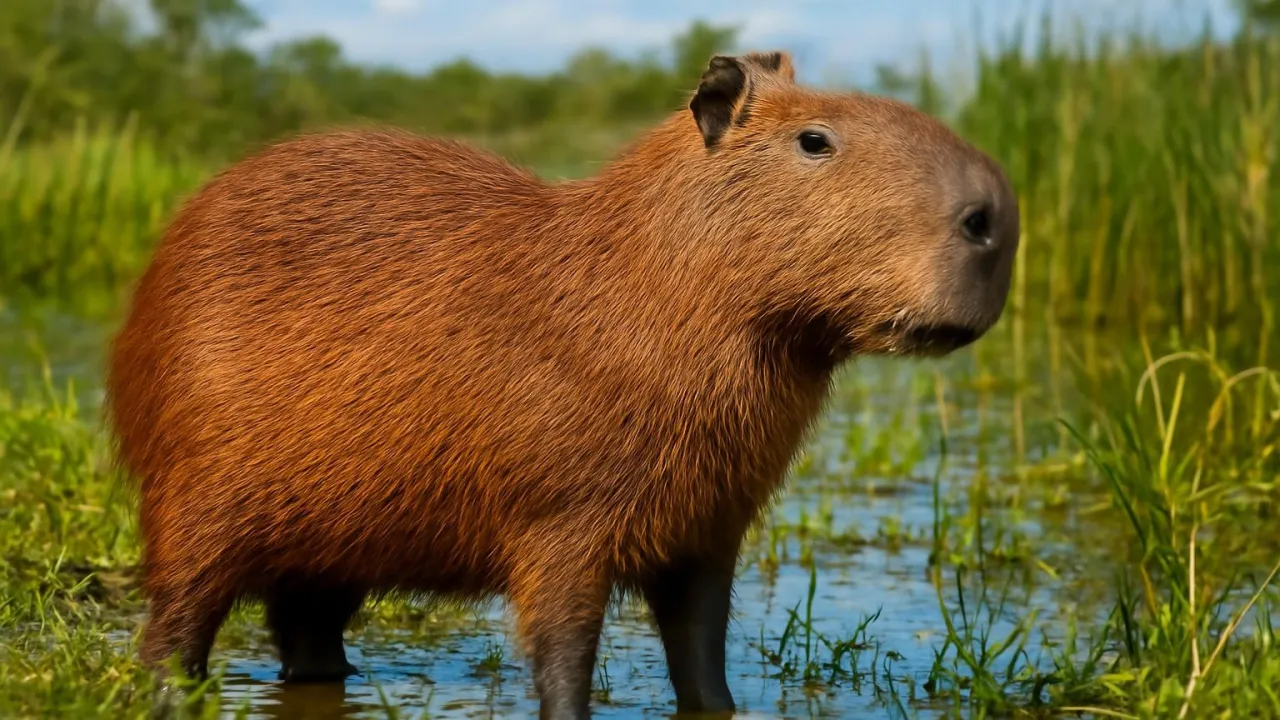
Capybaras can stay underwater for up to five minutes to hide from predators!
✨ Word Sparks (Grade 2 Glossary)
Tap 🔊 to hear
predator
An animal that hunts other animals for food
herbivore
An animal that eats only plants
webbed
Skin between toes that helps animals swim
🪝
Have you ever seen a giant rodent that swims very well?
1
Big Rodents in Water
Capybaras are the largest rodents in the world and live near water. They have brown fur and feet that help them swim fast. These animals like to stay cool by swimming in rivers and lakes. They can hold their breath underwater for many seconds.
2
Where They Live
Capybaras live in South America’s wetlands and forests where there is plenty of water. They build nests near riverbanks and sometimes hide in tall grass. Their homes keep them safe from like jaguars and anacondas. They often live in groups to watch for danger.
3
Eating Plants
Capybaras are that eat grass and water plants every day. They chew their food slowly to get all the nutrients they need. At night, they eat more to stay healthy and strong. Drinking water is also very important for their survival.
Capybaras can hold their breath underwater for up to five minutes to evade predators!
✨ Word Sparks (Grade 3 Glossary)
Tap 🔊 to hear
adaptation
A body change that helps animals survive
herbivore
An animal that eats plants only
predator
An animal that hunts others for food
🪝
Did you know the capybara is the largest rodent and a strong swimmer?
1
Largest Rodent in the World
Capybaras are the biggest rodents, growing up to 4.4 feet long. Their brown fur helps them blend into the wetland grasses. They have webbed feet that allow them to swim quickly in water. This helps them escape from like jaguars and caimans.
2
Wetland Habitat
These animals live in South American wetlands and forests with lots of water. Their habitat provides food and shelter from . Capybaras often rest near rivers and lakes where they can easily swim. They use water as a safe place to hide and cool down.
3
Herbivore Diet and Teeth
Capybaras are that eat grasses and aquatic plants for nutrients. Their large, sharp front teeth help them cut tough plants easily. They chew their food slowly to digest it well. This diet gives them the energy needed to swim and stay active.
4
Social Behavior and Survival
Capybaras live in groups to protect each other from . They communicate with sounds like barks and whistles. Their social groups help spot danger early and keep the herd safe. This teamwork is a key for survival in the wild.
Capybaras’ unique nose and eye placement allow them to stay almost fully underwater while watching for danger.
✨ Word Sparks (Grade 4 Glossary)
Tap 🔊 to hear
ecosystem
A community of plants and animals living together
herbivore
An animal that eats only plants
adaptation
A body change that helps animals survive
🪝
What makes the capybara a master of survival in South America’s wetlands?
1
Physical Adaptations for Water Life
Capybaras have webbed feet and dense fur that repels water, allowing them to swim efficiently in wetlands. Their eyes and nostrils are positioned high on their heads, so they can see and breathe while mostly submerged. These help them avoid predators and regulate body temperature in hot climates.
2
Role in the Ecosystem
As , capybaras play a key role in controlling aquatic and grassland plant growth, which maintains balance. They serve as prey for predators such as jaguars, anacondas, and caimans, making them an important food source in the food web. Their grazing also helps spread seeds, aiding plant reproduction.
3
Habitat and Geographic Range
Capybaras are native to South America and thrive in wetlands, savannas, and dense forests across countries like Brazil, Venezuela, and Argentina. Their preference for water-rich habitats means they are often found near rivers, lakes, and marshes. Human activities such as farming and habitat destruction impact their populations in some areas.
4
Social Structure and Communication
Capybaras live in groups ranging from 10 to 20 individuals, which helps them defend against predators and care for young. They communicate using barks, whistles, and purrs to maintain group cohesion and warn of danger. This social behavior increases their survival chances in complex wetland environments.
1. How do capybaras’ eyes and nostrils help them survive?
2. Why is the capybara important in its ecosystem?
🤯 Mind-Blowing Fact • Grade 5
Capybaras can hold their breath underwater for five minutes, swim 6 mph, and dive over 5 feet deep!
✨ Word Sparks (Grade 5 Glossary)
Tap 🔊 to hear
physiology
How an animal’s body works and functions
keystone
An important species that supports an ecosystem
thermoregulation
How animals control their body temperature
🪝
How do capybaras’ unique biology and social habits support their survival in South America’s wetlands?
1
Scientific Classification and Physical Traits
The capybara, Hydrochoerus hydrochaeris, is the largest rodent species native to South America. Adults measure up to 4.4 feet (1.3 meters) in length and weigh between 77 to 146 pounds (35 to 66 kilograms). Their dense, coarse fur provides insulation, while webbed feet enhance swimming efficiency in aquatic environments. Eyes and nostrils positioned dorsally allow breathing and vision while mostly submerged.
2
Physiological Adaptations for Aquatic Life
Capybaras exhibit several physiological adaptations such as the ability to hold their breath underwater for up to five minutes. Their partially webbed feet facilitate propulsion in water, and their nostrils close tightly to prevent water entry. These traits enable them to evade predators and regulate body temperature by spending time submerged during hot weather.
3
Ecological Role and Conservation Status
As a herbivore, capybaras influence wetland vegetation dynamics by grazing on grasses and aquatic plants. They serve as prey for apex predators including jaguars and anacondas, thus maintaining ecological balance. Although widespread, habitat loss and hunting have impacted some populations, leading to conservation efforts in protected areas.
4
Social Behavior and Communication
Capybaras live in social groups averaging 10 to 20 individuals, which enhances predator detection and offspring care. They communicate through vocalizations such as barks, whistles, and purrs to coordinate group activities and alert danger. This social complexity supports survival in diverse and challenging wetland ecosystems.
5
Quantitative Comparisons and Environmental Adaptations
Capybaras can swim at speeds up to 6 miles per hour (10 kilometers per hour) and dive to depths of over 5 feet (1.5 meters). They consume up to 8 pounds (3.6 kilograms) of vegetation daily to meet energy needs. Their through aquatic behavior helps them tolerate temperatures above 90 degrees Fahrenheit (32 degrees Celsius). These quantitative traits underline their evolutionary success in aquatic habitats.