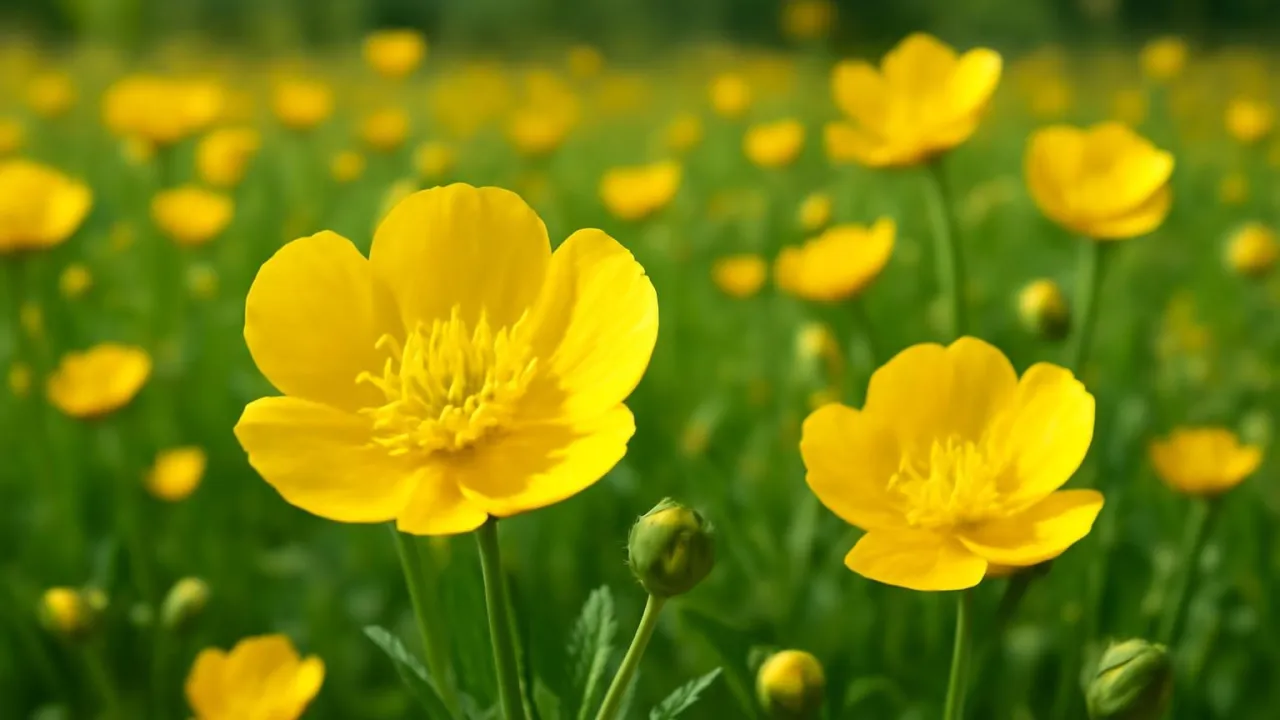
Buttercup petals reflect sunlight like tiny mirrors to attract busy bees.
✨ Word Sparks (Grade 2 Glossary)
Tap 🔊 to hear
pollinate
When bees help flowers make seeds
nectar
Sweet juice inside flowers for bees
moist
A little wet, like damp soil
🪝
Have you ever seen a flower that shines like a mirror in the sun?
1
Shiny Yellow Flowers
Buttercups have bright yellow petals that shine in the sunlight like tiny mirrors. These shiny petals help attract bees and other insects. The petals are smooth and reflect light very well.
2
Where Buttercups Live
Buttercups grow in meadows, fields, and woodlands where there is plenty of sunlight. They prefer soil that stays damp but not too wet. You can find them in many places in the Northern Hemisphere.
3
Growing and Blooming
Buttercups start as small buds that slowly open into bright yellow flowers. They grow low to the ground and bloom in spring and early summer. Bees visit the flowers to collect and help them.
Buttercup petals reflect sunlight so well they act like tiny mirrors to guide pollinators.
✨ Word Sparks (Grade 3 Glossary)
Tap 🔊 to hear
adaptation
A change that helps plants survive better
pollination
When pollen moves to help make seeds
nutrients
Food in soil that helps plants grow
🪝
Did you know buttercups have petals that act like tiny mirrors to attract pollinators?
1
Shiny Petals and Adaptations
Buttercup petals have a unique shiny surface that reflects sunlight like mirrors. This helps attract pollinators such as bees and butterflies. The bright yellow color also makes the flower easy to spot. This combination improves the chances of .
2
Habitat and Growth
Buttercups grow in temperate meadows, woodlands, and fields across the Northern Hemisphere. They prefer moist soil that provides essential for growth. These flowers bloom in spring and early summer when pollinators are most active. Their low height helps protect them from strong winds.
3
Pollination and Survival
happens when bees visit buttercup flowers to collect nectar and pollen. The shiny petals guide the insects to the flower’s center. This process helps the plant produce seeds for new buttercups. It is a vital survival strategy in their ecosystem.
4
Interesting Facts
Buttercups belong to the Ranunculus genus, which includes many species with similar traits. Some buttercups can be mildly toxic to animals if eaten. Their shiny petals also help reduce water loss by reflecting sunlight. This flower plays an important role in supporting local wildlife.
2. What helps buttercups grow well in their habitat?
🤯 Mind-Blowing Fact • Grade 4
Buttercups’ shiny petals not only attract pollinators but also help reduce water loss by reflecting sunlight.
✨ Word Sparks (Grade 4 Glossary)
Tap 🔊 to hear
ecosystem
A community of plants and animals living together
pollinator
An animal that helps plants make seeds
conservation
Protecting plants and animals in nature
🪝
How do buttercups use their shiny petals to survive and help their ecosystem?
1
Petal Shine and Pollination
Buttercups have petals that reflect sunlight like tiny mirrors, which attract such as bees and butterflies. This cause-and-effect relationship increases pollination success and helps produce seeds. The bright yellow color combined with the shiny surface makes the flower highly visible in its environment. These adaptations improve the plant’s chances of reproduction.
2
Ecosystem Role and Food Web
Buttercups play an important role in their by providing nectar and pollen to . These insects, in turn, support other animals higher in the food web. Some animals avoid eating buttercups because they contain mild toxins, which protect the plant from predators. Buttercups thus balance their role as a food source and a protected species.
3
Habitat and Geographic Range
Buttercups are native to many regions across the Northern Hemisphere, including North America, Europe, and Asia. They thrive in moist meadows, woodlands, and fields where sunlight is abundant. Human activities like farming and urban development can reduce their natural habitats. efforts help protect these flowers and maintain biodiversity.
4
Human Impact and Conservation
Buttercups are sometimes used in gardens for their bright color and shiny petals, which attract . However, habitat loss from agriculture and construction threatens wild populations. Protecting natural meadows and reducing pesticide use helps conserve buttercups. These efforts support healthy and the insects that rely on them.
Buttercup petals reflect up to 70 percent of visible light, making them some of nature’s brightest wildflowers.
✨ Word Sparks (Grade 5 Glossary)
Tap 🔊 to hear
epidermis
The outer layer of a plant’s petals or leaves
reflectance
How much light a surface bounces back
protoanemonin
A natural chemical that can be toxic to animals
🪝
What scientific secrets make buttercups’ shiny petals a marvel of nature and survival?
1
Taxonomy and Scientific Classification
Buttercups belong to the genus Ranunculus within the Ranunculaceae family, which includes over 600 species worldwide. These plants are classified as herbaceous perennials or annuals depending on the species. The genus name Ranunculus means 'little frog,' referring to many species’ preference for moist habitats. Understanding this classification helps scientists study their ecological roles and evolutionary history.
2
Physiological Mechanics of Shiny Petals
The shiny appearance of buttercup petals results from a unique cellular structure beneath the that reflects light efficiently. This multilayered cell arrangement acts like a mirror, enhancing the flower’s brightness and visibility. This adaptation not only attracts pollinators but also reduces heat absorption by reflecting sunlight, helping the plant conserve water. Such physiological traits are crucial for survival in sunny, moist environments.
3
Conservation and Botanical History
Historically, buttercups have been valued in folk medicine and cultural symbolism, though some species contain toxic compounds like . Conservation efforts focus on protecting natural habitats from agricultural expansion and urbanization, which threaten native populations. Botanical gardens and seed banks play essential roles in preserving genetic diversity. These efforts ensure buttercups continue to thrive in their natural ecosystems.
4
Quantitative Comparisons and Growth
Buttercups typically grow between 10 to 50 centimeters tall, with petals measuring about 1 to 3 centimeters across. Their flowering period usually lasts from early spring to mid-summer, depending on climate. measurements show buttercup petals can reflect up to 70 percent of visible light. This high reflectivity surpasses many other wildflowers, making buttercups uniquely adapted for pollinator attraction.
5
Ecological Impact and Human Interaction
Buttercups contribute significantly to local ecosystems by supporting pollinator populations, which in turn sustain broader food webs. Human cultivation of buttercups in gardens promotes biodiversity and educates people about native plants. However, pesticide use and habitat fragmentation pose ongoing threats. Sustainable land management and public awareness are vital to maintaining the ecological balance involving buttercups.