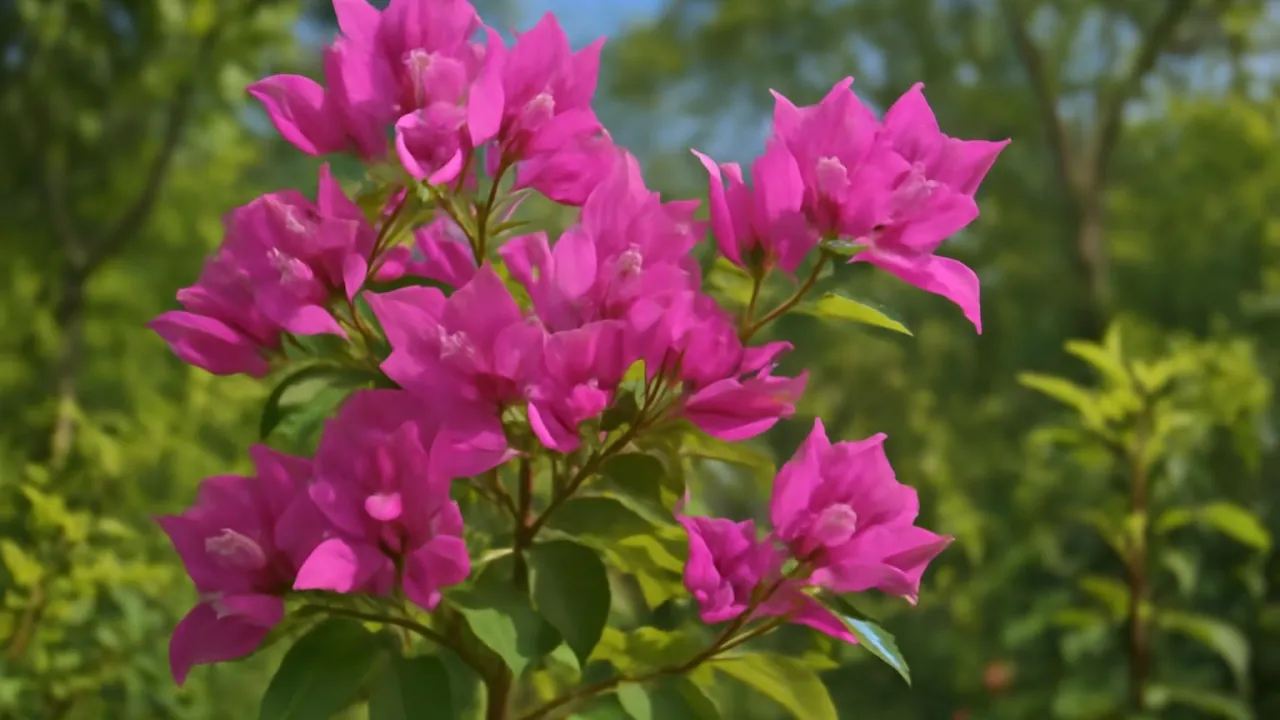
Bougainvillea’s bright bracts can last for many weeks, making it a long-lasting flower show!
✨ Word Sparks (Grade 2 Glossary)
Tap 🔊 to hear
bracts
Colorful leaves that look like flower petals
climb
To grow upward on walls or fences
pollinators
Animals like bees that help plants make seeds
🪝
Have you seen a plant that climbs and wears bright paper-like leaves?
1
Colorful Bracts
Bougainvillea has bright pink or purple that look like paper. These bracts are not flowers but colorful leaves that surround tiny white flowers. They help attract bees and butterflies to the plant.
2
Where It Grows
This plant grows well in warm, sunny places like tropical South America. It walls and fences using thin, thorny stems. It can grow very tall if it has support to climb on.
3
Sun and Water Needs
Bougainvillea needs full sun to bloom brightly and moderate water to stay healthy. It does not like too much water because its roots can rot. It grows best in well-drained soil.
1. What are the colorful parts of bougainvillea called?
2. Why does bougainvillea climb walls and fences?
🤯 Mind-Blowing Fact • Grade 3
Bougainvillea’s papery bracts reduce water loss, helping it survive dry climates!
✨ Word Sparks (Grade 3 Glossary)
Tap 🔊 to hear
pollination
When bees help flowers make seeds
adaptation
A special trait that helps plants survive
predator
An animal that eats other animals or plants
🪝
What makes bougainvillea’s bright bracts so special in nature?
1
Bright Bracts and Pollination
Bougainvillea’s bright bracts are colorful leaves that protect tiny white flowers inside. These bracts attract pollinators like bees and butterflies by standing out in the sunlight. helps the plant make seeds for new growth.
2
Climbing and Adaptation
This plant climbs using thorny stems to hold onto fences or walls. Climbing helps bougainvillea reach sunlight in crowded areas. Its thorns also protect it from that might eat its leaves.
3
Growth and Habitat
Bougainvillea grows best in tropical climates with warm temperatures and plenty of sun. It needs well-drained soil so its roots get enough oxygen and nutrients. This plant adapts well to dry conditions but grows faster with regular water.
4
Paper-Like Leaves
The bracts feel thin and papery, which helps reduce water loss in hot weather. This keeps the plant healthy during dry seasons. The real flowers are small and white, often hidden by the bright bracts.
Bougainvillea’s bright bracts help it thrive by attracting pollinators and reducing water loss.
✨ Word Sparks (Grade 4 Glossary)
Tap 🔊 to hear
biodiversity
Many different plants and animals living together
herbivore
An animal that eats plants
invasive
A plant that spreads too much and harms others
🪝
How does bougainvillea’s colorful bracts affect its ecosystem and survival?
1
Ecosystem Role and Pollination
Bougainvillea’s bright bracts serve as visual signals that attract pollinators such as bees and butterflies, which are essential for the plant’s reproduction. These pollinators transfer pollen from flower to flower, enabling seed production and supporting local . Without these interactions, the plant could not reproduce effectively in its tropical habitats.
2
Adaptations for Survival
The plant’s papery bracts reduce water loss by minimizing surface moisture evaporation, which is vital in hot, dry climates. Its thorny stems not only help it climb but also deter that might otherwise damage the plant. These adaptations increase bougainvillea’s chances of survival in competitive environments.
3
Growth and Geographic Distribution
Native to tropical South America, bougainvillea thrives in warm, sunny locations with well-drained soil. It has been widely cultivated worldwide in subtropical and Mediterranean climates, where it often decorates gardens and urban spaces. Its climbing habit allows it to cover large areas, providing shelter and food for various insects and birds.
4
Human Impact and Uses
Humans grow bougainvillea for its vibrant colors and ability to cover walls and fences attractively. It is used in landscaping to prevent soil erosion and create natural barriers. However, in some regions, it can become , outcompeting native plants and altering local ecosystems.
1. Why are bougainvillea’s bright bracts important in nature?
2. What is a possible negative effect of bougainvillea in some areas?
🤯 Mind-Blowing Fact • Grade 5
Bougainvillea’s papery bracts can last for weeks, making it one of the longest-lasting flowering plants.
✨ Word Sparks (Grade 5 Glossary)
Tap 🔊 to hear
transpiration
Water loss from plants through leaves or bracts
herbivory
Animals eating plants for food
botanical
Related to plants and their science
🪝
What scientific secrets help bougainvillea thrive in diverse climates worldwide?
1
Taxonomy and Botanical Classification
Bougainvillea belongs to the Nyctaginaceae family and is scientifically named Bougainvillea glabra. It is a genus of thorny ornamental vines, bushes, and trees native to South America. The plant’s colorful bracts are modified leaves that surround tiny, inconspicuous flowers, a unique adaptation. This classification helps scientists understand its relationships to other flowering plants.
2
Physiological Mechanics and Adaptations
The papery bracts reduce by limiting water loss through their thin, waxy surface, enabling survival in arid environments. Thorny stems provide mechanical support for climbing and protect against . Photosynthesis primarily occurs in green stems and leaves, allowing efficient energy production even when bracts dominate visually. These features make bougainvillea highly drought tolerant.
3
Conservation and Botanical History
Originally discovered in Brazil during the 18th century, bougainvillea was named after French explorer Louis Antoine de Bougainville. It has since become widely cultivated globally due to its ornamental appeal and drought tolerance. Conservation efforts focus on controlling its spread in non-native habitats to protect local biodiversity and prevent ecological imbalance caused by invasiveness.
4
Quantitative Comparisons and Growth
Bougainvillea can grow up to 30 feet (9 meters) tall, climbing at rates of several feet per year under optimal conditions. Its bracts can last up to several weeks, providing extended visual attraction for pollinators. The plant thrives in temperatures ranging from 60 to 100 degrees Fahrenheit (15 to 38 degrees Celsius). It requires moderate water but tolerates drought better than many other flowering plants.
5
Ecological and Human Impact
Bougainvillea plays a significant role in urban ecosystems by providing habitat and nectar for pollinators like bees and butterflies. It is widely used in landscaping for erosion control and aesthetic purposes. However, in some regions, its invasive growth can disrupt native plant communities, requiring careful management to maintain ecological balance and protect native species.