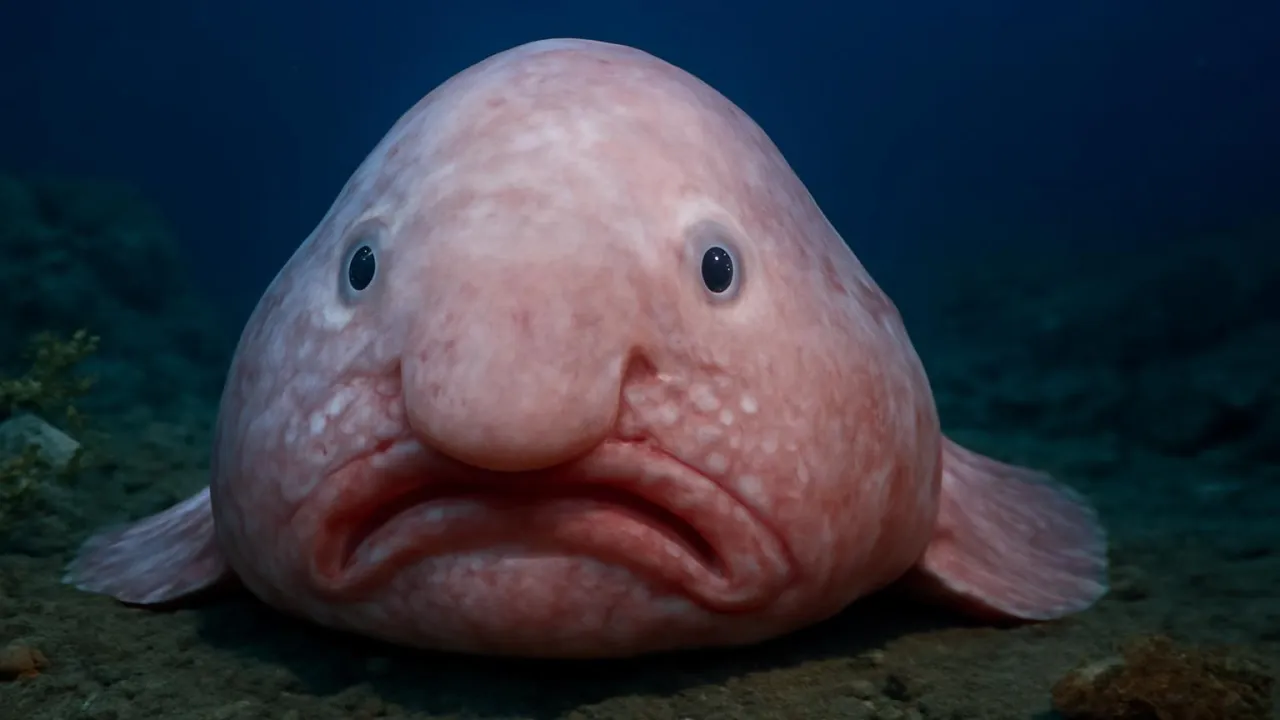
Blobfish are sometimes called the 'world’s ugliest fish' because of their unusual appearance out of water!
✨ Word Sparks (Grade 3 Glossary)
Tap 🔊 to hear
camouflage
Colors or shapes that help hide an animal
predator
An animal that hunts other animals
adaptation
A change that helps animals survive
🪝
Did you know the blobfish’s squishy body helps it survive deep ocean pressure?
1
Blobfish’s Unique Body
The blobfish has a jelly-like body that acts like a float. This soft body helps it survive the crushing ocean pressure. Unlike many fish, it has very little muscle. Its skin is loose and wrinkled, which helps it blend in with the ocean floor.
2
Deep-Sea Habitat
Blobfish live in deep waters near Australia and Tasmania. The ocean pressure there is very high, which would crush normal fish. Blobfish have adapted to this environment by having a body that does not rely on a swim bladder. Their habitat is dark and cold, with few .
3
Feeding and Survival
Blobfish are that eat small animals like crabs and shellfish. They do not chase prey but wait for food to float by. Their slow movement and help them avoid predators. This helps them survive in the deep-sea food web.
4
Camouflage and Adaptation
The blobfish’s loose skin and dull colors provide on the ocean floor. This helps protect it from . Its body shape also reduces energy use, which is important in a place with scarce nutrients. These make the blobfish a unique deep-sea survivor.
1. Why does the blobfish have loose, wrinkled skin?
2. How does the blobfish get its food?
🤯 Mind-Blowing Fact • Grade 4
Blobfish bodies are mostly gelatinous, allowing them to float without a swim bladder at crushing depths!
✨ Word Sparks (Grade 4 Glossary)
Tap 🔊 to hear
buoyant
Able to float in water or air
bycatch
Animals caught by accident in fishing
ecosystem
All living things in one place
🪝
How does the blobfish’s squishy body help it live in crushing ocean depths?
1
Body Structure and Pressure
The blobfish’s jelly-like body allows it to withstand extreme pressure in deep ocean habitats near Australia and Tasmania. Unlike typical fish, it lacks a swim bladder, which would be crushed at such depths. This soft body structure acts like a gel, helping it float just above the sea floor without expending much energy. Its loose skin and minimal muscle mass are adaptations to the high-pressure environment.
2
Ecosystem Role and Diet
Blobfish play an important role as predators of small crustaceans like crabs and shellfish, helping control their populations. They are slow-moving and rely on food drifting by rather than active hunting. This feeding strategy fits their low-energy lifestyle in nutrient-poor deep waters. Their presence contributes to the balance of the deep-sea food web and supports biodiversity.
3
Geographic Distribution and Habitat
Blobfish are found mainly off the coasts of Australia and Tasmania, inhabiting depths between 2,000 and 3,900 feet. These cold, dark waters have high pressure and limited light, shaping the blobfish’s unique adaptations. Human activities like deep-sea trawling can threaten their populations by damaging habitats and catching them as .
4
Human Impact and Conservation
Although blobfish are not currently endangered, deep-sea fishing threatens their fragile habitat. Conservation efforts aim to reduce and protect deep-sea . Understanding the blobfish’s role helps scientists advocate for sustainable ocean practices. Preserving these unique creatures maintains the health of deep-sea environments.
Blobfish can survive pressures over 100 times greater than at sea level thanks to their unique gelatinous bodies!
✨ Word Sparks (Grade 5 Glossary)
Tap 🔊 to hear
benthic
Lives on or near the ocean floor
neutral buoyancy
Floating without sinking or rising
bycatch mortality
Animals caught and killed by accident
🪝
How does the blobfish’s unique physiology enable survival in extreme deep-sea environments?
1
Taxonomy and Scientific Context
The blobfish, scientifically known as Psychrolutes marcidus, belongs to the family Psychrolutidae. It is a fish, meaning it lives near the ocean floor, primarily in deep waters off Australia and Tasmania. Its classification reflects adaptations to high-pressure, low-light marine environments. Understanding its taxonomy helps scientists study evolutionary traits among deep-sea fishes.
2
Physiological Mechanics of Survival
Blobfish have a gelatinous, low-density body that allows them to maintain without a swim bladder, which would collapse under extreme pressure. Their minimal muscle mass reduces energy needs, fitting their slow-moving lifestyle. The soft body structure absorbs pressure evenly, preventing damage in depths ranging from 600 to 1,200 meters. This physiology is a remarkable adaptation to deep-sea conditions.
3
Conservation and Human Interaction
While blobfish are not currently listed as endangered, deep-sea trawling poses significant threats by destroying habitats and causing . Conservation efforts focus on regulating fishing practices and protecting deep-sea ecosystems. Public interest in blobfish has increased awareness of deep-sea biodiversity and the importance of sustainable ocean management.
4
Botanical History and Cultural Impact
Though not a plant, the blobfish has captured popular imagination as a symbol of deep-sea mystery and oddity. It was first described scientifically in 1926. Its unusual appearance out of water has inspired educational campaigns about ocean life. This cultural significance helps promote marine science and conservation awareness worldwide.
5
Quantitative Comparisons and Measurements
Blobfish typically measure up to 30 centimeters (12 inches) in length and weigh about 1.5 kilograms (3.3 pounds). They inhabit depths between 600 and 1,200 meters, where water temperature ranges from 4 to 10 degrees Celsius. Their slow swimming speeds and energy-efficient physiology contrast sharply with faster, more muscular fish found in shallower waters.