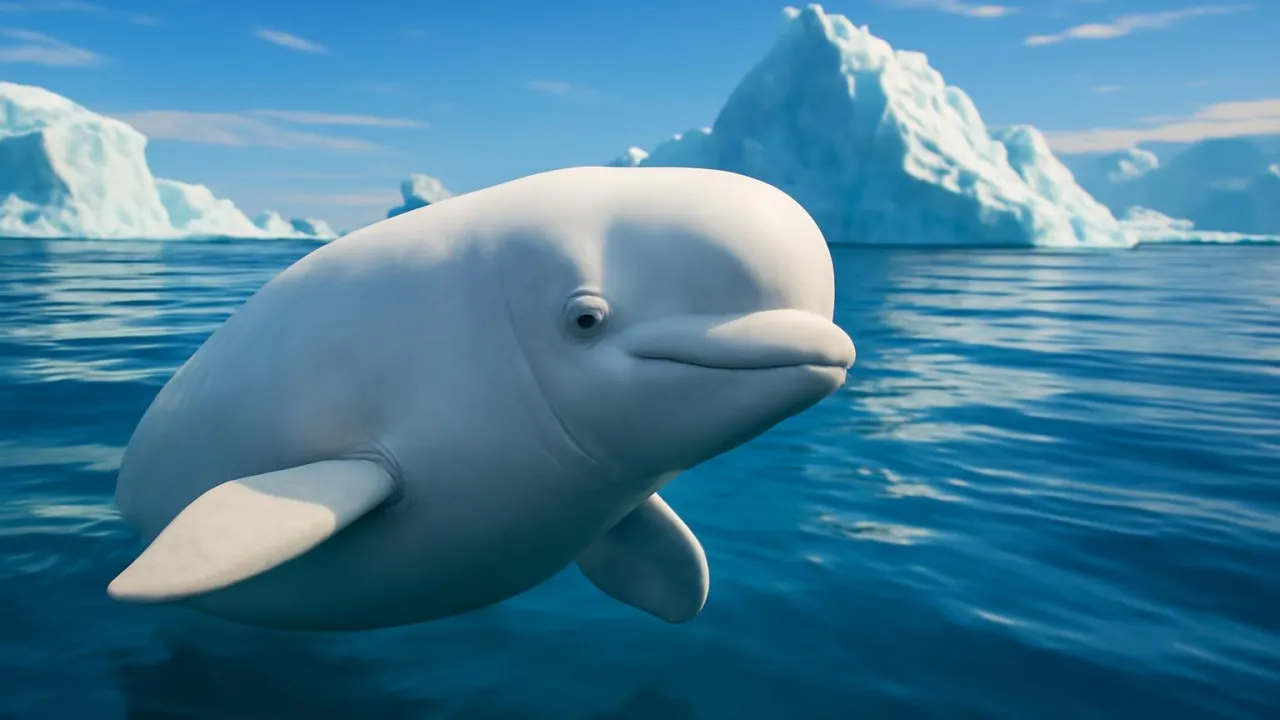
Beluga whales can mimic sounds like other animals and even humans!
✨ Word Sparks (Grade 2 Glossary)
Tap 🔊 to hear
Arctic
The very cold area near the North Pole
melon
A round part on a whale’s head that makes sounds
mimic
To copy sounds or actions of others
🪝
Have you heard a whale make sounds like a human?
1
Living in Cold Water
Beluga whales live in icy seas and cold ocean waters. They swim near ice and snow. They like shallow coastal areas to find food.
2
Growing Up in the Arctic
Baby belugas are born in warm waters and stay close to their mothers. They drink milk and learn to swim fast. They grow bigger as they eat fish and squid.
3
A Nose That Talks
Belugas have a rounded forehead called a that helps them make sounds. They whistle, click, and even noises around them. This helps them talk to their friends.
Beluga whales can mimic human speech sounds, making them called the 'canaries of the sea.'
✨ Word Sparks (Grade 3 Glossary)
Tap 🔊 to hear
echolocation
Using sound to find things underwater
blubber
Thick fat that keeps whales warm in cold water
camouflage
Colors or shapes that help hide animals
🪝
How do beluga whales use sounds to survive in icy waters?
1
Arctic Home and Adaptations
Beluga whales live in the Arctic Ocean where waters are freezing cold. Their thick keeps them warm in icy conditions. They have no dorsal fin to swim easily under ice. Their white color helps them among ice and snow.
2
Communication and Echolocation
Belugas use to find food and navigate underwater. They produce clicks and whistles that bounce off objects to locate prey. Their melon on the forehead focuses these sounds like a sonar. This adaptation helps them survive in dark, murky waters.
3
Diet and Feeding Habits
Belugas eat fish, squid, and crustaceans found near the ocean floor. They use their teeth to catch slippery prey but swallow food whole. Their flexible neck allows them to turn their heads to hunt in tight spaces. This helps them find food in complex Arctic environments.
4
Life Cycle and Social Groups
Belugas live in pods of a few to hundreds of whales for protection. Mothers nurse calves for about a year while teaching survival skills. Calves learn to use and social calls from adults. Social bonds help them avoid predators like polar bears and orcas.
Beluga whales’ ability to mimic human speech is so advanced they are called the 'canaries of the sea.'
✨ Word Sparks (Grade 4 Glossary)
Tap 🔊 to hear
pod
A group of whales that live and travel together
insulate
To keep heat inside and cold outside
ecosystem
A community of living things and their environment
🪝
What role do beluga whales play in Arctic ecosystems and how do they survive harsh conditions?
1
Surviving in the Arctic Environment
Beluga whales thrive in the Arctic by relying on thick blubber that their bodies from freezing temperatures, allowing them to swim comfortably in icy waters. Their lack of a dorsal fin reduces heat loss and helps them maneuver beneath sea ice. Because of their white color, they blend into snowy surroundings, which helps protect them from predators such as orcas and polar bears.
2
Communication and Social Behavior
Belugas are highly social animals that live in ranging from a few individuals to hundreds, which provides safety and cooperation during hunting. They use a complex system of whistles, clicks, and mimicry to communicate, which is essential for coordinating movements and caring for young calves. Their ability to mimic sounds also helps them adapt to changing environments and avoid threats.
3
Diet and Ecosystem Role
Belugas feed on a variety of fish, squid, and crustaceans that live on or near the ocean floor, helping to control these populations and maintain balance in the Arctic food web. By consuming prey, they transfer nutrients through the and support the health of marine habitats. Human activities like shipping and pollution impact their food sources and migration routes, which can threaten their survival.
4
Geographic Range and Conservation
Beluga whales inhabit Arctic and sub-Arctic regions including parts of Canada, Russia, and Alaska, where seasonal ice changes affect their movements. Conservation efforts focus on protecting critical habitats and reducing noise pollution from ships, which interferes with their echolocation. Monitoring populations helps scientists understand how climate change affects their habitat and food availability.
Beluga whales can produce over 50 different sounds and mimic human speech patterns remarkably well.
✨ Word Sparks (Grade 5 Glossary)
Tap 🔊 to hear
blubber
Thick fat that keeps whales warm in cold water
echolocation
Using sound waves to find objects underwater
taxonomy
The science of classifying living things
🪝
How do beluga whales’ unique biology and behaviors help them thrive in the Arctic’s extreme environment?
1
Taxonomy and Scientific Classification
Beluga whales belong to the family Monodontidae and the species Delphinapterus leucas, which means 'white dolphin without a fin.' They are closely related to narwhals but differ in their lack of a tusk and their white coloration. Their evolutionary adaptations reflect millions of years surviving Arctic conditions.
2
Physiological Adaptations for Cold
Belugas have a thick layer of up to 5 inches thick that insulates their bodies from freezing Arctic waters. Their circulatory system can adjust blood flow to conserve heat, and the absence of a dorsal fin reduces heat loss. Their flexible neck vertebrae allow them to turn their heads, which is unusual for whales and helps in hunting.
3
Communication and Echolocation Mechanics
Belugas produce a wide range of sounds using specialized nasal sacs and the melon organ on their forehead, which focuses sound waves for . This sonar system allows them to detect prey, navigate murky waters, and communicate complex messages. Their vocal mimicry includes copying human speech patterns and other animal calls.
4
Conservation History and Challenges
Beluga populations face threats from climate change, habitat loss, pollution, and increased shipping traffic in the Arctic. Conservation programs monitor population sizes and protect critical habitats to ensure their survival. Indigenous communities have historically hunted belugas sustainably, but modern challenges require international cooperation.
5
Quantitative Comparisons and Behavior
Adult belugas measure between 13 and 20 feet long and weigh up to 3,500 pounds, making them medium-sized whales. They can swim at speeds up to 15 miles per hour and dive as deep as 2,300 feet to find food. Their social pods can include hundreds of individuals, demonstrating complex social structures similar to primates.