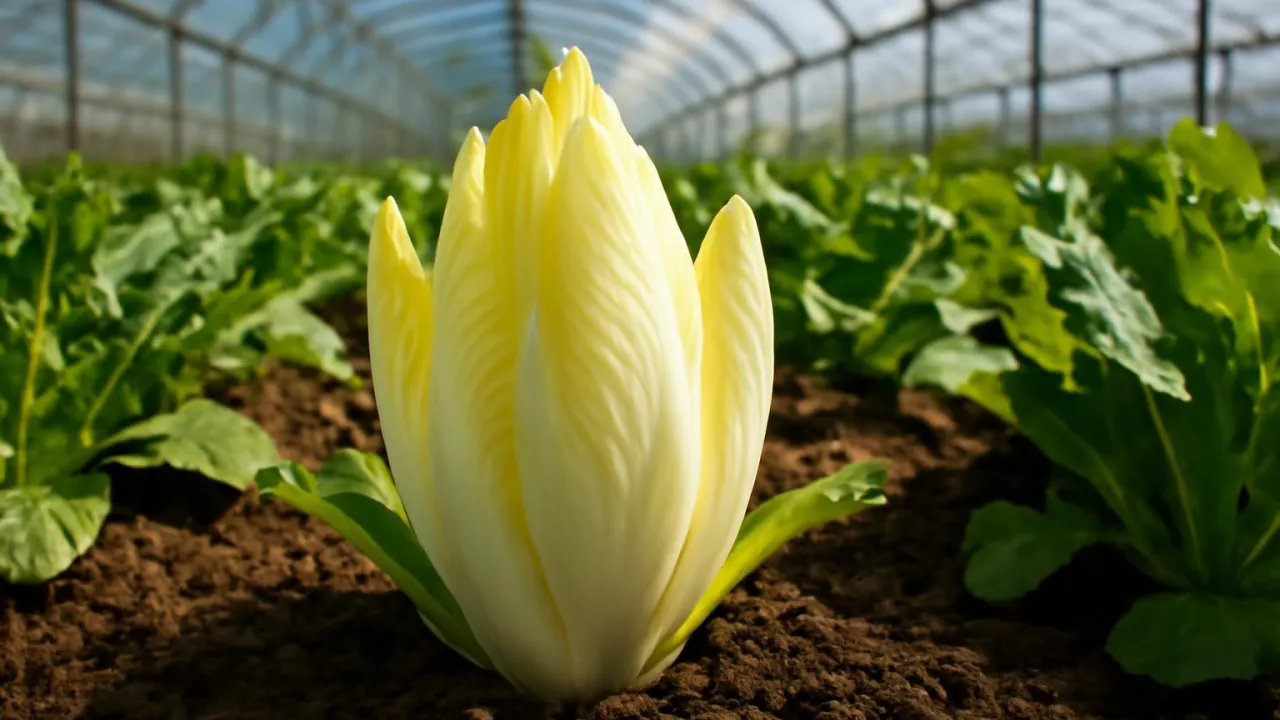
Belgian endive grows in the dark so its leaves stay white and crunchy!
✨ Word Sparks (Grade 2 Glossary)
Tap 🔊 to hear
moist
A little wet, not too dry
bitter
A sharp, strong taste
greenhouse
A glass house for growing plants
🪝
Have you ever seen a vegetable that grows in the dark?
1
What Belgian Endive Looks Like
Belgian endive has pale, creamy white leaves that are tightly packed together. The leaves feel crisp and smooth when you touch them. It looks like a small, pointed cabbage or lettuce head.
2
How It Grows
This vegetable grows in dark, cool places to keep its leaves pale and fresh. Farmers grow it in cellars or with little light. It needs soil but does not like sunlight.
3
Why People Like It
People eat Belgian endive raw in salads or cooked in warm dishes. It has a slightly taste that adds flavor to meals. Its crunchy texture makes it fun to eat.
Belgian endive stays white because it grows in darkness, avoiding chlorophyll production!
✨ Word Sparks (Grade 3 Glossary)
Tap 🔊 to hear
chlorophyll
Green stuff in plants that helps them make food
blanching
Growing plants in dark to keep leaves pale
nutrients
Food plants need to grow healthy and strong
🪝
Did you know Belgian endive is a vegetable that grows without sunlight?
1
Appearance and Texture
Belgian endive has pale, creamy leaves that are tightly packed and smooth. These leaves stay white because they grow in the dark, avoiding sunlight. The texture is crisp and crunchy, making it a fresh vegetable to eat. Its shape is like a small, pointed lettuce head.
2
Growth and Adaptation
This vegetable grows in cool, dark places such as cellars or greenhouses. Growing without sunlight helps prevent , which keeps leaves white instead of green. This adaptation helps the plant stay tender and less bitter. Moist soil provides the needed for healthy growth.
3
Role in Food and Ecosystem
Belgian endive is often used in salads or cooked dishes because of its crunchy texture. It provides like fiber and vitamins for people. In the ecosystem, it is a cultivated plant that depends on humans to grow it safely. Its growth method shows how plants can adapt to different environments.
4
Interesting Botanical Facts
Belgian endive is a type of chicory, related to dandelions and radicchio. Unlike many leafy vegetables, it grows underground or in darkness to keep its pale color. This process is called and helps reduce bitterness. It is a perfect example of how humans use plant adaptations for food.
Belgian endive’s growth in darkness is a special adaptation that reduces bitterness and keeps leaves tender.
✨ Word Sparks (Grade 4 Glossary)
Tap 🔊 to hear
symbiosis
A helpful relationship between living things
chlorophyll
Green pigment that helps plants make food
blanching
Growing plants in darkness to keep leaves pale
🪝
How does growing in darkness help Belgian endive thrive in its ecosystem?
1
Growth Environment and Adaptations
Belgian endive grows best in cool, dark environments such as cellars or greenhouses where sunlight is limited. This lack of sunlight prevents from forming, which keeps the leaves pale and tender. The plant’s adaptation to grow in darkness is called , which reduces bitterness and improves texture. Moist soil and controlled temperatures are essential to support healthy growth.
2
Role in Human Agriculture
Farmers cultivate Belgian endive as a specialty vegetable because of its unique taste and texture. It plays an important role in food webs by providing nutrients like fiber and vitamins to humans. The vegetable depends on human care for its growth since it cannot survive well in natural sunlight. Its cultivation showcases how humans influence plant growth through controlled environments.
3
Ecological Impact and Distribution
Belgian endive is mainly grown in temperate regions such as Belgium, France, and the Netherlands where greenhouse farming is common. Its production requires energy for maintaining dark, cool conditions, which can impact the environment. However, its role in providing diverse food options supports sustainable diets. The plant’s growth method demonstrates a unique human-plant in agriculture.
4
Botanical Characteristics and Uses
As a variety of chicory, Belgian endive is related to dandelions and radicchio, sharing similar bitter compounds. Its pale leaves are harvested before they turn green, which is different from many leafy vegetables. The vegetable is popular in European cuisine and is valued for its crisp texture and slightly bitter flavor. It can be eaten raw or cooked in many dishes.
1. Why do farmers grow Belgian endive in dark places?
2. What is one ecological impact of growing Belgian endive?
🤯 Mind-Blowing Fact • Grade 5
Belgian endive’s unique dark-forcing process prevents chlorophyll and bitterness, creating its crisp, pale leaves.
✨ Word Sparks (Grade 5 Glossary)
Tap 🔊 to hear
photosynthesis
How plants use light to make food
cultivar
A plant variety made by humans
forcing
Growing plants in special conditions to change growth
🪝
What unique physiological and agricultural traits make Belgian endive a fascinating vegetable?
1
Taxonomy and Botanical Classification
Belgian endive, scientifically known as Cichorium intybus var. foliosum, belongs to the Asteraceae family. It is a of chicory, closely related to radicchio and dandelion, sharing similar bitter compounds. Unlike many leafy vegetables, Belgian endive is cultivated through a unique process called blanching. This process involves growing the plant in darkness to inhibit chlorophyll development and maintain pale leaves.
2
Physiological Growth Mechanisms
The plant grows initially in sunlight to develop roots and a basal rosette, then is harvested and forced to grow in dark, humid conditions. This dark prevents , reducing chlorophyll and bitterness while promoting tender, creamy leaves. Moisture and temperature control during forcing are critical to prevent spoilage and ensure optimal texture. This physiological adaptation allows the vegetable to maintain its characteristic crispness and mild flavor.
3
Conservation and Agricultural History
Belgian endive was first developed in Belgium in the 19th century as a way to extend the chicory harvest. Since then, it has become a valued crop in Europe and North America, prized for its unique taste and texture. Modern greenhouse techniques have improved yields and reduced energy consumption. Conservation efforts focus on sustainable greenhouse practices to minimize environmental impact while maintaining crop quality.
4
Quantitative Comparisons and Growth Data
Belgian endive typically grows to 6–8 inches (15–20 cm) tall and weighs about 3 to 5 ounces (85 to 140 grams). The period in darkness usually lasts 3 to 4 weeks at temperatures between 50 and 60 degrees Fahrenheit (10 to 16 degrees Celsius). Compared to other leafy greens, its growth speed is slower due to the dark forcing process. However, its unique texture and flavor make it highly prized in culinary uses.
5
Ecological and Economic Importance
Belgian endive cultivation requires controlled environments, which consume energy but allow year-round production. Its role in human diets provides important nutrients like fiber, vitamins A and K, and antioxidants. Economically, it supports specialized farming communities in temperate regions. Research continues to optimize growth conditions to reduce environmental costs while enhancing crop resilience and quality.