🎵 INSTRUMENTS
🎶 Dual-Valve Slide Cylindrical Brass Aerophone (Hornbostel-Sachs 423.22)
VA Music, Fine Arts & Sound Physics SOL 5.5
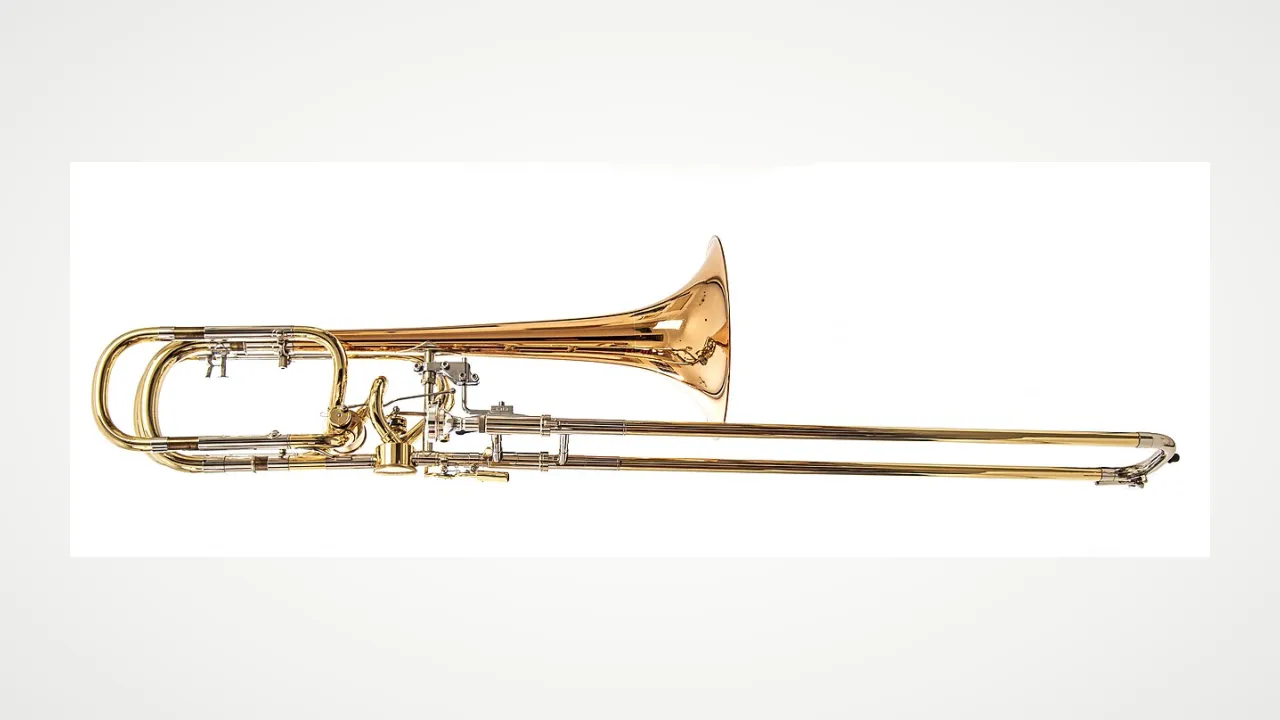
Bass Trombone
Thunderous Slide Power of Low Brass
Grade 1 • Early Reader • 85 words
🎶 Instrument Family & OriginBrass family; evolved from Renaissance bass sackbuts and modernized in 19th-century Germany and 20th-century America
🪵 Materials & RangeBrass alloy with wide 0.562-inch bore and ~10-inch bell; ~9 ft base B-flat tube plus dual valve loops reaching below B-flat0 (~29 Hz)
🔊 How Sound Is MadeDeep lip buzz in a wide cup mouthpiece drives low waves through a hand slide and two thumb/finger trigger valves
⚡ Signature Sound SparkBridges trombones and tubas with earth-shaking pedal tones and crisp brass growls
🤯 Mind-Blowing Fact • Grade 1
A bass trombone's lowest notes vibrate fewer than thirty times per second—so deep you feel them buzzing in your chest!
✨ Word Sparks (Grade 1 Glossary)
Tap 🔊 to hear
trigger
Thumb or finger lever opening extra tubing
rumble
Deep rolling sound you can almost feel
wide
Measuring far across from side to side
🪝
What happens when a sliding horn grows extra tubes for giant low rumbles?
1
Boom Goes the Bell!
BRRR-UMMM! A giant brass shakes the floor under your shoes! Meet the deep big brother of the sliding horn family. Its shiny bell opens like a golden bowl.
2
Slide Plus Two Triggers
A player buzzes loose lips into a deep metal cup. One hand glides the long slide out and in. The other hand presses two special thumb and finger !
3
Floor-Shaking Notes
Those two open extra loops of coiled brass pipe. Air zooms down the long path to make super low notes. It anchors the whole band!
1. How is a bass trombone different from a smaller tenor trombone?
2. How do the player's lips move to make very low bass trombone sounds?
🤯 Mind-Blowing Fact • Grade 2
Early bass trombones were once so long that players had to attach a hinged wooden handle just to push the slide past the reach of their arm!
✨ Word Sparks (Grade 2 Glossary)
Tap 🔊 to hear
bore
Inside width of a hollow brass tube
air column
Tube of trapped air vibrating as sound
anchor
Strong low voice supporting all higher instruments
🪝
Why is a bass trombone the exact same length as a tenor trombone, yet able to boom much lower?
1
Same Length, Deeper Roar!
Feel the wooden concert stage hum as a massive golden chord rolls out from the low brass! Surprisingly, a closed bass trombone starts out nine feet long—the exact same main length as a tenor trombone—yet its voice sounds far deeper and darker.
2
Wider Pipes and Twin Triggers
The secret lies in its wider brass pipes, deeper mouthpiece cup, and flaring ten-inch bell that move huge breaths of air. Even better, two thumb and finger triggers near the neck open extra coiled loops of tubing right away!
3
Movie Monsters and Big-Band Grooves
With both triggers pressed and the hand slide pushed out, the grows super long for floor-rattling bass notes. Movie composers love that mighty growl for dragon roars, ocean storms, and heroic adventures!
1. Why did old-fashioned bass trombones once need a hinged handle on the slide?
2. What gives the modern bass trombone its dark, booming tone even in first position?
🤯 Mind-Blowing Fact • Grade 3
Pressing both triggers while extending the slide to seventh position stretches a bass trombone's total air path from nine feet to nearly eighteen feet!
✨ Word Sparks (Grade 3 Glossary)
Tap 🔊 to hear
register
Specific high, middle, or low pitch zone
axial valve
Smooth-flowing valve keeping air moving straight
pedal tone
Extra-low fundamental note rumbling at the bottom
🪝
How do two clever left-hand valves replace an impossible arm stretch?
1
Solving the Long-Arm Puzzle
Imagine trying to push a brass slide five feet away when your arm is only two and a half feet long! Centuries ago, giant Renaissance bass sackbuts pitched in G or F needed a wooden extension handle, making fast musical passages nearly impossible.
2
A B-Flat Frame Built for Power
Modern makers solved that puzzle by building the bass trombone on a compact nine-foot B-flat slide frame—just like the tenor—while widening the inner bore and expanding the bell to roughly ten inches across. Paired with a large cup mouthpiece, this wide airway moves massive volumes of air.
3
Dual Valves Unlock the Deep Register
Coiled inside the rear bell section sit two extra tubing loops controlled by left-hand rotary or , usually tuned to F and G-flat. Pressing one or both triggers adds several feet of brass instantly, dropping the pitch into thunderous low D!
4
Bridge of the Low Brass Choir
In orchestras, wind ensembles, and jazz big bands, this powerhouse connects bright tenor trombones above with deep tubas below, delivering velvety bass lines or fiery, earth-shaking blasts.
1. How long does the air path become when a bass trombonist presses both triggers and extends the slide fully?
2. Which two instruments does the bass trombone acoustically bridge in a symphony orchestra?
🤯 Mind-Blowing Fact • Grade 4
Because a bass trombone moves so much air on sustained low pedal notes, orchestral players train their lungs to exhale five to six liters of air smoothly in a single breath!
✨ Word Sparks (Grade 4 Glossary)
Tap 🔊 to hear
independent valves
Two valves usable alone or pressed together
chromatic gap
Missing low notes unreachable on shorter tubing
gooseneck
Curved main pipe connecting slide and bell
🪝
Why does switching from dependent to independent valves transform how a bass trombonist navigates low notes?
1
From Handle Slides to German Trigger Horns
During the 16th and 17th centuries, composers like Heinrich Schütz scored sacred music for immense Quartposaunen pitched a fourth or fifth below the tenor trombone, complete with hinged iron or wooden slide handles. In 1839, Leipzig maker Christian Friedrich Sattler revolutionized low-brass design by adding a thumb rotary valve to a wide-bore B-flat trombone, eliminating the clumsy handle while preserving cavernous low tones.
2
Closing the Chromatic Low-Register Gap
A single F-attachment still left one glaring acoustic blind spot: low B1 right above pedal B-flat1 could not be reached because an F-tuned horn loses its seventh slide position when its base length grows longer. Mid-20th-century American players and makers solved this by adding a second valve, making the instrument fully chromatic from top to bottom.
3
Dependent Versus Independent Valve Architecture
Early dual-valve horns used a dependent layout, where the second valve perched inside the F-loop and worked only while the first thumb trigger stayed pressed. Modern independent (in-line) systems place both valves directly along the main —tuned individually to F and G-flat, and dropping to D when pressed together—giving players dozens of clever alternate slide combinations for rapid low leaps.
4
Acoustic Weight and Big-Band Grit
With a 0.562-inch (14.3-millimeter) cylindrical bore and a 9.5-to-10.5-inch bell flare, the bass trombone demands prodigious breath capacity. Whether laying down silky foundational chords in Wagner operas or snapping percussive pedal B-flats beneath a Count Basie jazz chart, its unmistakable sonic weight anchors modern ensembles.
1. Why couldn't a single-valve F-attachment trombone easily play the note low B1?
2. What advantage do modern independent (in-line) valves give a bass trombonist?
🤯 Mind-Blowing Fact • Grade 5
Even when playing a 29.1 Hz pedal B-flat0, over eighty percent of the sound energy your ear hears from a bass trombone actually comes from crisp upper harmonics above 150 Hz rather than the fundamental wave itself!
✨ Word Sparks (Grade 5 Glossary)
Tap 🔊 to hear
spectral envelope
Balance of low and high overtone strengths
impedance
Acoustic resistance helping standing waves lock in
fundamental mode
Lowest whole-tube vibration of an air column
🪝
How does bore-to-bell geometry let a cylindrical bass trombone out-punch a wider tuba at the same low frequency?
1
Organology and Acoustic Footprint
Classified under Hornbostel-Sachs 423.22 as a dual-valve chromatic slide aerophone, the modern orchestral bass trombone shares the tenor's nominal nine-foot (2.74-meter) B-flat open fundamental yet commands a vastly deeper operational compass—extending chromatically from below C1 (32.7 Hz) and B-flat0 (29.1 Hz) up past C5 (523.3 Hz). Rather than lengthening the closed slide, builders achieve bass timbre by scaling internal bore diameter to 14.3 millimeters (0.562 inch), deepening cup-mouthpiece volume to 28–30 millimeters rim width, and flaring the bell to 24–27 centimeters.
2
Cylindrical Spectral Brilliance Versus Conical Warmth
When a bass trombone and a contrabass tuba sound the exact same 58.3 Hz B-flat1 pitch, listeners immediately distinguish them by . Whereas the tuba's steeply expanding cone suppresses high-frequency partials to yield a round, enveloping cushion, the bass trombone's long cylindrical slide preserves dense energy up through the tenth and fifteenth harmonics (600–1,500 Hz), projecting a focused, laser-like low-brass core across a hundred-piece orchestra.
3
In-Line Valve Aerodynamics and Tuning Physics
Modern independent bass trombones feature twin in-line valves—such as Thayer axial-flow cones or Hagmann free-flow rotors—that deflect the airstream by fewer than 30 degrees instead of the 90-degree turns of older rotors. Engaging the thumb F valve adds ~0.91 meters of tubing; engaging the middle-finger G-flat valve adds ~0.70 meters; depressing both together yields a combined D horn (~4.34 meters closed), enabling seamless chromatic execution down to low B1 (61.7 Hz) and pedal tones below.
4
Acoustic Impedance and Pedal-Register Resonance
In the extreme pedal octave below B-flat1, the of a mostly cylindrical pipe sits slightly flat relative to upper harmonics unless aided by cooperative resonances. The wide bell flare and generous mouthpiece volume align higher harmonic peaks (2f, 3f, 4f) to lock the player's slow lip oscillation into a stable, thunderous regime.
5
Orchestral Majesty and Studio Power
From Richard Wagner's Ring cycle and Béla Bartók's fierce orchestral glissandi to contemporary film scores and big-band jazz charts, the bass trombone supplies unmatched low-frequency articulation, agile slide legato, and visceral acoustic authority.