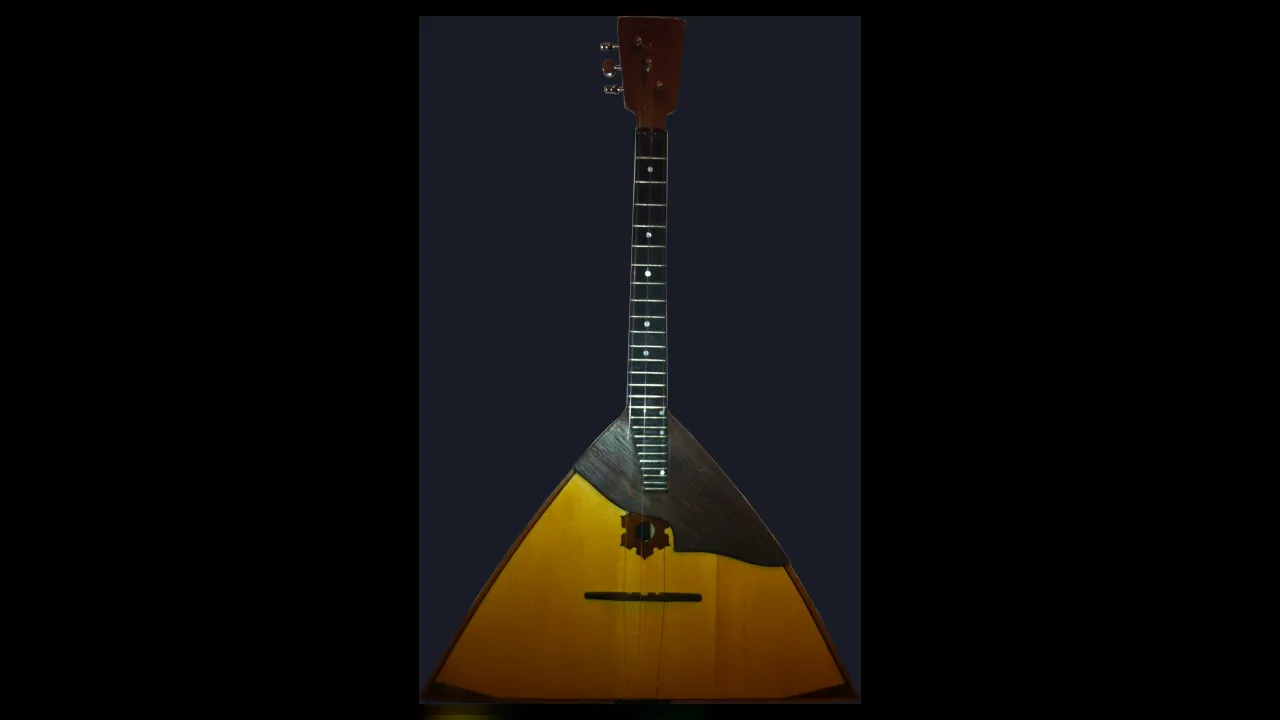
2. What is unusual about two of the balalaika's three strings?
🤯 Mind-Blowing Fact • Grade 2
Country carpenters originally built the balalaika as a triangle because three flat wooden boards were much easier to glue together than curved violin ribs!
✨ Word Sparks (Grade 2 Glossary)
Tap 🔊 to hear
unison
Two strings sounding the exact same musical pitch.
spruce
Light, resonant evergreen wood used for soundboards.
chatter
Fast, lively, playful talking or musical notes.
🪝
How can one flicking pointer finger sound like two instruments playing together?
1
Music Made for Dancing
Brrm—ting—brrm—ting! Lively strums start slow like snowflakes falling, then whirl faster and faster like spinning village dancers! In Russia, the triangular balalaika gets its playful name from an old word meaning 'to and joke.'
2
Two Twins Plus One Soloist
Look closely at the three strings on a standard prima balalaika and you will spot a clever trick. Two nylon strings are tuned to the exact same E note, while one bright steel string sits higher at A!
3
Thumb Over the Top
Instead of holding a plastic pick, players brush the soft pad and fingernail of their right pointer finger rapidly back and forth. Meanwhile, their left thumb wraps right over the top edge of the neck to press those twin strings!
1. Why did village builders long ago give the balalaika a triangular body?
2. How does a prima balalaika player usually strum and pluck the strings?
🤯 Mind-Blowing Fact • Grade 3
Look at the front of a balalaika and you will find a tiny soundhole barely wider than a coin—just big enough to brighten the crisp spruce soundboard!
✨ Word Sparks (Grade 3 Glossary)
Tap 🔊 to hear
prima
The standard lead solo size of the balalaika.
contrabass
The largest, deepest-pitched giant of an instrument family.
rib
Curved wooden strip forming the back of lutes.
🪝
How did a humble peasant lute grow into a full triangular symphony from tiny piccolo to giant contrabass?
1
Whirling Strings of Winter Nights
Flick—shimmer—zoom! A solo melody sparkles high above steady rhythmic strums—yet only one pair of hands is onstage! Since the late seventeenth century, Russia's triangular balalaika has turned fireside folk tunes into dazzling musical storytelling.
2
Unison Twins and Steel Sparkle
On the popular lead size—the balalaika—two lower nylon strings are tuned in unison to E4, while a thin steel first string is tuned a fourth higher to A4. Wrapping the left thumb over the neck frets both unison strings at once while free fingers dance up the steel melody string.
3
Concert Upgrade in the 1880s
In the 1880s, musician Vasily Andreyev teamed up with master violin makers to transform rough village instruments into precision concert balalaikas. They shortened the neck, added fixed metal frets, and arched the back out of six or seven maple or rosewood beneath a spruce top.
4
An Entire Triangular Family
Andreyev also built an entire orchestral family of six sizes—from tiny high-pitched piccolos down to giant balalaikas strummed with thick leather shoe-sole picks!
1. Who teamed up with violin makers in the 1880s to design modern concert balalaikas and whole balalaika orchestras?
2. What kind of pick do contrabass balalaika players use to pluck their thick, booming strings?
🤯 Mind-Blowing Fact • Grade 4
When Vasily Andreyev brought his newly invented balalaika orchestra to the 1900 Paris World's Fair, audiences were so thrilled that balalaika clubs soon sprang up across Europe and America!
✨ Word Sparks (Grade 4 Glossary)
Tap 🔊 to hear
pizzicato
Plucking individual strings cleanly with a fingertip.
pickguard
Protective hardwood layer shielding the spruce soundboard.
dombra
Two-stringed Central Asian lute cousin of the balalaika.
🪝
Why does combining two soft nylon unison strings with one high-tension steel string create a one-person duet?
1
A One-Musician Duet
What would happen if you tuned two strings on an instrument to the exact same note—and made them out of completely different material from the third string? Watch a concert prima balalaika soloist launch into 'Kalinka': while a single right index finger blurs in rapid tremolo, warm chordal harmony and crystalline solo melody seem to pour from two separate players at once!
2
Hybrid String Physics: Nylon Meets Steel
That illusion comes from deliberate acoustic contrast. On a prima balalaika, the second and third strings are spun from warm, mellow nylon (historically gut) and tuned in unison to E4, whereas the first string is high-tension bare steel tuned to A4. When the index finger sweeps across all three strings, the twin E strings blend into a velvety rhythmic cushion while the bright steel A string cuts cleanly over the top.
3
From Peasant Workshops to St. Petersburg Halls
First mentioned in a 1688 Moscow document and related to the Kazakh , early village balalaikas had long necks with five to seven tied gut frets. In 1883, nobleman Vasily Andreyev heard a farmhand playing one and partnered with St. Petersburg luthiers Franz Paserbsky and Semyon Nalimov to engineer a concert instrument with a multi-ribbed maple back, spruce soundboard, hardwood , and chromatic metal frets.
4
Index-Finger Gymnastics and Orchestral Choirs
Soloists master dazzling right-hand strokes—soft fleshy-pad strums (bryatsaniye), shimmering fingernail tremolos, and harp-like —while hooking the left thumb over the narrow neck. Across Andreyev's six-member family (piccolo, prima, secunda, alto, bass, and contrabass), triangular bodies scale up until the contrabass anchors whole folk orchestras.
1. Why does a prima balalaika pair two nylon unison strings with one bare steel string?
2. How does a balalaika player's left thumb help unlock chords on just three strings?
🤯 Mind-Blowing Fact • Grade 5
Master luthier Semyon Nalimov's turn-of-the-century rosewood-and-spruce balalaikas are so prized for their concert projection that Russia treats surviving examples as protected national treasures!
✨ Word Sparks (Grade 5 Glossary)
Tap 🔊 to hear
cantabile
Smooth, lyrical, and flowing like a human song.
stave
A shaped wooden strip joined to form curved backs.
chorusing
Rich shimmer created when unison strings vibrate together.
🪝
How do a tiny Helmholtz aperture, hybrid nylon-and-steel unison tuning, and ribbed triangular geometry shape the prima balalaika's voice?
1
Crystalline Velocity from a Three-Cornered Frame
Flickered at hummingbird speed by a single bare index finger, the prima balalaika unleashes a paradoxical sonic blend: dry, percussive rhythmic drive crowned by bell-bright, singing sustain. Measuring roughly sixty-seven centimetres in total length with up to twenty-seven chromatic metal frets, Russia's iconic three-stringed lute spans over two and a half octaves from E4 (329.6 hertz) to C7 (2,093 hertz).
2
Etymology, Steppe Cousins, and Andreyev's Standardization
Classified under Hornbostel-Sachs 321.322 as a fretted composite lute, the balalaika first enters written records in 1688 and takes its name from Slavic roots akin to balabolit—'to prattle or banter.' Sharing ancestry with the two-stringed Turkic-Kazakh dombra, rural instruments featured tied gut frets until 1880s reformer Vasily Andreyev collaborated with luthiers V. V. Ivanov, Franz Paserbsky, and Semyon Nalimov—often hailed as the 'Stradivari of the balalaika'—to codify a chromatic concert standard and a six-tier orchestral choir.
3
Acoustic Physics of the Tiny Soundhole and Ribbed Shell
Whereas concert guitars employ a wide ninety-millimetre soundhole to boost low-frequency Helmholtz air resonance, a prima balalaika pierces its thin Caucasian spruce soundboard with a tiny circular aperture barely fifteen millimetres across! Combined with a vaulted back constructed from six or seven bent maple or rosewood and an ebony-veneered upper pickguard apron, this high-stiffness enclosure suppresses muddy bass boom and concentrates energy between one and four kilohertz for razor-sharp ensemble articulation.
4
Asymmetric E4–E4–A4 Stringing and Thumb-Over Ergonomics
Acoustic Ingenuity continues in its asymmetric stringing: courses two and three use matched nylon (formerly gut) filaments tuned in unison at E4, creating a warm beat when slightly detuned by fractions of a cent, while the first string uses high-tension plain steel at A4. Wrapping the left thumb over the narrow V-profile ebony fingerboard stops both E4 strings simultaneously, liberating digits one through four for wide melodic leaps.
5
Right-Hand Articulations and Symphonic Legacy
Rejecting rigid plectra on the prima size, virtuosos cultivate dual-surface right-hand strokes—alternating fleshy-pad strumming (bryatsaniye), seamless wrist-driven nail tremolos, guitar-style arpeggiated pizzicato, and cascading harmonics—performing transcriptions of Bach, Paganini, Tchaikovsky, and original concertos worldwide.