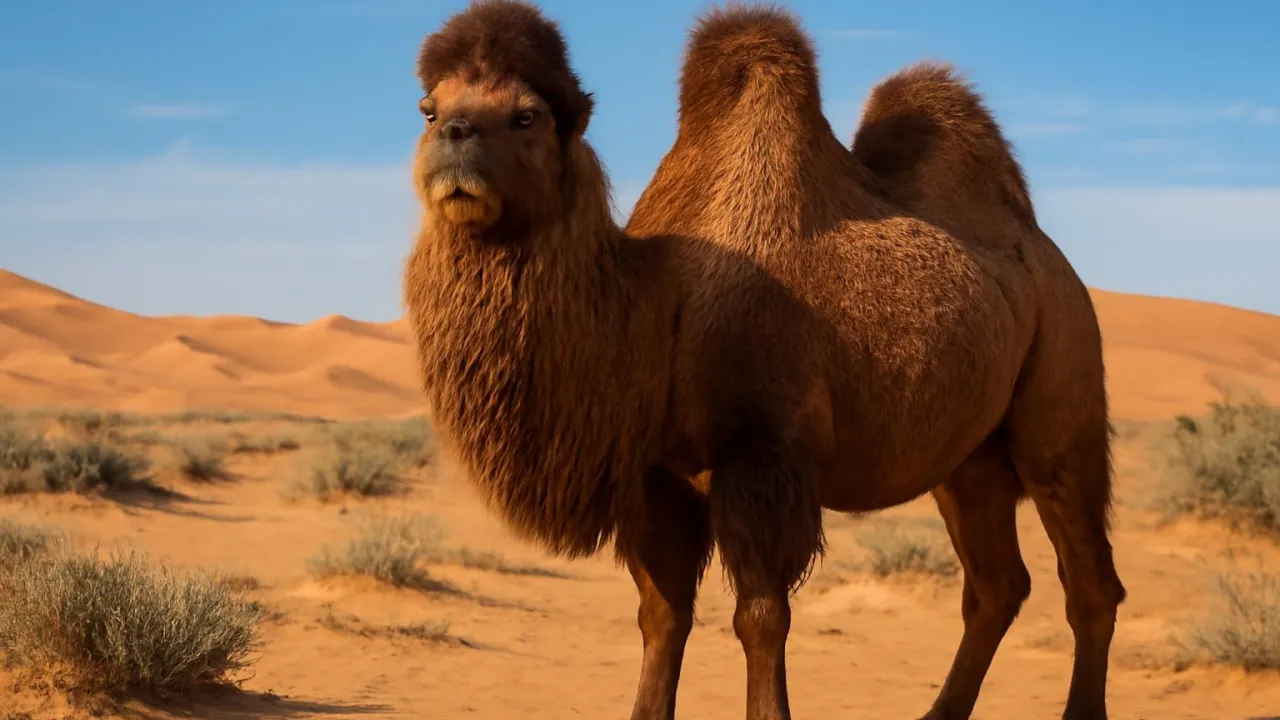
1. Why do Bactrian camels store fat in their humps?
2. Where do Bactrian camels live?
🤯 Mind-Blowing Fact • Grade 3
Bactrian camels can drink salty or brackish water that many animals cannot tolerate.
✨ Word Sparks (Grade 3 Glossary)
Tap 🔊 to hear
adaptation
A body change that helps survival
camouflage
Colors that help animals hide
nutrients
Food parts that help animals grow
🪝
What special features help a Bactrian camel survive harsh desert climates?
1
Fat-Storing Humps
Bactrian camels have two humps that store fat for energy during food shortages. This helps them survive long desert journeys without eating. When food is scarce, the fat breaks down to provide and water.
2
Thick Fur and Cold Adaptation
Their thick fur protects them from cold desert winters and hot summers. This fur acts as insulation, keeping body heat inside during cold nights. It also shields them from the sun’s heat during the day.
3
Desert Habitat and Camouflage
These camels live in Central Asian deserts and steppes, where sand and rocks dominate. Their tan and brown fur helps them from predators. Camouflage is a survival that helps animals blend into their environment.
4
Water Conservation and Nostrils
Bactrian camels can survive long periods without water by conserving moisture. They can close their nostrils during sandstorms to keep out dust. This helps protect their lungs and reduces water loss through breathing.
1. How do Bactrian camels use their humps during food shortages?
2. Why can Bactrian camels close their nostrils?
🤯 Mind-Blowing Fact • Grade 4
Wild Bactrian camels can survive in saltwater lakes and eat thorny desert plants that few animals can digest.
✨ Word Sparks (Grade 4 Glossary)
Tap 🔊 to hear
ecosystem
A community of living things and their home
herbivore
An animal that only eats plants
domestication
When humans tame wild animals
🪝
How do Bactrian camels survive extreme deserts with freezing winters and hot summers?
1
Energy Storage in Two Humps
Bactrian camels store fat in their two humps, which provides energy when food is scarce during long desert journeys. This fat can also be converted into water, helping them survive without drinking for days. This adaptation is crucial for survival in harsh environments. Their ability to rely on fat reserves allows them to travel far distances without food.
2
Thick Fur and Temperature Control
Their dense fur protects them from cold winter temperatures and insulates them against hot summer sun. This fur sheds in warmer months to keep them cool. Such temperature regulation allows camels to thrive in deserts with extreme seasonal changes. The fur also helps reduce water loss by blocking strong desert winds.
3
Role in Desert Ecosystems
Bactrian camels are important that feed on tough desert plants, helping control vegetation growth. They serve as prey for predators and also assist humans by carrying loads across deserts. Their grazing affects plant communities and helps maintain balance. By moving seeds in their droppings, they help plants grow in new areas.
4
Geographic Range and Human Impact
Native to Central Asia’s cold deserts and steppes, Bactrian camels have adapted to extreme climates. has spread them worldwide, but wild populations are endangered due to habitat loss and hunting. Conservation efforts focus on protecting wild herds and their habitats. Human activities like farming and mining threaten their natural environment.
1. Why is the fat in Bactrian camel humps important?
2. What role do Bactrian camels play in their ecosystem?
🤯 Mind-Blowing Fact • Grade 5
Bactrian camels survive temperature swings from -40°F to over 100°F thanks to their thick fur and fat stores.
✨ Word Sparks (Grade 5 Glossary)
Tap 🔊 to hear
physiological
How the body works and functions
endangered
At risk of disappearing forever
habitat
The natural home of a plant or animal
🪝
What unique biological features allow Bactrian camels to thrive in Central Asia’s harsh deserts?
1
Taxonomy and Scientific Classification
The Bactrian camel, scientifically known as Camelus bactrianus, belongs to the family Camelidae. It is distinct from the dromedary camel, which has only one hump. This species evolved to survive the cold deserts and steppes of Central Asia with remarkable adaptations. Its two-humped form is a key evolutionary trait.
2
Physiological Adaptations for Survival
Bactrian camels have two large humps that store up to 80 pounds (36 kilograms) of fat, which can be metabolized into energy and water. Their thick fur insulates against temperatures ranging from -40°F (-40°C) to over 100°F (38°C). Specialized nostrils close tightly to prevent sand inhalation during desert storms, protecting their respiratory system.
3
Conservation Status and History
Wild Bactrian camels are critically , with fewer than 1,000 individuals remaining in remote desert areas. Domestication began over 4,000 years ago, providing humans with transport and labor. Conservation efforts focus on protection, anti-poaching measures, and breeding programs to prevent extinction and preserve genetic diversity.
4
Ecological Role and Human Interaction
As large herbivores, Bactrian camels influence desert plant communities by grazing on tough shrubs and grasses. They support human livelihoods by carrying heavy loads across deserts and steppes. However, fragmentation from human activities such as farming and mining threatens their wild populations and disrupts migration routes.
5
Quantitative Comparisons and Unique Traits
Adult Bactrian camels stand about 6.5 to 7 feet (2 to 2.1 meters) tall at the shoulder and weigh between 1,000 and 1,800 pounds (450 to 820 kilograms). They can travel up to 25 miles (40 kilometers) per day without water. Their ability to drink salty or brackish water allows survival in harsh desert environments, a rare trait among large mammals.