👷 CAREERS
💼 Astrophysics, Stellar Dynamics & Cosmology
VA Economics, Civics & Career Readiness SOL K.8, 1.8, 2.8, 3.9
Astrophysicist
Decoding How Stars Shine, Explode, and Bend Space
Grade 1 • Early Reader • 64 words
🧭 Career FieldSpace Research Institutes, Supercomputer Centers & Universities
🛠️ Key Tools & SkillsSupercomputers, physics equations, gravitational-wave detectors, and space spectrometers
🏢 WorkplaceUniversity physics labs, NASA research centers, and supercomputing hubs
⚡ Everyday Impact SparkUses math and physics to explain black holes, star engines, and how the universe began
🤯 Mind-Blowing Fact • Grade 1
One teaspoon of material from a super-squished 'neutron star' would weigh as much as a giant mountain here on Earth!
✨ Word Sparks (Grade 1 Glossary)
Tap 🔊 to hear
gravity
Invisible pull drawing objects toward each other
star
A giant glowing ball of hot gas
energy
Power that makes heat, light, and motion
🪝
What makes the Sun stay hot and bright every single day?
1
Asking Space 'Why?'
Look up at the warm golden Sun! Spotting a is fun, yet asking how it shines is the job of an astrophysicist.
2
Giant Star Engines
Deep inside every , tiny bits of gas squeeze together. Boom! Out bursts bright light and cozy heat. Fast computers help scientists test these big space ideas.
3
Gravity's Big Pull
Invisible keeps planets spinning around . Even mysterious black holes follow nature's rules!
1. What main question does an astrophysicist try to answer?
2. What invisible force holds Earth in its path around the Sun?
🤯 Mind-Blowing Fact • Grade 2
Every single second, the core of our Sun smashes 600 million tons of hydrogen gas together to create sunshine!
✨ Word Sparks (Grade 2 Glossary)
Tap 🔊 to hear
black hole
A space spot with inescapable gravity pull
physics
Science of energy, forces, light, and motion
simulation
A computer model testing real-world science
🪝
How can a scientist test what happens inside an exploding star without getting burned?
1
Space Laboratories on Screens
Nobody can fly a thermometer into the fiery center of the Sun—it would melt in a flash! Instead, an astrophysicist builds virtual stars inside super-fast computers using the laws of heat, light, and gravity.
2
Astronomer vs. Astrophysicist
The two jobs are close teammates, and many scientists do both! While astronomers focus on finding and mapping objects in the sky, astrophysicists figure out the behind how stars are born, live, and explode.
3
Solving Black Hole Mysteries
They also study —places in space where gravity pulls so hard that not even a flashlight beam can escape!
1. Why do astrophysicists build computer simulations of stars?
2. What makes a black hole so unusual?
🤯 Mind-Blowing Fact • Grade 3
Contrary to bath-faucet labels where blue means cold and red means hot, blue stars are up to ten times hotter than red stars!
✨ Word Sparks (Grade 3 Glossary)
Tap 🔊 to hear
nuclear fusion
Joining small atoms together to release energy
dark matter
Invisible space mass detected through gravity pull
core
The super-hot center of a star
🪝
How did stars cook up the gold in jewelry and the oxygen you are breathing right now?
1
Cosmic Star Kitchens
Take a deep breath! Every atom of oxygen in your lungs—and every speck of gold or silver on Earth—was forged billions of years ago inside giant stars. Uncovering that incredible recipe was the triumph of modern astrophysicists.
2
Nuclear Fusion Power
Stars are not burning like wood campfires. Crushing pressure at a star's squeezes tiny hydrogen atoms together into helium—a process called that releases enormous heat and light for billions of years.
3
Colors Tell Temperature
Just like a stove burner or a candle flame, a star's color reveals how hot its surface is! Cool stars glow orange-red, medium stars like our Sun shine yellow-white, and the hottest stars blaze brilliant blue-white.
4
Invisible Dark Matter
By measuring how fast spiral galaxies spin, astrophysicists like Vera Rubin noticed galaxies should fly apart unless extra invisible stuff—now called ''—holds them together!
1. Which color star has the hottest surface temperature in space?
2. How did astrophysicist Vera Rubin realize invisible 'dark matter' must exist?
🤯 Mind-Blowing Fact • Grade 4
In 1925, twenty-five-year-old astrophysicist Cecilia Payne-Gaposchkin proved for the first time that stars are made mostly of lightweight hydrogen and helium rather than heavy Earth rocks!
✨ Word Sparks (Grade 4 Glossary)
Tap 🔊 to hear
gravitational wave
A ripple in space from colliding giants
solar flare
A sudden burst of energy on Sun
white dwarf
Dense glowing core left by medium stars
🪝
How can scientists hear tiny ripples in space itself from two black holes crashing billions of light-years away?
1
Listening to Space Ripples
Picture tossing two pebbles into a calm pond and watching ripples spread outward. Over a century ago, Albert Einstein predicted that colliding giants in space send invisible ripples——stretching and squeezing space itself! Today, an astrophysicist measures those whispers using twin 2.5-mile laser tunnels in Washington State and Louisiana.
2
Life Cycles of Stars
Using physics equations and NASA space observatories, astrophysicists chart a star's entire life based on its starting mass. Medium-sized stars like our 4.6-billion-year-old Sun shine steadily for ten billion years before puffing off outer gas layers and cooling into a compact '.' Giant stars ten times heavier race through their fuel in just millions of years, erupting as supernovas and leaving behind ultra-dense neutron stars or black holes.
3
Space Weather and Earth's Shield
Closer to home, solar astrophysicists monitor giant magnetic loops and erupting from the Sun's outer atmosphere. Timely space-weather forecasts protect orbiting astronauts, airline crews, GPS navigation satellites, and electrical power grids across Virginia and the entire globe.
4
Training for the Cosmos
Future astrophysicists build strong foundations in mathematics, computer coding, electricity, magnetism, and creative teamwork to tackle the universe's biggest unsolved riddles!
1. What determines whether a star ends its life quietly as a white dwarf or explodes in a giant supernova?
2. Why do solar astrophysicists watch for powerful solar flares?
🤯 Mind-Blowing Fact • Grade 5
LIGO's laser detectors are so sensitive they can measure space stretching by 1/1,000th the width of a single proton—equivalent to measuring the distance to the nearest star within the width of one human hair!
✨ Word Sparks (Grade 5 Glossary)
Tap 🔊 to hear
cosmology
Science studying the universe's origin and growth
dark energy
Mysterious force speeding up cosmic space expansion
general relativity
Einstein's theory showing mass curves space-time
🪝
Why does everything we can see—every star, planet, and galaxy—make up only five percent of the universe?
1
A Ninety-Five Percent Mystery
Count every blazing star, swirling nebula, rocky planet, and living creature across two trillion galaxies: together, ordinary atomic matter accounts for roughly 5 percent of the cosmos! Unraveling the remaining 95 percent—split between invisible dark matter (about 27 percent) and mysterious accelerating cosmic expansion (about 68 percent)—drives twenty-first-century astrophysicists.
2
When Physics Joined Stargazing
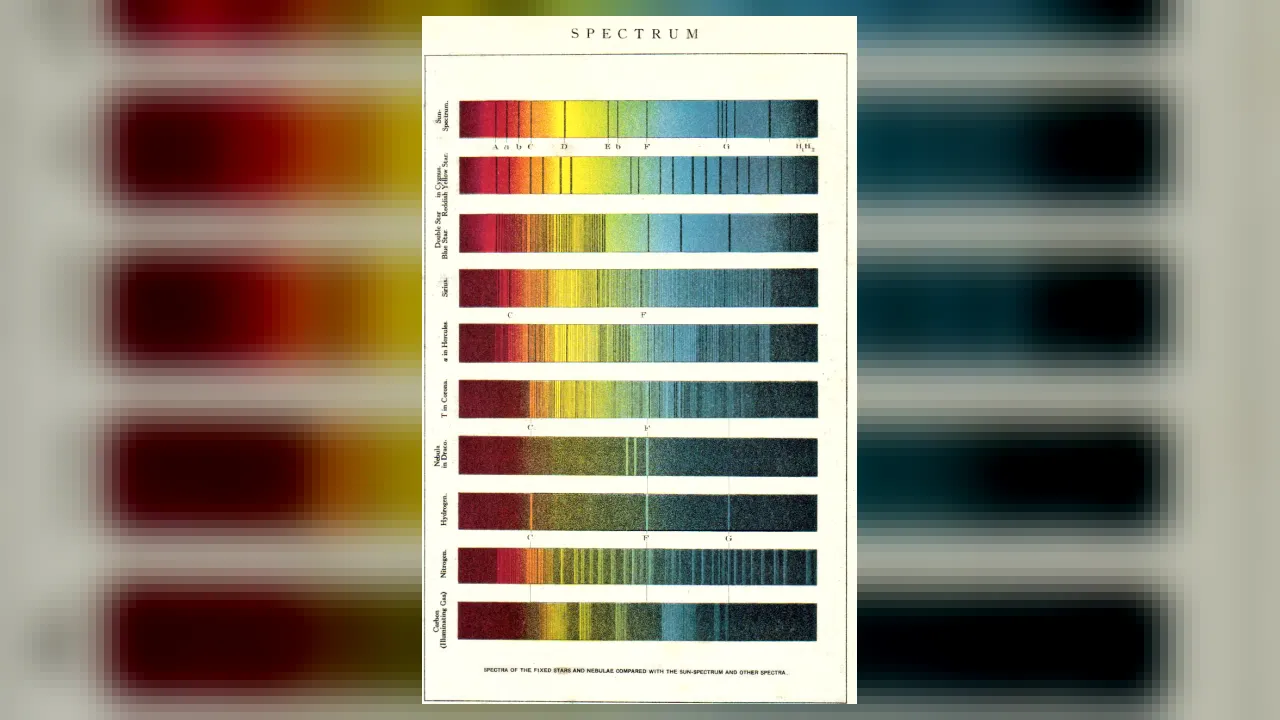
For millennia, skywatchers mapped where celestial bodies moved without knowing what they were made of. Astrophysics emerged in the mid-1800s when Joseph von Fraunhofer, Gustav Kirchhoff, and Robert Bunsen discovered that glowing chemical elements imprint identical spectral lines in laboratory flames and in sunlight—proving the exact same laws of physics govern Earth and distant galaxies!
3
Echoes of the Early Universe
In 1964, Arno Penzias and Robert Wilson detected a faint, uniform hiss of microwaves coming from every direction in the sky: the Cosmic Microwave Background, leftover heat from when the universe was just 380,000 years old! By mapping tiny temperature ripples of 0.00001 degrees in that afterglow, cosmologists calculated the universe's age at 13.8 billion years.
4
LIGO and Relativistic Extremes
In 2015, the LIGO laser observatory detected gravitational waves shifting mirrors by less than one-thousandth the width of a proton as two black holes merged 1.3 billion light-years away. Combined with gamma-ray and neutrino observatories, multi-messenger astrophysics now witnesses gold and platinum being forged live when neutron stars collide!
5
Everyday Spinoffs from Cosmic Math
Even your phone's GPS relies on Einstein's : without correcting satellite atomic clocks by 38 microseconds per day for weaker gravity in orbit, every map pin on Earth would drift miles off course!