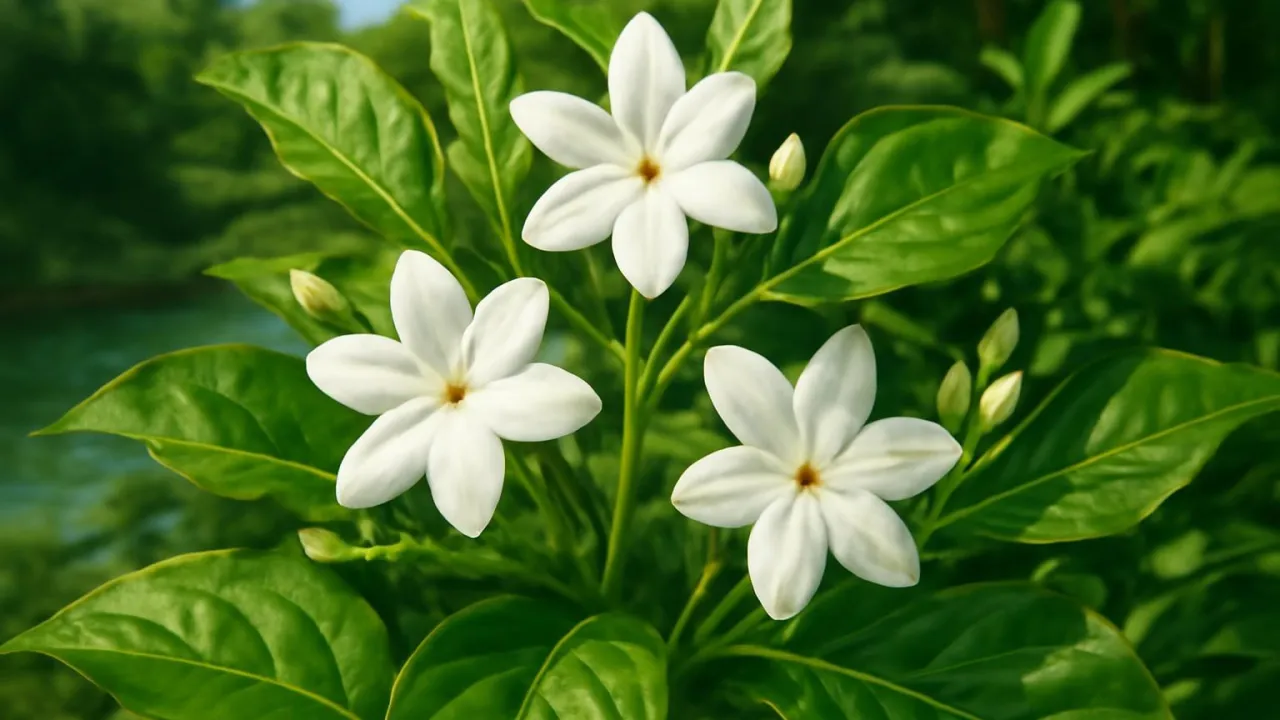
2. What do people use Arabian Jasmine flowers for?
🤯 Mind-Blowing Fact • Grade 2
Arabian Jasmine flowers release their strongest scent during warm summer nights!
✨ Word Sparks (Grade 2 Glossary)
Tap 🔊 to hear
nectar
Sweet juice inside flowers that bees drink
fragrance
A nice smell that comes from flowers
shrub
A small bushy plant with many branches
🪝
Have you ever smelled a flower that smells like sweet honey?
1
Beautiful White Flowers
Arabian Jasmine has many small white flowers that smell very sweet and fresh. Bees and butterflies visit these flowers often to collect . The flowers bloom mostly at night when their scent is strongest.
2
Warm Places to Grow
This flower grows well in warm places with plenty of sunshine and water. People plant Arabian Jasmine in gardens and near homes to enjoy its lovely smell. It can grow as a or a climbing vine.
3
Fragrant and Useful
The sweet scent of Arabian Jasmine flowers is used in perfumes and to flavor tea. Its can fill a whole room or garden. Some people use the flowers in special ceremonies and decorations.
1. When do Arabian Jasmine flowers smell the strongest?
2. What do bees collect from Arabian Jasmine flowers?
🤯 Mind-Blowing Fact • Grade 3
Arabian Jasmine’s night fragrance is a clever adaptation to attract specific pollinators.
✨ Word Sparks (Grade 3 Glossary)
Tap 🔊 to hear
pollination
When insects help flowers make seeds
adaptation
A special trait that helps plants survive
nectar
Sweet liquid inside flowers for insects
🪝
Did you know Arabian Jasmine flowers bloom mostly at night to attract pollinators?
1
Night-Blooming Fragrance
Arabian Jasmine flowers open mostly at night to release their strong fragrance. This helps attract night pollinators like moths. The scent guides these insects to the flower’s . This process is called .
2
Flower Structure and Survival
The small white flowers have a star shape that helps insects land easily. Their bright color stands out in the dark, making them easier to find. These features increase the chance of and reproduction. This is an important survival .
3
Habitat and Growth
Arabian Jasmine grows in warm tropical and subtropical regions, needing full sun and well-drained soil. It can grow as a shrub or vine, climbing on supports for more sunlight. These plants need regular watering to get nutrients from the soil. They are often found in gardens and parks.
4
Human Uses and Importance
People use Arabian Jasmine flowers for their fragrance in perfumes and teas. The flowers are also used in cultural ceremonies and decorations. This flower plays a role in the ecosystem by supporting pollinators. It also helps humans enjoy natural scents and flavors.
1. Why do Arabian Jasmine flowers bloom mostly at night?
2. What helps insects land on Arabian Jasmine flowers?
🤯 Mind-Blowing Fact • Grade 4
Arabian Jasmine’s night fragrance supports a complex web of pollinators and animals.
✨ Word Sparks (Grade 4 Glossary)
Tap 🔊 to hear
symbiosis
When two living things help each other
nocturnal
Active at night, like moths and bats
biodiversity
Many different plants and animals living together
🪝
How does Arabian Jasmine’s fragrance affect its role in the ecosystem?
1
Cause and Effect of Night Blooming
Arabian Jasmine flowers bloom at night, releasing a strong fragrance that attracts pollinators such as moths and bats. This cause-and-effect relationship helps the plant reproduce successfully by ensuring pollination during cooler hours. The flower’s white color enhances visibility in low light, increasing pollinator visits. Without these adaptations, the plant’s survival chances would decrease.
2
Role in Food Webs and Symbiosis
The flowers provide nectar that feeds many insects, which in turn support birds and other animals higher in the food web. This symbiotic relationship benefits both the plant and the pollinators. Arabian Jasmine also supports human agriculture by supplying fragrant flowers used in perfumes and teas. Its presence in gardens promotes and healthy ecosystems.
3
Geographic Distribution and Growth
Native to South Asia and the Arabian Peninsula, Arabian Jasmine thrives in tropical and subtropical climates with warm temperatures and moderate rainfall. It prefers well-drained soils and full sun exposure. The plant can grow as a shrub or climbing vine, adapting to different environments. Human cultivation has spread it to many warm regions worldwide.
4
Human Impact and Conservation
Arabian Jasmine is widely cultivated for commercial use, which helps conserve the species by encouraging propagation. However, habitat loss in native areas could threaten wild populations. Sustainable gardening practices and awareness of its ecological role support conservation. Protecting this plant helps maintain pollinator populations and .
1. What animal types are attracted by Arabian Jasmine’s night fragrance?
2. How does Arabian Jasmine help ecosystems?
🤯 Mind-Blowing Fact • Grade 5
Arabian Jasmine’s scent molecules increase sharply at night to attract nocturnal pollinators efficiently.
✨ Word Sparks (Grade 5 Glossary)
Tap 🔊 to hear
Oleaceae
The plant family that includes jasmine and olives
nocturnal
Active at night, like moths that pollinate flowers
pollinator
An animal that helps plants make seeds
🪝
What scientific secrets make Arabian Jasmine a fragrant marvel in tropical climates?
1
Taxonomy and Botanical Classification
Arabian Jasmine belongs to the family and is scientifically named Jasminum sambac. It is a woody shrub or vine native to South Asia and the Arabian Peninsula. This species is one of over 200 jasmine types worldwide. Its classification helps scientists understand its evolutionary relationships and ecological roles.
2
Physiological Mechanics of Fragrance Production
The plant produces fragrant oils concentrated in tiny glands on the petals, which release scent molecules especially at night. This emission attracts specific like moths, which rely on scent to locate flowers in darkness. The flower’s white color enhances visibility under low light, complementing the chemical signals. These combined traits increase reproductive success.
3
Ecological Role and Conservation Status
Arabian Jasmine supports species that are crucial for many ecosystems, forming part of complex food webs. While widely cultivated, wild populations face habitat loss due to urbanization and agriculture. Conservation efforts include sustainable cultivation and habitat protection to preserve genetic diversity and ecological balance. Its cultural importance also promotes conservation awareness.
4
Cultural and Historical Significance
The flower has been used for centuries in perfumes, teas, and religious ceremonies across Asia and the Middle East. It symbolizes purity and love in many cultures and is the national flower of the Philippines. Historical trade routes spread its cultivation worldwide, influencing horticulture and fragrance industries. Its delicate scent continues to inspire art and tradition.
5
Quantitative Comparisons and Growth Characteristics
Arabian Jasmine grows between 3 to 6 feet tall and thrives in temperatures from 60 to 90 degrees Fahrenheit (15 to 32 degrees Celsius). Its flowers measure about 1 to 1.5 inches (2.5 to 4 centimeters) across. The plant requires daily watering in dry seasons and full sun exposure for optimal growth. Compared to other jasmines, its scent is among the strongest and most enduring.