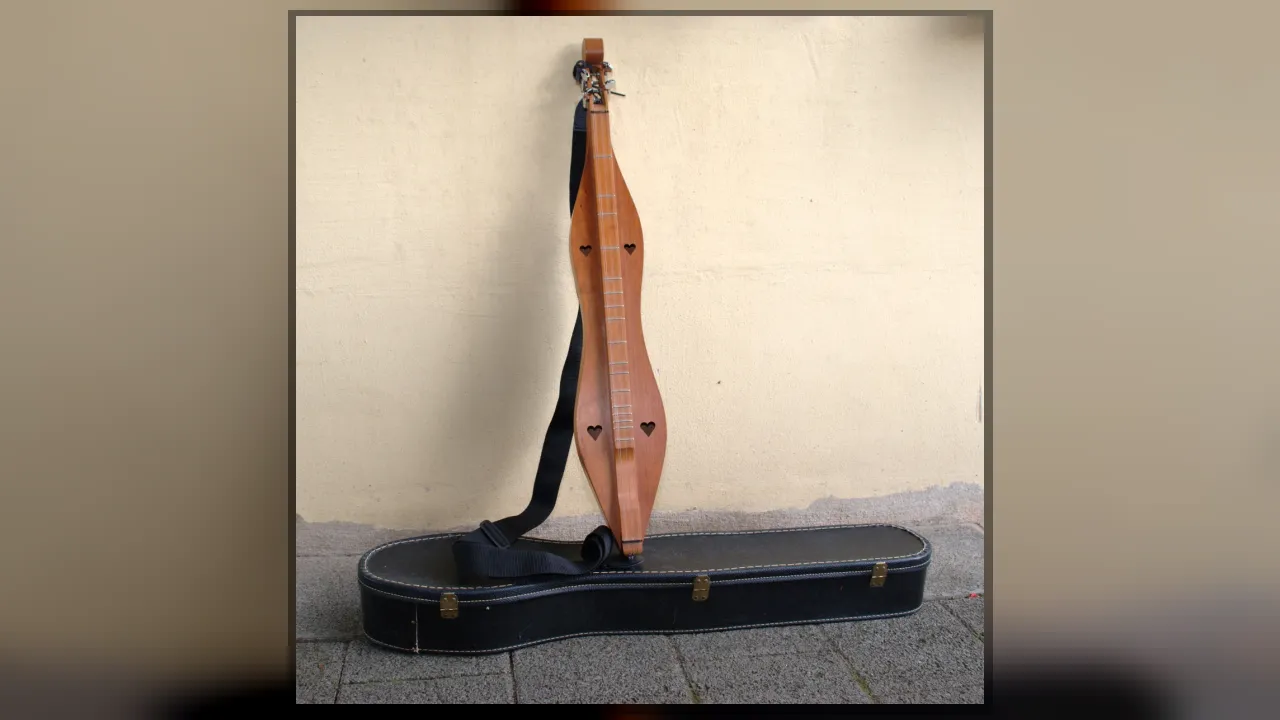
1. How does a musician hold an Appalachian dulcimer while playing?
2. What charming shape is often carved for the soundholes on an Appalachian dulcimer?
🤯 Mind-Blowing Fact • Grade 2
The word dulcimer comes from Latin and Greek roots—'dulce melos'—meaning 'sweet song'!
✨ Word Sparks (Grade 2 Glossary)
Tap 🔊 to hear
noter
Small wooden stick slid along the melody string.
drone
Open string humming steady harmony underneath a tune.
frontier
Early rural settlements nestled near wild forests.
🪝
Why are some spaces wide and some spaces narrow along this instrument's fretboard?
1
Songs of Misty Ridges
Strum—hummm—chime! Picture a quiet log cabin tucked high in the misty Blue Ridge Mountains as gentle music fills the room! Early American families crafted the slender Appalachian dulcimer—also called the mountain or lap dulcimer—from local walnut, cherry, and sassafras trees.
2
Built-In Do-Re-Mi Frets
Look down at the raised wooden strip running down the center and you will notice uneven gaps between the metal frets! Just like singing only the white keys on a piano, those diatonic frets spell out 'do-re-mi-fa-sol-la-ti-do' automatically.
3
Sliding a Wooden Stick
Traditional players slide a smooth wooden dowel called a along the closest melody string with their left hand, while strumming across all the humming strings with a flexible pick or feather quill!
1. Why do the metal frets on a traditional Appalachian dulcimer have uneven wide and narrow gaps?
2. What is a 'noter' in traditional mountain dulcimer playing?
🤯 Mind-Blowing Fact • Grade 3
In the 1960s and 1970s, folk singer Kentucky-born Jean Ritchie and songwriter Joni Mitchell brought the gentle Appalachian dulcimer onto famous concert stages worldwide!
✨ Word Sparks (Grade 3 Glossary)
Tap 🔊 to hear
Scheitholt
Narrow German zither ancestor of the mountain dulcimer.
ballad
A folk song that tells a dramatic story.
hourglass
Curved figure-eight shape pinched narrower in the middle.
🪝
Why does an Appalachian dulcimer look nothing like a hammered dulcimer even though they share a last name?
1
A Quiet Voice for Storytelling
Whisp—hum—ring! Unlike loud banjos built for crowded barn dances, this slender wooden zither sings softly enough to accompany a storyteller's quietest ! Born in the early 1800s along rugged valleys from Virginia to Kentucky, the Appalachian dulcimer became one of North America's signature folk instruments.
2
European Zither Roots
Despite sharing the 'sweet song' name, it is completely different from the trapezoidal hammered dulcimer! German, Scots-Irish, and Scandinavian settlers adapted straight-sided European fretted zithers—especially the German and Swedish hummel—and gave the body graceful teardrop or curves.
3
Hollow Spine and Heart Soundholes
Down the center of its walnut or spruce top runs a raised, hollow fretboard channeling vibrations into the main soundbox, where four carved hearts or f-holes let warm resonance bloom.
4
Modal Tunings
By retuning the melody string against middle and bass drones, players switch in seconds from sunny major melodies to haunting old-world Dorian or Mixolydian mountain modes!
1. Which European folk instrument directly inspired settlers to create the Appalachian dulcimer?
2. Why was the Appalachian dulcimer originally favored inside quiet family parlors and cabins?
🤯 Mind-Blowing Fact • Grade 4
On traditional old-time Kentucky dulcimers, narrow wire frets ran *only* underneath the single melody string—leaving the two drone strings completely fretless!
✨ Word Sparks (Grade 4 Glossary)
Tap 🔊 to hear
Mixolydian
A classic folk scale with a lowered seventh.
bout
Rounded upper or lower curve of an instrument.
unadorned
Simple, pure, and natural without flashy extras.
🪝
How did adding one single 'six-and-a-half' fret turn a nineteenth-century frontier drone zither into a versatile concert instrument?
1
Echoes Along the Wilderness Road
What would happen if German woodworkers carrying rectangular Scheitholt zithers met Scots-Irish ballad singers traveling southward down the Great Wagon Road into Virginia and Kentucky? Out of that early nineteenth-century crossroads emerged the Appalachian dulcimer—a slender lap zither whose humming drones echoed the ancient skirl of Highland bagpipes.
2
Acoustic Upgrade: Freeing the Soundboard
On older European Scheitholts, metal wire staples were driven straight into the side of a narrow wooden box, slightly stiffening the top plate. Frontier luthiers such as Elihu Rauch in western Virginia engineered a smarter acoustic design: they mounted a separate, hollowed-out central fretboard above wide teardrop or hourglass , allowing thin walnut, cherry, or spruce soundboards to flex freely.
3
Four Strings, Three Courses, and Modal Magic
Most modern mountain dulcimers carry four steel strings grouped in three courses: a paired unison melody course closest to the player, a single middle string, and a wound bass string. Tuning to D–A–D places the unfretted seventh scale step cleanly into the mode, while tuning D–A–A unlocks the bright Ionian major scale across two and a half octaves.
4
The Famous '6+' Fret
Traditional diatonic fretboards skipped half-steps, locking songs into one mode per tuning. In the late twentieth century, builders inserted a single extra fret halfway through the sixth gap—the 'six-and-a-half fret'—instantly unlocking modern major keys without retuning a single peg!
1. How did frontier American builders make the Appalachian dulcimer louder and warmer than its narrow German Scheitholt ancestor?
2. What clever shortcut did modern builders create by adding the 'six-and-a-half' (6+) fret?
🤯 Mind-Blowing Fact • Grade 5
Museum historians discovered that before factory wire arrived in remote mountain hollows, early nineteenth-century Appalachian builders hammered flattened horseshoe nails or stiff broom wires into dulcimer fretboards!
✨ Word Sparks (Grade 5 Glossary)
Tap 🔊 to hear
decouple
To separate parts so vibrations move freely.
Ionian
Standard bright major 'do-re-mi' seven-note scale.
Dorian
Soulful minor-sounding folk mode used in ballads.
🪝
How do a decoupled central spine, modal diatonic fret topology, and contemporary chord-melody fingerstyle define America's fretted box zither?
1
Silver Drones Across Two and a Half Octaves
Laid horizontally across the performer's thighs at roughly eighty-five to ninety-five centimetres in length, the Appalachian dulcimer whispers rather than shouts—yet its crystalline steel overtones and shimmering open-fifth drones command hushed attention in any hall. Spanning roughly two to two and a half octaves from D3 (146.8 hertz) past A5, North America's native fretted zither bridges archaic balladry and modern acoustic fingerstyle.
2
Trans-Appalachian Organology and Settler Synthesis
Classified under Hornbostel-Sachs 314.122 as a true board/box zither with resonator, the Appalachian dulcimer carries no structural kinship with the trapezoidal struck hammered dulcimer; early mountain players simply called it a 'harmonium' or 'hog-fiddle' before adopting the poetic Latin-Greek name dulcimer. Archival research traces its birth around 1800–1830 along Pennsylvania-German and Scots-Irish migration corridors in southwestern Virginia, eastern Kentucky, and Tennessee, where builders fused the narrow German Scheitholt (and Scandinavian langeleik/hummel) with wider British acoustic sensibilities.
3
Structural Acoustics of the Raised Hollow Fretboard
Acoustic efficiency hinges on decoupling string tension from soundboard stiffness. Instead of anchoring frets directly onto a thin top plate, builders construct a rigid, hollow hardwood fretboard spine—often routed internally with wide relief windows—glued down the longitudinal centerline of bookmatched walnut, cherry, sassafras, cedar, or Sitka spruce wings. Vibrations travel from a bone nut and saddle through the spine into hourglass, teardrop, or elliptical chambers vented by four traditional hearts or f-holes.
4
Diatonic Topology, Modal Drones, and the 6.5 Fret
Historically fitted with short wire frets solely beneath the melody string, nineteenth-century dulcimers spaced intervals in an asymmetrical W-W-H-W-W-H-W diatonic pattern—naturally yielding a seven-note Mixolydian scale starting from the open nut! Tuning three courses (four strings: D4/D4–A3–D3) produces open-fifth bagpipe harmony; retuning to D4–A3–A3 shifts the tonic to the third fret for major, or D4–G3–D3 for minor. Full-width frets paired with modern 6.5 (F#4) and 1.5 (F4) half-frets later expanded harmonic reach without sacrificing effortless drone playability.
5
From Jean Ritchie's Folk Revival to Chromatic Virtuosity
Carried into mid-twentieth-century concert halls by Viper, Kentucky balladeer Jean Ritchie and reimagined in open-chord fingerpicking by Joni Mitchell on her landmark 1971 album 'Blue,' the mountain dulcimer today supports jazz chord-melody, classical counterpoint, and full twelve-tone chromatic fretboards.