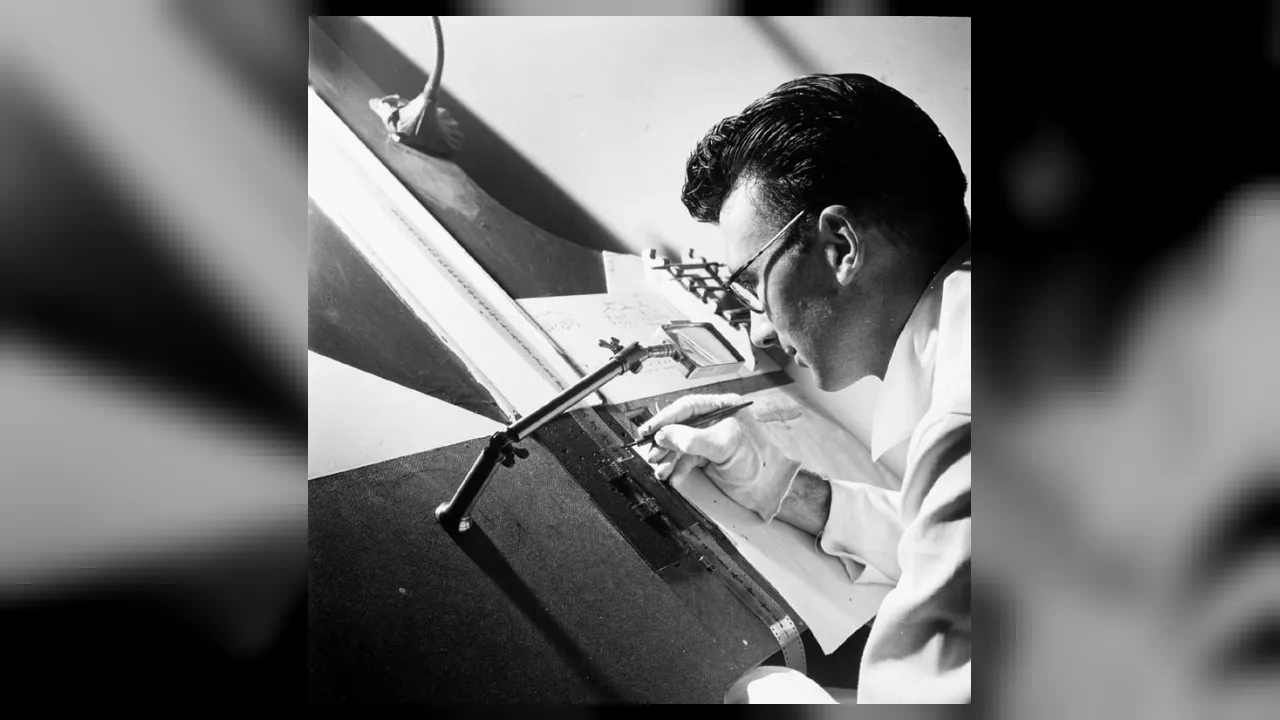
1. How many single frames flash by in one second of a standard animated movie?
2. Why do animators keep small mirrors on their desks?
🤯 Mind-Blowing Fact • Grade 2
Wait—voice actors almost always record their lines BEFORE the movie is animated so animators can match the character's mouth and eyebrows to the actor's real laugh!
✨ Word Sparks (Grade 2 Glossary)
Tap 🔊 to hear
storyboard
Comic panels planning every movie scene
stop-motion
Filming real puppets moved tiny amounts
dialogue
Spoken words between characters in stories
🪝
What are the three main ways animators make characters move today?
1
Three Cool Styles of Animation
Imagine sculpting a clay dragon, sketching on a glowing screen, or rotating a 3D robot! Hand-drawn 2D animators draw flat shapes, 3D computer animators pose digital models, and animators move real miniature puppets one tiny millimeter per photo.
2
Starting With a Storyboard
Before animating a single jump, the team pins up hundreds of comic-strip panels called a . Voice actors record the jokes and first so animators can match every lip movement to the sound!
3
Squash and Stretch!
Watch a cartoon ball bounce: it flattens slightly when hitting the floor and stretches as it zooms up, making motion feel lively and bouncy.
1. Which usually happens FIRST when making an animated feature film?
2. How does stop-motion animation work?
🤯 Mind-Blowing Fact • Grade 3
Released in 1995, 'Toy Story' was the very first full-length 3D computer-animated movie in history, requiring 800,000 hours of computer rendering time!
✨ Word Sparks (Grade 3 Glossary)
Tap 🔊 to hear
keyframe
Main pose marking start or end action
rig
Digital skeleton letting 3D models bend
render
Use computers to calculate final lit frames
🪝
How does an invisible digital skeleton let 3D characters dance, fly, and smile?
1
Inside a 3D Animation Pipeline
Step inside a modern animation studio and you will discover dozens of specialists collaborating! Modelers sculpt characters like digital clay, and technical artists build an invisible inner skeleton of joints and controls called a ''—just like strings on a marionette.
2
Keyframes and In-Betweens
Animators first pose the big storytelling moments called —such as a squirrel crouching low to leap and landing safely on an oak branch. Next, assistant artists or smooth computer curves fill in all the transitional frames in between.
3
Studying Real Animal Physics
To make a galloping horse, diving pelican, or soaring hawk look believable, animators visit zoos with sketchbooks and study slow-motion videos of real muscles, gravity, and balance.
4
Beyond Movies: Science and Space!
Animators don't just make cartoons and video games! NASA engineers and medical schools hire scientific animators to show Mars rovers landing on red craters or red blood cells carrying oxygen.
1. What is a digital 'rig' in 3D character animation?
2. Why does NASA hire scientific animators?
🤯 Mind-Blowing Fact • Grade 4
The root word 'animate' comes from the Latin 'anima,' meaning breath or soul—literally breathing life into still objects!
✨ Word Sparks (Grade 4 Glossary)
Tap 🔊 to hear
anticipation
Backward wind-up motion preparing for big action
zoetrope
Spinning cylinder toy showing early moving drawings
cycle
Repeating loop of frames like walking steps
🪝
What optical brain science makes 24 separate pictures blend into living motion?
1
The Illusion of Motion
Every animated film ever projected onto a theater screen relies on a remarkable partnership between your eyes and brain! When slightly different still drawings flash faster than 12 to 24 frames per second, neurons in your visual cortex connect those tiny position changes into seamless motion—an optical phenomenon nineteenth-century inventors first explored using spinning drums.
2
The 12 Principles of Animation
In the 1930s, pioneering studio animators Frank Thomas and Ollie Johnston documented 12 classic principles still practiced by every 2D and 3D studio worldwide. '' means a baseball pitcher winds backward before throwing forward so viewers' eyes can track the action; 'follow-through' means floppy puppy ears, ponytails, or superhero capes keep swinging for a beat after the character's feet stop.
3
One Week for Four Seconds!
Feature-film character animation requires extraordinary focus and patience. Because every eyebrow lift, breath, finger tap, and weight shift must look sincere, a professional animator on a major movie typically polishes only three to five seconds of finished screen time across an entire 40-hour workweek!
4
Video Games and Interactive Cycles
Video game animators solve a different exciting puzzle: creating smooth, repeatable loops—sprinting, climbing, swimming, and landing —that blend instantaneously at 60 frames per second the exact moment a player presses a controller button.
1. In animation principles, what is 'anticipation'?
2. Roughly how many seconds of finished feature-film animation does one animator complete per week?
🤯 Mind-Blowing Fact • Grade 5
At modern stop-motion studios like LAIKA, 3D printers fabricate thousands of tiny, snap-on replacement faces for a single puppet so one hero character can display over 50,000 distinct facial expressions!
✨ Word Sparks (Grade 5 Glossary)
Tap 🔊 to hear
kinematics
Geometry describing how connected joints move together
silhouette
Solid outline shape readable even in shadow
simulation
Computer math modeling natural water, hair, or wind
🪝
How do kinematics math, physics simulations, and hand-crafted acting merge in modern animation?
1
Where Classical Art Meets Applied Physics
Early twentieth-century pioneers like Winsor McCay—who painstakingly hand-drew 10,000 ink frames on rice paper for 1914's 'Gertie the Dinosaur'—and German artist Lotte Reiniger, who scissored intricate backlit fairy tales in the 1920s, proved animation could evoke genuine emotion. Today, that timeless acting craft converges with three-dimensional Cartesian geometry, linear algebra, and high-speed GPU rendering farms.
2
Forward vs. Inverse Kinematics
Inside professional 3D animation software, character animators pose digital rigs along X, Y, and Z coordinate axes using mathematical Bezier spline curves. Forward (FK) rotates a chain of joints outward from parent to child—shoulder to elbow to wrist—which produces natural pendulum arcs when an arm swings freely. Inverse kinematics (IK) reverses the math: locking a character's hand onto a ladder rung or planting a boot firmly on sloped ground while the computer calculates exact knee and hip angles.
3
Stepped Blocking to Spline Polish
Studio shots progress through disciplined review stages. Animators start in 'stepped blocking,' sculpting key storytelling poses without smooth interpolation to verify comedic timing, readable black-and-white , and clear eye-lines with the director. Once approved, the animator transitions into spline polish—refining acceleration curves, overlapping tail or fabric motion, subtle chest breathing, and 1/24-second micro-blinks.
4
Procedural Simulation and Motion Capture
Alongside character animators, technical effects animators write physics solvers that calculate millions of colliding snow crystals, splashing ocean waves, and wind-blown hairs interacting naturally with virtual lighting.
5
Demo Reels and Studio Collaboration
Aspiring animators enter feature film, television, medical visualization, or interactive video game studios by crafting a focused 60-second demo reel showcasing believable physical weight, crisp balance, and heartfelt character acting—working seamlessly alongside storyboarding, rigging, lighting, and sound-design departments.