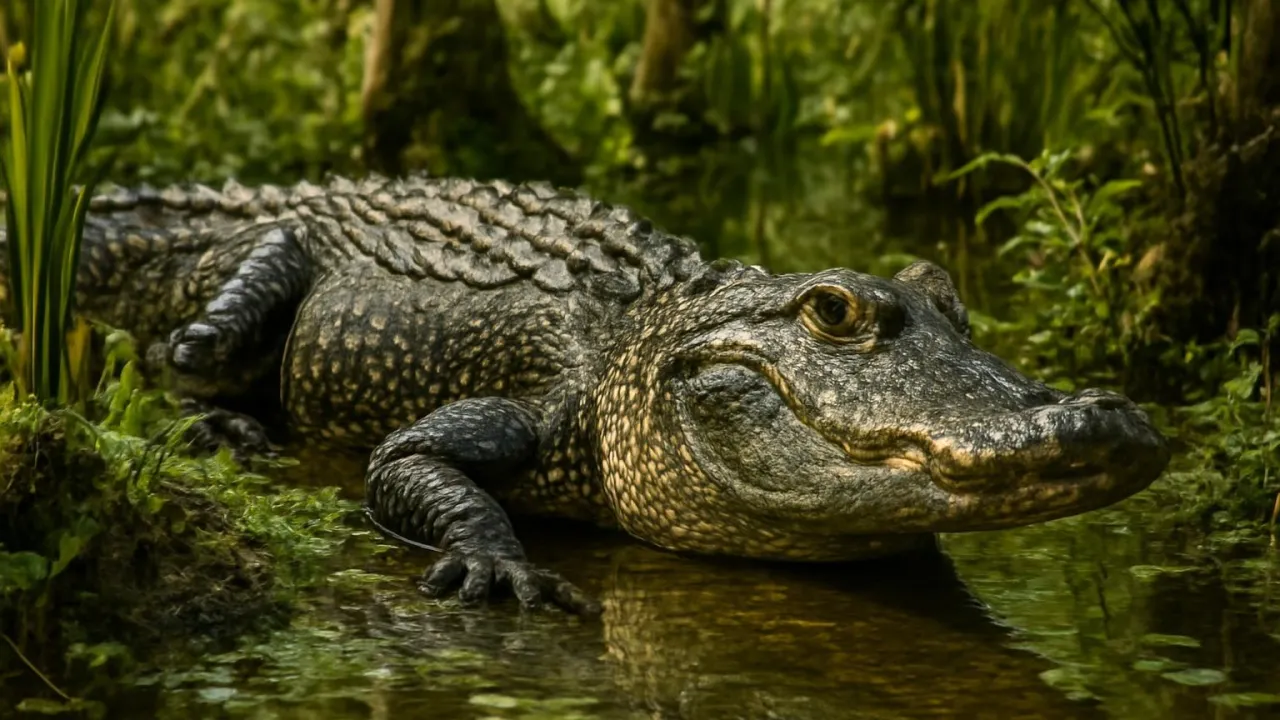
Alligators can hold their breath underwater for up to two hours!
✨ Word Sparks (Grade 2 Glossary)
Tap 🔊 to hear
reptile
A cold-blooded animal with scales
nest
A safe place where animals lay eggs
prey
An animal that is hunted for food
🪝
Have you ever heard an alligator’s loud bellow in the swamp?
1
Strong and Big Reptile
American alligators are large that can grow very long. They have rough, scaly skin that helps protect them. Their strong tails help them swim quickly in water.
2
Swamp Homes and Babies
Alligators live in warm swamps, rivers, and lakes in the southeastern United States. Female alligators build to lay eggs. Baby alligators hatch after about two months.
3
Sharp Teeth and Diet
They have sharp teeth to catch fish, birds, and small mammals. Alligators use their powerful jaws to crush . Their eyes and nostrils sit on top of their heads to see above water.
An alligator’s bite force can reach over 2,000 pounds per square inch!
✨ Word Sparks (Grade 3 Glossary)
Tap 🔊 to hear
camouflage
Colors that help animals hide in nature
ecosystem
A community of plants and animals living together
symbiotic
When animals help each other live well
🪝
Did you know alligators use camouflage to hide from predators and prey?
1
Adapted for Survival
American alligators have rough, scaly skin that acts as armor to protect them from predators. Their dark green color helps them blend into swampy waters, a form of . Their powerful tails provide propulsion for swimming and defense. These adaptations help alligators survive in their wetland habitats.
2
Life Cycle and Growth
Female alligators build nests made of mud and plants to lay eggs. After about 65 days, baby alligators hatch and rely on their mother’s protection. Young alligators grow quickly by eating fish and insects. As they grow, they become top predators in their .
3
Hunting and Diet
Alligators are carnivores that hunt fish, turtles, birds, and mammals. They use their strong jaws to catch and crush prey. Their eyes and nostrils are positioned on top of their heads, allowing them to see and breathe while mostly underwater. This helps them sneak up on prey without being seen.
4
Ecosystem Role
Alligators help control populations of other animals, keeping the balanced. They create holes in wetlands that provide habitats for fish and other creatures. This relationship supports many species in the swamp. Without alligators, wetland health would decline.
2. What do alligators create that helps other animals?
🤯 Mind-Blowing Fact • Grade 4
Alligator nests use temperature to decide if babies are boys or girls!
✨ Word Sparks (Grade 4 Glossary)
Tap 🔊 to hear
osteoderms
Bony plates that protect an alligator’s skin
apex predator
Top animal hunter with no natural enemies
biodiversity
Many different kinds of plants and animals
🪝
Have you ever wondered how alligators shape their wetland homes and food chains?
1
Physical Adaptations and Defense
American alligators have tough, armored skin covered with bony plates called , which protect them from predators and injuries. Their powerful tails not only help them swim swiftly but also serve as weapons against threats. Their eyes and nostrils are positioned on top of their heads, allowing them to remain mostly submerged while watching for prey or danger. These physical adaptations enable alligators to thrive in aquatic environments.
2
Reproduction and Growth Cycle
Female alligators build large nests from vegetation and mud to incubate their eggs, where temperature determines the sex of the hatchlings. After about two months, the young alligators hatch and the mother guards them carefully. Juveniles grow rapidly by feeding on insects and small fish before becoming . This life cycle ensures alligator populations remain stable in their habitats.
3
Role in Ecosystems and Food Webs
Alligators are that regulate populations of fish, turtles, and small mammals, maintaining balance in wetland food webs. Their digging creates ‘alligator holes’ that hold water during dry spells, providing refuge for many aquatic species. This symbiotic relationship supports and wetland health. Human activities like habitat destruction can threaten these important ecological roles.
4
Geographic Distribution and Human Impact
American alligators are native to the southeastern United States, especially Florida and Louisiana wetlands. Conservation efforts have helped their populations recover after past hunting threats. However, habitat loss and pollution still pose risks. Protecting wetlands is crucial for preserving alligator habitats and the many species that depend on them.
1. What do alligator holes provide during dry times?
2. How does temperature affect alligator eggs?
🤯 Mind-Blowing Fact • Grade 5
American alligators can swim up to 20 miles per hour in short bursts using their powerful tails!
✨ Word Sparks (Grade 5 Glossary)
Tap 🔊 to hear
incubation
Keeping eggs warm until babies hatch
apex predator
Top animal hunter with no natural enemies
tapetum lucidum
Eye layer that helps animals see at night
🪝
Did you know the American alligator’s evolutionary history dates back over 37 million years?
1
Taxonomy and Evolutionary History
The American alligator, scientifically named Alligator mississippiensis, belongs to the family Alligatoridae within the order Crocodylia. This species evolved approximately 37 million years ago during the late Eocene epoch. It is one of two living alligator species, the other being the Chinese alligator. Fossil records show remarkable stability in their body structure over millions of years, highlighting their successful adaptation.
2
Physiological Adaptations and Mechanics
American alligators possess a powerful bite force exceeding 2,000 pounds per square inch, one of the strongest among living animals. Their muscular tails provide propulsion, enabling swimming speeds up to 20 miles per hour in short bursts. Specialized valves in their throat prevent water from entering their lungs while submerged. Their eyes have a reflective layer called the , enhancing night vision for hunting.
3
Reproductive Biology and Conservation Status
Alligator reproduction involves temperature-dependent sex determination, where temperatures above 86 degrees Fahrenheit produce males, and lower temperatures produce females. Females exhibit parental care by guarding nests and assisting hatchlings to water. Listed as a species of least concern, conservation efforts have successfully increased populations after near-extirpation due to hunting and habitat loss.
4
Ecological Role and Human Interaction
As , American alligators regulate prey populations, including fish and small mammals, maintaining wetland ecosystem balance. Their creation of alligator holes supports biodiversity by providing aquatic refuges during droughts. Human activities like wetland drainage and pollution threaten their habitats, but ongoing conservation programs promote habitat restoration and sustainable coexistence.
5
Quantitative Comparisons and Records
Adult American alligators can reach lengths up to 13 feet and weigh over 1,000 pounds, with males generally larger than females. Their bite force ranks among the highest recorded in reptiles, surpassing that of most crocodiles. They can remain submerged underwater for up to two hours by slowing their heart rate. These impressive physiological traits enable them to dominate their aquatic environments.